
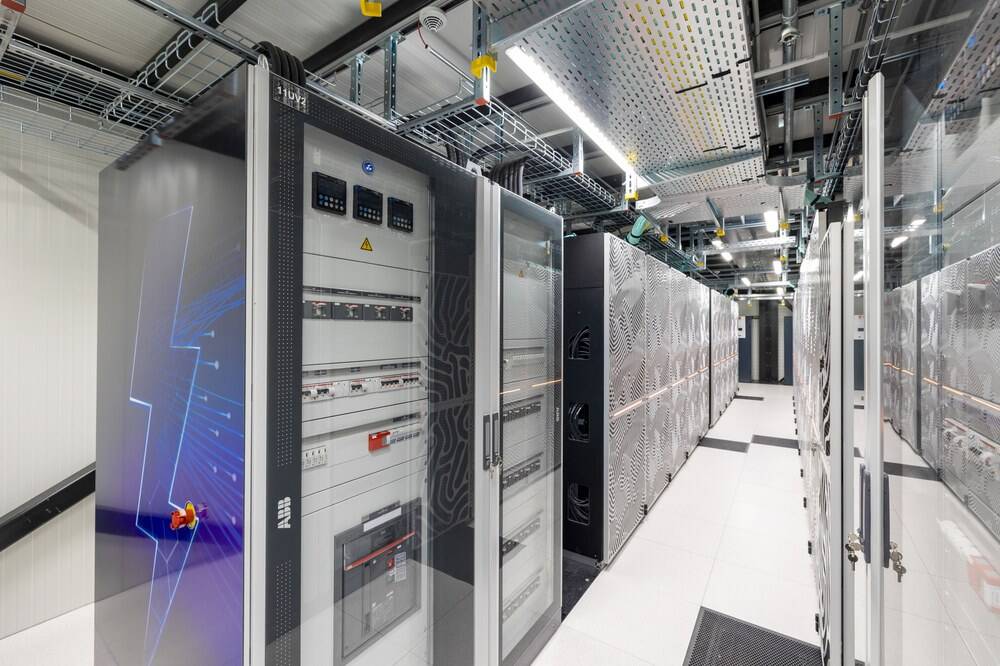
Europe joins US as exascale superpower after Jupiter clinches Top500 run
Summary
EuroHPC’s Jupiter supercomputer (the Jupiter Booster) has joined the Top500 list as the fourth public system to exceed one exaFLOPS of double-precision HPL performance, marking Europe’s arrival as an exascale superpower alongside the US. Built by Eviden and powered by Nvidia Grace-Hopper GH200 superchips, the Booster section achieved a 1.0 exaFLOPS HPL result. Jupiter remains under construction: the Booster represents roughly 6,000 nodes (about 24,000 GH200 chips) and a CPU-based Universal Cluster using SiPearl Rhea1 processors is expected to come online late next year, adding further compute capacity.
The Top500 ranking still places US systems El Capitan, Frontier and Aurora ahead in overall HPL numbers, but Jupiter is closing the gap and could overtake Aurora once the Universal Cluster is integrated and remaining optimisations are applied. The article also highlights the shifting benchmarking landscape — with mixed-precision (HPL-MxP) and HPCG results showing different system orderings and reflecting the growing role of lower-precision arithmetic for AI and ML workloads.
Key Points
- Jupiter Booster (EuroHPC/Eviden) achieved >1 exaFLOPS on the HPL benchmark — Europe’s first public exascale Top500 entry outside the US.
- Booster uses Nvidia Grace-Hopper GH200 accelerators: roughly 24,000 GH200 chips across ~6,000 BullSequana XH3000 nodes.
- Jupiter remains under construction; the Universal Cluster (SiPearl Rhea1 CPU nodes) will add ~2,600 Rhea1 CPUs late next year and a few more petaFLOPS.
- Jupiter is within ~12 petaFLOPS of Argonne’s Aurora and could overtake it with further integration and tuning.
- HPL still dominates Top500 rankings, but alternative benchmarks (HPCG, HPL-MxP) and lower-precision modes (FP32/16/8) are reshaping how practical performance is measured, especially for AI-driven science.
Why should I read this?
Short version: Europe just levelled up. If you care about where heavyweight compute happens — whether for climate models, AI, or big science — Jupiter joining the exascale club matters. It shows Europe’s investments in sovereign HPC are paying off and that next-gen mixed-precision computing is becoming the norm. Read on if you like knowing who’s got the biggest number-crunching toy and why it changes the research and AI landscape.
Context and Relevance
This milestone is significant to researchers, HPC centres, and organisations investing in AI infrastructure. It highlights:
– A geopolitical and technological shift: Europe now fields publicly known exascale capability alongside the US (China likely has secret systems too).
– The hardware trend: large-scale GH200 and MI300A-class accelerators deliver immense mixed-precision throughput that can hugely speed AI/ML tasks when lower precisions are acceptable.
– Benchmark nuance: HPL ranks raw double-precision throughput, but HPCG and HPL-MxP reveal practical and mixed-precision performance differences influencing real-world workloads.
For procurement teams, researchers and AI engineers, Jupiter’s rise underscores the need to consider both raw exascale numbers and how systems perform on mixed-precision and application-specific workloads.
Author style
Punchy: This is a proper win for European HPC — not just a trophy, but a real signal that EuroHPC and partners can compete at the very top. If you track supercomputing or the infrastructure that powers serious AI and science, this is headline news — worth a closer look rather than a skim.
Source
Source: https://go.theregister.com/feed/www.theregister.com/2025/11/17/europe_jupiter_supercomputer/