
Rewiring an olfactory circuit by altering cell-surface combinatorial code
Article Date: 19 November 2025
Article URL: https://www.nature.com/articles/s41586-025-09769-3
Article Image: Figure 1
Summary
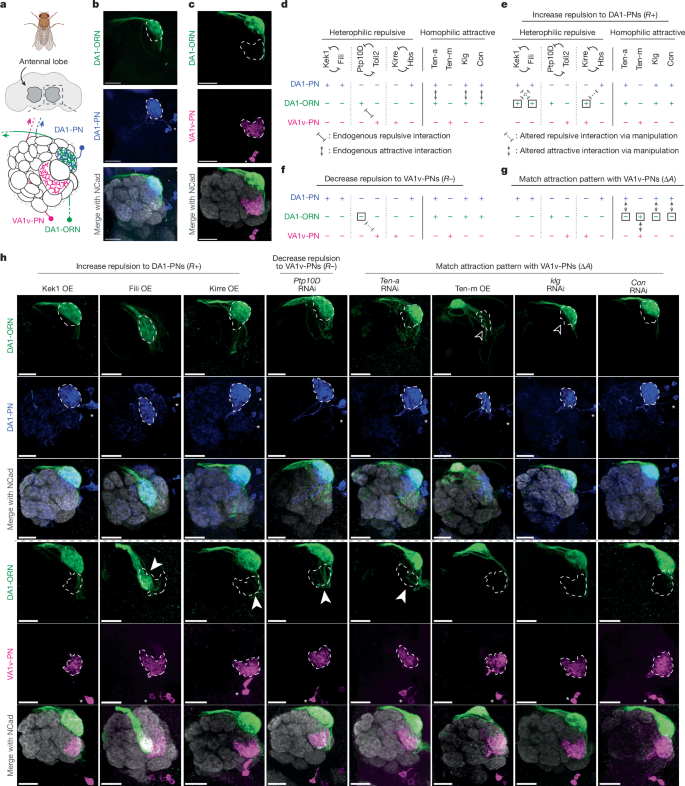
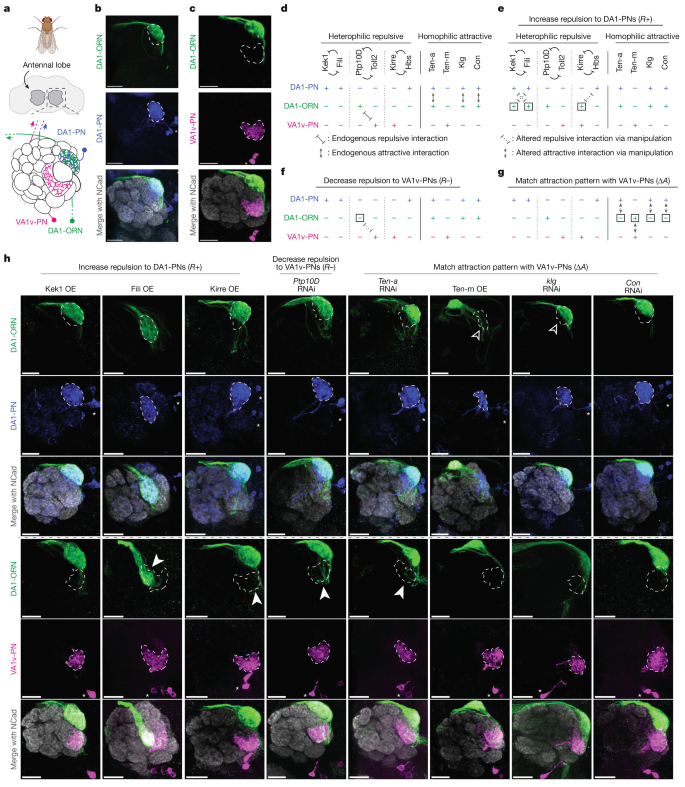
This study demonstrates that altering a small combinatorial set of cell-surface proteins (CSPs) in single olfactory receptor neuron (ORN) types in Drosophila can re-route their axons to different projection neuron (PN) partners, change downstream odour responses and flip behaviour. Using a split-GAL4 driver to manipulate CSP expression specifically in DA1-ORNs (and later VA1d-ORNs), the authors apply three complementary strategies: increase repulsion to the native PN, decrease repulsion to a target PN, and match attractive CSPs with the new partner. Manipulating five CSPs together (Kek1, Fili, Ptp10D, Ten-a and Con) produced near-complete DA1→VA1v rewiring. Rewired circuits showed functional synapses (calcium imaging) and behavioural consequences — rewired males displayed increased male–male courtship driven by the repurposed pheromone pathway. The approach generalised to other ORN types and targets, showing the combinatorial CSP code is a flexible, transferable strategy for partner selection during wiring.
Key Points
- Altering only a handful (2–5) of cell-surface proteins in a single ORN type can largely rewire its synaptic partner choice in the fly antennal lobe.
- Three genetic strategies underpin rewiring: boost repulsion from the original partner, reduce repulsion with the new partner, and create or remove attractive matches.
- Single-CSP changes produced minor effects; combinatorial manipulations produced substantially stronger loss-of-innervation (LoI) from the native PN and gain-of-innervation (GoI) to the target PN.
- DA1-ORN→VA1v-PN rewiring required five CSP changes and produced near-complete anatomical switch and functional synapses confirmed by GCaMP imaging.
- Rewired VA1v-PNs responded to both their native odour and the DA1-specific pheromone cVA, indicating functional integration of the new inputs.
- Behaviourally, rewired males increase courtship toward other males because cVA (normally inhibitory via DA1) now activates a courtship-promoting PN pathway (VA1v).
- The same strategies generalised to rewiring VA1d-ORNs toward VA1v, DC3 or DL3 PNs, though trajectory adjustments (Sema2b knockdown) improved matching for some targets.
- Different CSP families (teneurins, immunoglobulin-like, LRR-containing, fibronectin III) act in various combinations but likely converge on common intracellular pathways to drive attraction or repulsion.
- Results imply wiring specificity is combinatorial and flexible: the particular CSPs can vary as long as the net attractive/repulsive code between partners is achieved.
Context and relevance
This work addresses Sperry’s decades-old chemoaffinity idea by showing that a cell-surface combinatorial code is both necessary and sufficient, in practical terms, to specify synaptic partners. It tackles redundancy directly: rather than systematically knocking out many molecules, the authors re-engineer the CSP profile of single neurons and successfully retarget them. The finding is important for anyone interested in developmental wiring rules, synaptic specificity, neural-circuit engineering or evolution of behaviour, because it links molecular surface codes to circuit function and animal behaviour.
Author style
Punchy: the paper is a neat demonstration that changing a few surface tags rewrites a sensory channel and reshapes behaviour. If you care about how circuits form or how molecular diversity maps onto function, the detail is worth digging into — the experiments are methodical and the behavioural flip is convincing.
Why should I read this?
Want the short version: tweak a handful of surface proteins and you can rewire smell circuits and alter behaviour. It’s clever, tangible proof that wiring specificity can be edited with a small molecular toolkit — great if you like how molecules become circuits and circuits become actions. Read it for the strategy, the crisp anatomy-to-physiology-to-behaviour link, and the generalisable manipulations.