
Triplets electrically turn on insulating lanthanide-doped nanoparticles
Summary
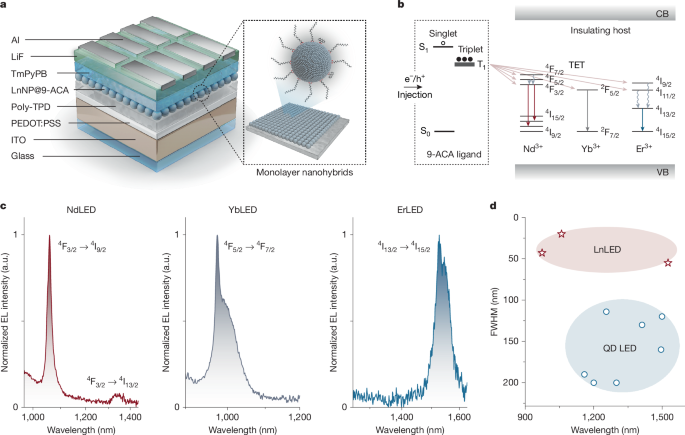
This paper demonstrates a new route to electrically excite insulating lanthanide-doped nanoparticles (LnNPs) by using molecular triplet excitons as mediators. By partially replacing insulating oleic acid ligands with 9-anthracenecarboxylic acid (9-ACA), the authors form LnNP@9-ACA nanohybrids in which injected electrons and holes recombine on the organic ligands, generate triplet excitons and transfer energy efficiently (TET) into lanthanide 4f levels. The team uses this mechanism to fabricate the first proof-of-concept LnLEDs that emit in the NIR-II range (≈1,000–1,533 nm) with very narrow electroluminescence linewidths.
Key Points
- LnNPs (NaGdF4-based hosts doped with Nd, Yb, Er) are normally insulating; direct electrical excitation is not possible without an intermediary.
- Partial ligand exchange of oleic acid for 9-ACA creates a surface-bound molecular antenna that absorbs UV/visible light and, crucially, accepts charge-carrier recombination under electrical bias to form triplet excitons.
- Triplet energy transfer (Dexter-type TET) from 9-ACA to Ln3+ ions is extremely efficient (>98% for Nd, Yb, Er nanohybrids), enabling bright NIR-II emission under electrical driving.
- Device architecture: ITO/PEDOT:PSS/poly-TPD/LnNP@9-ACA/TmPyPB/LiF/Al — electrons and holes recombine on ligands, not in the inorganic host.
- LnLED electroluminescence is spectrally narrow (FWHM ≈ 20–55 nm), far narrower than typical QD LEDs (>150 nm), which is promising for imaging and optical communications.
- Measured NIR-II peak emissions: Nd 1,058 nm, Yb 976 nm, Er 1,533 nm; turn-on voltages ≈5 V and devices tolerate >15 V.
- Peak external quantum efficiencies are modest (Nd ≈0.01%, Yb ≈0.04%, Er ≈0.004%); optimisation (core–shell Yb@Nd, improved transport layers, out-coupling) pushes Yb@Nd devices to >0.6% EQE.
- Main current limitations: low ligand replacement ratios (<10%), monolayer device morphology causing charge leakage, and modest PLQEs of ultrasmall highly doped LnNPs — all addressable with materials and device engineering.
Content summary
The authors synthesised ultrasmall (<10 nm, ~6 nm) NaGd0.8F4:Ln0.2 nanoparticles with controlled doping of Nd/Yb/Er. They performed ligand exchange to replace part of oleic acid with 9-ACA, which preferentially binds at Ln3+ surface sites. Spectroscopy (absorption, FTIR, DFT, TCSPC, pump–probe) shows that binding accelerates intersystem crossing in 9-ACA and produces long-lived triplets that transfer energy rapidly to the lanthanide ions.
Transient measurements reveal fast singlet decay and rapid triplet rise in the nanohybrids relative to free 9-ACA; Dexter-type TET dominates because of short ligand–ion separation and broad triplet phosphorescence overlap with multiple Ln3+ levels. The nanohybrids show large PL enhancements under UV excitation (several-fold increases vs bare LnNPs).
Devices built with the hybrid films emit narrow NIR-II EL peaks with minimal spectral shift under bias. Structural characterisation (HAADF STEM, elemental mapping, GIWAXS) confirms uniform incorporation of particles in the emissive layer. Optical simulation and layer-thickness choices aim to optimise light extraction in the NIR. Control devices without ligand substitution produced no Ln emission, confirming the antenna role of 9-ACA in electrical turn-on.
Context and relevance
This work addresses a long-standing limitation: lanthanide-doped fluoride/oxide nanoparticles are excellent, narrow-line NIR emitters but are electrically inert. By using molecular triplet excitons as an energy-harvesting and transfer channel, the authors bridge organic electronics and rare-earth photophysics to create electrically driven NIR-II sources. The narrow linewidths and solution-processability make these hybrids attractive for applications where spectral purity matters (optical communication, multiplexed bioimaging, theranostics).
Although current EQEs and brightness trail quantum-dot and perovskite LEDs, the paper lays out clear strategies (higher surface replacement ratios, core–shell designs to boost PLQE, improved charge-blocking layers, out-coupling) that can materially improve device performance. The approach also leverages decades of OLED/device know-how, so progress is plausible and rapid.
Author style
Punchy — this is a clear proof-of-concept with tangible metrics and a roadmap for improvement. If you follow NIR photonics or hybrid optoelectronics, the technical novelty (triplet-mediated electrical excitation of insulating LnNPs) is worth digging into.
Why should I read this?
Want tiny NIR-II LEDs with laser-like narrow lines? This paper shows the trick: stick a triplet-harvesting dye on the surface and let the molecule do the heavy lifting. It’s neat, pretty practical, and gives a realistic route to electrically pumped, narrowband NIR emitters — likely to be relevant if you’re into deep-tissue imaging, optical comms or next-gen LED tech.