
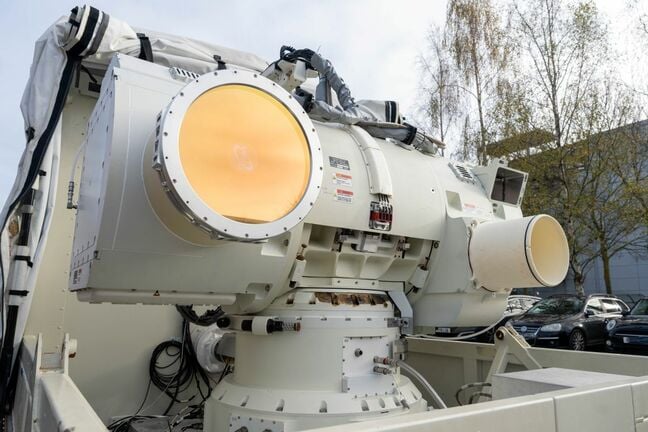
DragonFire laser to be fitted to Royal Navy ships after acing drone-zapping trials
Summary
The UK Ministry of Defence has signed a £316 million contract with MBDA UK to deliver the DragonFire Laser Directed Energy Weapon (LDEW) to the Royal Navy from 2027, five years ahead of previous plans. Trials in the Hebrides showed the system can track, target and destroy fast-moving drones (up to 650 km/h). DragonFire will initially be fitted to Type 45 destroyers rather than to the Type 26 frigates, and uses a turret-mounted, scalable 50 kW laser employing Coherent Beam Combining to create a single high-power beam.
The MoD highlights the cost advantages: a laser shot is said to cost roughly £10 compared with over £1 million for an anti-aircraft missile, and the weapon can keep firing while the ship has electrical power. The system is claimed to be able to hit a coin-sized target at around one kilometre and engage drones at distances of more than three miles.
Key Points
- MoD awarded a £316 million contract to MBDA UK to field DragonFire from 2027.
- DragonFire successfully shot down high-speed drones in Hebrides trials; targets reached ~650 km/h.
- Initial fit will be to Type 45 destroyers (air-defence ships) rather than Type 26 frigates.
- System uses 50 kW baseline power and Coherent Beam Combining (CBC) to merge beams into a single high-power laser.
- Claimed performance: coin-sized target at ~1 km, drone engagement beyond three miles; turret-mounted for tracking.
- Per-shot cost is roughly £10 versus over £1 million for conventional anti-aircraft missiles.
- Laser weapons reduce the risk of ammo exhaustion when facing swarming drone attacks, limited primarily by ship power.
Why should I read this?
Because this is proper game-changing kit for navies dealing with swarms of cheap drones. Fitted sooner than planned, DragonFire could cut costs and keep ships fighting longer without burning through million-pound missiles. If you care about defence tech, naval tactics or how military budgets stretch, this one’s worth a skim — we did the legwork so you don’t have to read every press release.
Context and Relevance
DragonFire marks a notable step in directed-energy weapon adoption in Europe: if deployed as planned, the UK will be among the first European nations to field a high-power shipborne laser. The move responds to an operational problem seen in recent years where adversaries use inexpensive drones (sometimes weaponised) to saturate defences. Laser systems offer a lower-cost-per-engagement and long-duration response constrained mainly by available shipboard electrical power.
Fitting the system to Type 45 destroyers accelerates capability delivery (Type 26s are still entering service). The program’s progress — from a demonstrator contract in 2016 through public trials since 2022 — shows directed-energy weapons advancing from experiment to deployable capability. Expect further development in power scaling, integration with ship sensors and tactics for countering swarm threats.
Source
Source: https://go.theregister.com/feed/www.theregister.com/2025/11/24/royal_navy_dragonfire_laser/