
New finds shed light on diet and locomotion in Australopithecus deyiremeda
Summary
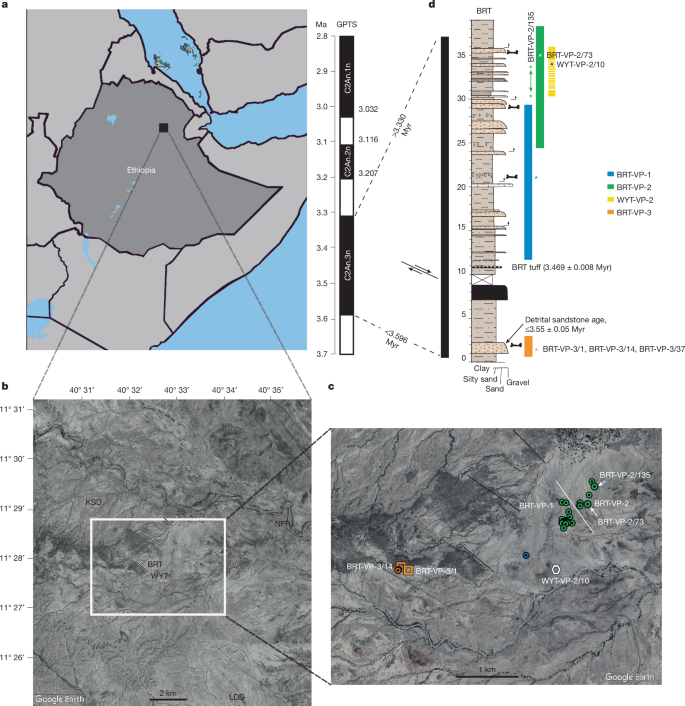
New mid-Pliocene fossils from Woranso-Mille, Ethiopia (3.47–3.33 Ma) — notably a juvenile mandible with teeth and additional dentognathic material — strengthen the case for Australopithecus deyiremeda as a distinct species. The newly associated BRT partial foot (BRT-VP-2/73) and several dental specimens are likely from the same species and together indicate a mosaic of primitive and derived traits: dentition more similar to earlier taxa (A. anamensis, A. ramidus) with small, narrow molars and reduced canine lingual relief, but a foot with a mix of climbing-capable and bipedal adaptations. Enamel carbon isotopes (δ13C mean ≈ −10.2‰) show a C3-dominated diet, distinct from contemporaneous A. afarensis which used more C3–C4 resources. Overall, the evidence supports multiple bipedal forms and dietary niches among Pliocene hominins.
Key Points
- New dentognathic material (including juvenile mandible BRT-VP-2/135) from BRT confirms diagnostic features of A. deyiremeda.
- The BRT partial foot (BRT-VP-2/73) is spatially and stratigraphically associated with dental remains and can be confidently assigned to A. deyiremeda.
- Dental morphology (oval P4s, reduced/absent P3 metaconid, small buccolingually narrow M1s, reduced lingual relief on canines) is more primitive—resembling A. anamensis and A. ramidus—than A. afarensis.
- Enamel δ13C values (n=8) average −10.2‰ (range −12.4 to −8.8‰), indicating a C3-dominated diet similar to earlier hominins and distinct from A. afarensis and Kenyanthropus.
- Foot anatomy combines features for bipedal push-off and retained midfoot mobility/prehension, suggesting capability for climbing as well as terrestrial locomotion.
- The mosaic cranio-dental and postcranial traits imply that postcanine enlargement (megadontia) and obligate human-like bipedality did not evolve simultaneously.
- Finds reinforce mid-Pliocene hominin diversity and the existence of multiple locomotor strategies within Australopithecus lineages.
Content summary
The Woranso-Mille fieldwork recovered 25 BRT specimens (mostly teeth), with new, more diagnostic dentognathic material from the same horizon as the previously reported partial foot. A juvenile mandible (BRT-VP-2/135) preserves mixed dentition and matches developmental patterns seen in early australopiths. Detailed metric and morphological comparisons place the BRT dentition within A. deyiremeda’s diagnostic range and show closer affinities in some dental traits to A. anamensis/A. ramidus than to A. afarensis.
Micro-CT and morphological analysis of premolars and canines highlight primitive premolar occlusal patterns and small canines—traits used to diagnose A. deyiremeda. Molars are small and unusually narrow buccolingually, reinforcing dental distinctiveness.
Postcranial evidence (partial foot, juvenile ischium) reveals a foot capable of dorsiflexion at the metatarsophalangeal joint and an oblique push-off axis, but lacking a fully rigid longitudinal arch seen in A. afarensis. Some features resemble A. africanus, indicating mosaic evolution of pedal anatomy across taxa.
Isotope results from enamel (δ13C) indicate reliance on C3 resources, aligning A. deyiremeda with earlier, more forest- or woodland-associated hominins rather than the broader C3–C4 dietary breadth of A. afarensis. Combined, morphology and isotopes suggest ecological separation and niche partitioning among contemporaneous hominins.
Context and relevance
These findings matter because they tighten the link between dental, isotopic and foot data for A. deyiremeda, reducing earlier uncertainties about the BRT foot’s taxonomic assignment. The work adds weight to the idea that the mid-Pliocene hosted multiple, coexisting hominin species with varied locomotor and dietary adaptations. That in turn affects models for the origin of obligate bipedality and the timing of dental specialisations (megadontia) within Australopithecus. For researchers tracking hominin diversity, locomotor evolution or palaeoecology, this is a meaningful advance.
Why should I read this?
Quick version: if you care about where and how early hominins walked and ate, these fossils tidy up a messy bit of the story. The paper nails the link between teeth, diet and a weird, partly-grasping foot — so you don’t have to wade through scattered finds to see the bigger picture. Worth a look if you’re into evolutionary puzzles or just want the latest on how many different kinds of early humans were stomping around 3.4 million years ago.
Author style
Punchy: the authors present firm new material and multi-proxy data (morphology + isotopes + stratigraphy) that together make a strong case for A. deyiremeda’s distinct biology and ecology. If you follow hominin evolution, this paper sharpens a key debate and is packed with useful comparative datasets.