
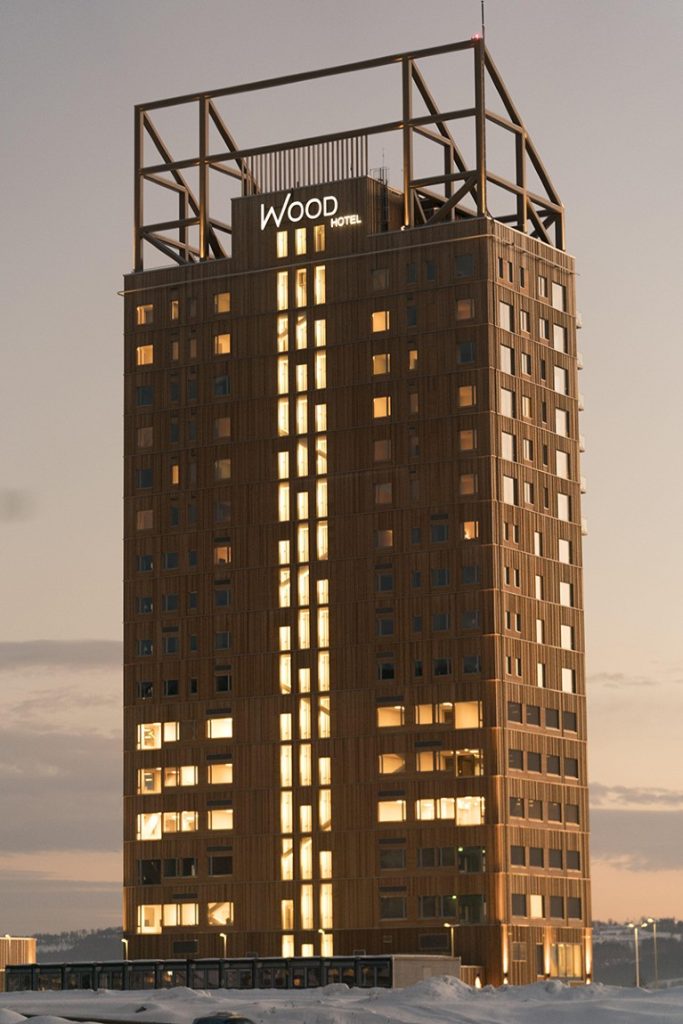
Wooden skyscrapers point the way to more sustainable cities
Article Date: 2025-12-03
Article URL: https://www.nature.com/articles/d41586-025-03928-2
Article Image: https://media.nature.com/lw767/magazine-assets/d41586-025-03928-2/d41586-025-03928-2_51782254.jpg
Summary
The article describes how engineered timber — especially cross-laminated timber (CLT) — is enabling taller wooden buildings and could cut the construction sector’s huge carbon footprint. Timber towers like Milwaukee’s Ascent and projects proposed by firms such as MGA showcase the technical progress and public attention, but the greatest climate gains are expected from broad uptake in mid-rise building stock rather than landmark skyscrapers.
Engineered wood captures and stores carbon taken up by trees and avoids many of the emissions tied to concrete and steel production. Studies cited show large potential savings (for example, a 20-storey wooden building can cut thousands of tonnes of CO2 compared with concrete), and modelling suggests widespread timber construction in Europe could sequester a sizeable fraction of cement-industry emissions. Timber also speeds up assembly through prefabrication, reduces site noise and can lower embodied emissions over a building’s life.
Barriers remain: industry inertia, limited standards for mid- and high-rise timber, supply-chain constraints and end-of-life challenges (reuse, contamination and processing). Policy levers — carbon reporting, procurement rules and wood-first policies already used in parts of Canada — could accelerate adoption. Researchers emphasise designing for long service life and second-life reuse of timber components, while cautioning against uncritical ‘wood-only’ thinking: wood is powerful but not always the optimal material, and future plant‑fibre materials may outperform it.
Key Points
- Engineered timber (eg, cross-laminated timber) makes safe mid-rise and some high-rise wooden buildings feasible.
- Buildings and construction cause nearly 40% of global emissions; structural materials (concrete and steel) are a major part of that footprint.
- A 20-storey timber building can avoid roughly 4,300 tonnes of CO2 versus concrete — part from avoided production emissions, part from carbon stored in wood.
- Widespread use of wood could sequester substantial carbon: scenarios in Europe show large mitigation potential relative to cement emissions.
- Timber construction can cut build times (prefabrication) and reduce site noise, lowering social and embodied costs.
- Main obstacles are industry conservatism, thin profit margins, lack of standards and immature supply chains for mid/high-rise timber projects.
- Policy actions — mandatory carbon reporting, procurement rules and staged limits — would create market certainty and push materials industries to decarbonise.
- End-of-life strategies (reuse, remanufacture, careful particle-board practice) are vital to keep carbon sequestered; contamination and adhesives complicate reuse.
Author style
Punchy. The piece is written to make the reader feel the momentum behind timber construction while flagging practical limits and policy levers. If this topic matters to urban planners, developers or sustainability teams, the article is presented as both a wake-up call and a practical primer — so read the detail if you’re involved in decisions about materials, procurement or long-term carbon accounting.
Why should I read this?
Short version: if you care about cutting urban carbon, this is worth ten minutes. It explains why timber is more than architectural theatre — it stores carbon, trims embodied emissions and speeds up builds — and it points out the real-world hurdles (standards, supply chains, reuse). We’ve saved you the deep dive: read this to get the arguments, the numbers and the policy moves you need to push timber projects forward or evaluate them properly.