
Search for light sterile neutrinos with two neutrino beams at MicroBooNE
Summary
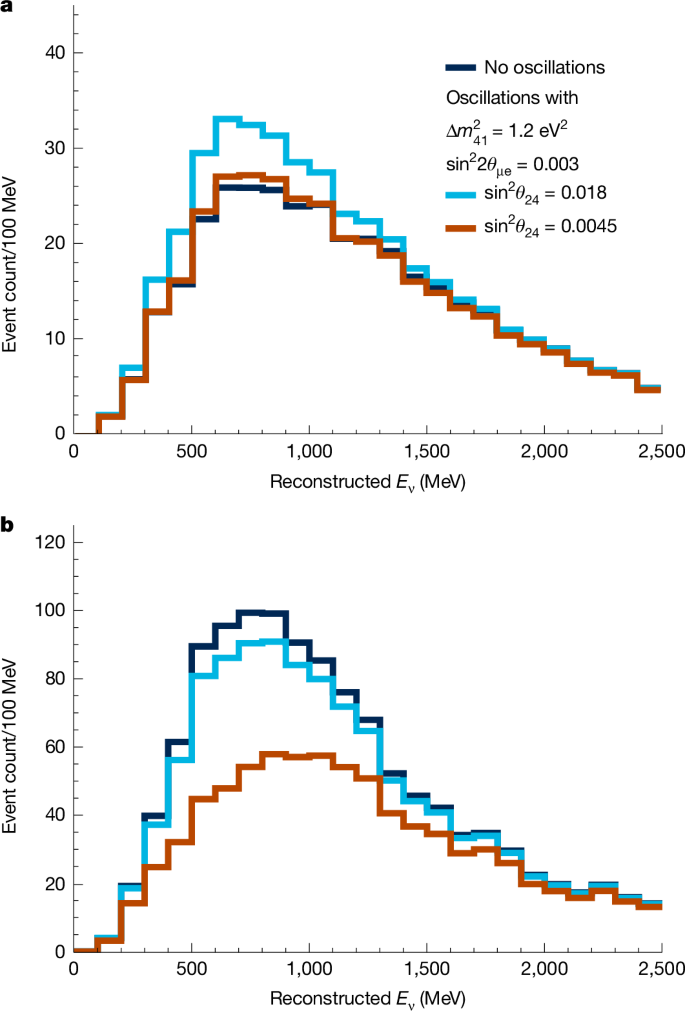
The MicroBooNE Collaboration reports a new, high-precision search for light sterile neutrinos using data from two accelerator neutrino beams — the Booster Neutrino Beam (BNB) and the Neutrinos at the Main Injector (NuMI) — recorded in a single liquid-argon time projection chamber (LArTPC) detector at Fermilab. By exploiting the very different intrinsic electron-neutrino fractions of BNB (0.57%) and NuMI (4.6% at MicroBooNE’s off-axis position), the analysis breaks a long-standing degeneracy between electron-neutrino appearance and disappearance that limited prior searches. The combined fit uses 14 distinct charged-current and neutral-current samples from both beams, constrains systematic uncertainties through correlated samples, and finds the data consistent with the three-flavour (3ν) oscillation hypothesis. The result places robust 95% CLs exclusions on the 3+1 sterile-neutrino parameter space, ruling out much of the regions previously favoured by LSND and MiniBooNE and excluding parts of the parameter space relevant to gallium and Neutrino-4 anomalies.
Key Points
- MicroBooNE used two distinct accelerator beams (BNB and NuMI) to produce independent νe and νμ datasets in the same LArTPC detector, breaking the νe appearance vs νe disappearance degeneracy.
- The detector’s precise imaging and calorimetry (LArTPC) allow high-purity νe selection and reduced backgrounds compared with Cherenkov-based detectors.
- Data correspond to 6.369×10^20 POT from BNB and 10.54×10^20 POT from NuMI (roughly half of MicroBooNE’s total exposure), analysed together across 14 categories (FC/PC CC νe, CC νμ, NC π0, etc.).
- The combined fit shows no significant preference for a 4th light sterile neutrino; the 3ν hypothesis is consistent with the data (p-value ≈ 0.96, Feldman–Cousins).
- 95% CLs exclusion contours strongly constrain (Δm^2_{41}, sin^2(2θ_{μe})) space — excluding almost all the LSND 99% allowed region and the majority of the MiniBooNE 95% region when interpreted in a 3+1 framework.
- Significant exclusions are also placed in (Δm^2_{41}, sin^2(2θ_{ee})) space, reducing the parameter space relevant to gallium and some Neutrino-4 interpretations.
- Systematic uncertainties (flux, interaction modelling, detector response) are handled via a full covariance-matrix formalism and a conditional-constraint procedure that uses all sidebands to tighten the νe prediction.
- Public data (νe channel binned results, predictions and full systematics) and Δχ^2 grids are available on HEPData and Zenodo for reuse and validation.
Why should I read this?
Short version — if you care about whether the weird short‑baseline neutrino hints (LSND/MiniBooNE/gallium) are from a single new light sterile neutrino, this paper matters. MicroBooNE used a neat trick — two very different beams into the same detector — to untangle a long-standing measurement ambiguity and then excluded large swathes of the parameter space that would explain those anomalies. It’s a big step in closing off a simple sterile‑neutrino explanation.
Author style
Punchy: this is a careful, high-impact negative result. The collaboration leverages detector imaging and a two‑beam strategy to deliver the strongest short‑baseline accelerator constraint to date on a single light sterile neutrino as the source of the longstanding anomalies. If you follow neutrino anomalies or model-building around eV‑scale states, read the exclusions and methods closely.
Source
Source: https://www.nature.com/articles/s41586-025-09757-7
Data & code notes
Data supporting the νe-channel binned results and full systematic covariance information are publicly available on HEPData and Zenodo (links in the paper). Analysis code is maintained by the MicroBooNE Collaboration and is not public, but result artefacts and Δχ^2 grids are provided for external reuse.