
Laser spectroscopy and CP-violation sensitivity of actinium monofluoride
Article Date: 17 December 2025
Article URL: https://www.nature.com/articles/s41586-025-09814-1
Image: 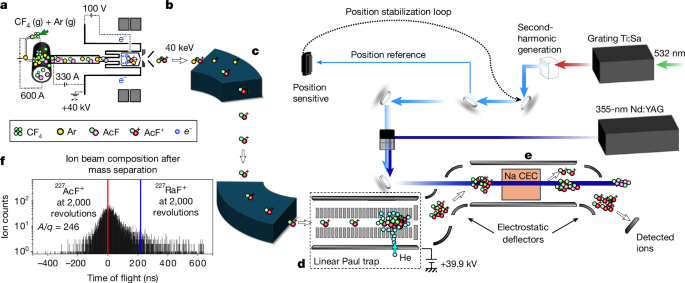
Summary
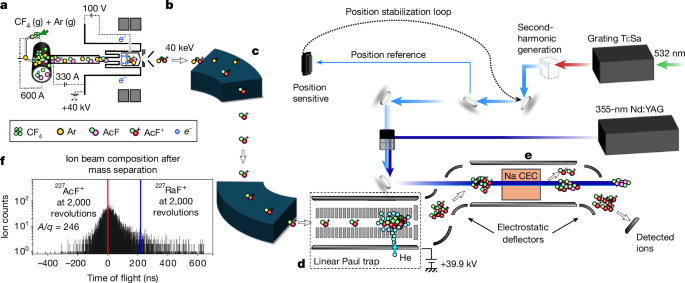
This paper reports the first experimental spectroscopy of actinium monofluoride (AcF) and assesses its potential as a probe for nuclear CP violation. Using isotopically pure 227Ac19F+ beams produced at CERN-ISOLDE, the team performed collinear resonance ionisation spectroscopy (CRIS) after in-flight neutralisation and identified a strong electronic transition from the X 1Σ+ ground state near 387 nm, assigned to (8)1Π ← X 1Σ+. High-accuracy relativistic quantum-chemistry (four-component coupled-cluster) and nuclear density functional theory (NDFT) calculations were combined to evaluate the molecule’s sensitivity to the nuclear Schiff moment and other CP-odd interactions. The results indicate 227AcF is exceptionally promising: 227Ac has a large intrinsic Schiff moment and, when combined with the molecular sensitivity factors, a dedicated 227AcF experiment could substantially tighten global constraints on several CP-violating parameters, including the QCD ̅theta parameter, if an experiment reaches sub-mHz precision.
Key Points
- First experimental spectroscopy of AcF: a strong transition from X 1Σ+ around 25,770–25,860 cm⁻¹ (≈387 nm) was observed and assigned to (8)1Π ← X 1Σ+.
- CERN-ISOLDE provided continuous, isotopically pure 227Ac19F+ beams (intensities of 6×10⁶–2×10⁷ ions s⁻¹ demonstrated during the campaign).
- High-level relativistic coupled-cluster calculations give the ground-state sensitivity to the nuclear Schiff moment W_S = −7,748(545) e/(4πϵ₀ a₀⁴) with a conservative 7% uncertainty.
- Nuclear DFT predicts a large intrinsic Schiff moment for 227Ac (S_int(227Ac) = 37.1(16) e fm³), about 40% higher than 225Ra, making 227Ac highly sensitive to CP-odd nuclear interactions.
- Global-analysis projections show a 227AcF experiment at 1 mHz precision would shrink the seven-dimensional CP-violation parameter-space volume by ~6×10³; at 0.1 mHz, by ~6×10⁴.
- Practical experimental pathways are feasible: the observed transition is suitable for optical state readout and possibly laser-cooling schemes, and production rates shown at ISOLDE support a shot-noise-limited 1 mHz sensitivity within ~100 days with conservative efficiencies.
- Closed-shell molecules like AcF are complementary to open-shell systems (HfF⁺, ThO) because they probe different combinations of CP-odd sources (Schiff moment, electron–nucleon couplings, short-range nucleon EDMs).
Context and relevance
Explaining the baryon asymmetry requires new sources of CP violation beyond the Standard Model. Precision atomic and molecular experiments measure tiny symmetry-violating energy shifts that map onto fundamental CP-odd parameters (electron EDM, pion–nucleon couplings, QCD ̅theta, etc.). Heavy, octupole-deformed nuclei such as 227Ac are predicted to amplify nuclear Schiff moments; combining that with a polar molecule’s large internal field yields an especially sensitive laboratory probe. This paper brings together experiment (production and spectroscopy of a radioactive molecule) and state-of-the-art theory (four-component relativistic chemistry and NDFT) to show 227AcF can play a decisive role in future global EDM/CP-violation searches.
Author’s take (punchy)
Big-picture: they made AcF talk. That single discovery — a strong 387 nm line from the ground state — is the practical hinge between exotic theory and an actual measurement that could probe deep QCD physics. If you care about new sources of CP violation (and you should), this is not incremental: it opens a viable experimental route to a nucleus with one of the largest predicted Schiff moments. Read the details if you want to know how they tamed radioactive molecules and combined rigorous quantum chemistry with nuclear theory to estimate experimental reach.
Why should I read this?
Short version: because the team did the hard bit — they produced and spectroscopically identified AcF and paired that with solid theory to show an experiment with 227AcF could smash current sensitivity in parts of the CP-violation parameter space. If you’re interested in tests of fundamental symmetries, nuclear enhancement mechanisms, or practical plans to measure tiny EDM-like shifts with radioactive molecules, this paper saves you a lot of digging and gives a concrete roadmap.