
UNIX V4 tape successfully recovered: First ever version of UNIX written in C is running again
Summary
Conservators have successfully recovered and imaged a 1970s nine-track tape containing UNIX V4 — the first widely circulated version of UNIX where much of the kernel was rewritten in the C programming language. The Computer History Museum team used raw-magnetic-flux sampling tools to reconstruct the tape; the files are now available on the Internet Archive and can be run under the SimH PDP-11 emulator.
Key Points
- A 1970s nine-track tape discovered at the University of Utah has been recovered and imaged; the work was led by the Computer History Museum team including Al Kossow and Len Shustek.
- UNIX V4 is historically important as the first version with a C-written kernel — roughly 55,000 lines of source code with about 25,000 in C and a tiny kernel (~27 KB).
- Recovery used the readtape tool to sample raw magnetic flux (similar in principle to Greaseweazle for floppies); a 1.6 GB raw image was produced from a tape that originally held ~40 MB.
- Only two blocks failed to read cleanly and their contents were reconstructed; a processed, download-friendly version is hosted (squoze.net) and a full raw dump is on the Internet Archive.
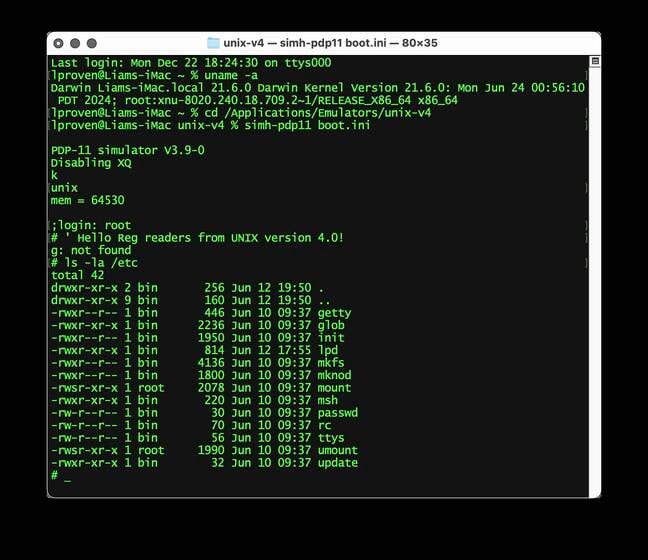
- You can boot and run UNIX V4 in SimH (PDP-11) using the provided boot.ini; community posts include step-by-step guidance and screenshots of it running under modern hosts.
- The find fills a gap in early UNIX history and complements other recent restorations (e.g. a beta of UNIX V2), making source and behaviour visible for historians and retrocomputing enthusiasts.
Content Summary
The recovered tape contains files for UNIX Fourth Edition, the edition that moved much of the kernel to C. Recovery produced both a large raw flux image and a processed, usable archive. Practical instructions and links to run the system under SimH are available, and the community has already shared screenshots and video clips of the OS booting. The article places the recovery in historical context, outlining earlier UNIX editions, hardware constraints of the time (PDP-7, PDP-11), and how quirks such as the original /usr split arose from very small storage resources.
Context and relevance
This is a significant archival recovery: it directly illuminates the early transition from assembly to C in operating-system development and provides a primary artefact for researchers, historians and anyone curious about the roots of modern OS design. It also demonstrates modern preservation techniques (flux-level imaging) that make long-lost media readable again, and complements ongoing efforts to reconstruct other early UNIX versions.
Why should I read this?
Short version: it’s a rare bit of computing archaeology that actually boots. If you care about OS history, retrocomputing, or how C changed system software, this is one of those delightfully nerdy wins — full of neat tech (flux imaging, SimH boots) and context that explains why tiny early hacks shaped today’s systems. We’ve saved you the digging: download links and run instructions are right there.