
Intel unleashes Panther Lake CPUs, first built on 18A process
Summary
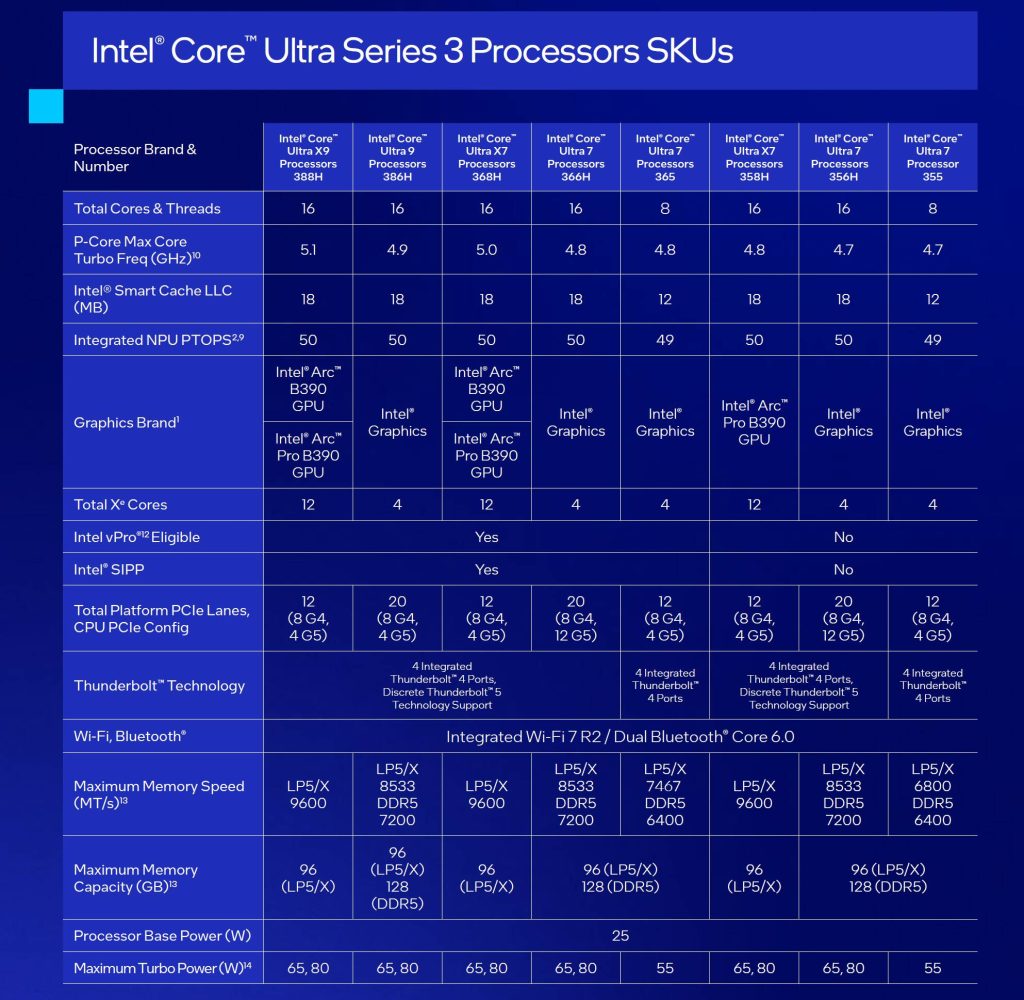
Intel has launched Panther Lake — marketed as the Intel Core Ultra Series 3 — the company’s first chips to use its 18A process. The line includes 14 SKUs (from the high-end Core Ultra X9 388H down to Core Ultra 5 322), with chips shipping to laptops from 27 January and over 200 design wins already announced, including Dell’s XPS 14 and 16.
Key improvements come from the die shrink and new transistor tech: Intel cites a 30% increase in transistor density, single-thread performance-per-watt up 10% and multithread gains of 50% versus Lunar/Arrow Lake. The platform mixes 18A compute dies with TSMC-made platform controllers and either TSMC or Intel 3 integrated GPUs on lower-end parts.
Key Points
- Panther Lake is Intel’s first use of the 18A process for the compute die, building Core Ultra Series 3 CPUs.
- Fourteen SKUs span 8- and 16-core designs with combinations of P, E and low-power E (LP E) cores to balance performance and efficiency.
- Intel claims +30% transistor density, +10% single-thread perf-per-watt and +50% multithreaded perf over prior gen.
- Top SKUs (X9/X7) offer large multithread and gaming gains — Intel cites ~60% better multithreaded performance and ~77% faster gaming workloads.
- Integrated Intel Arc GPUs up to 12 Xe cores, with up to 120 TOPS for AI; NPUs deliver up to 50 TOPS for low-power AI tasks.
- Power-management features include Intelligent Display (AI-driven refresh/brightness scaling) and Endurance Gaming Mode to extend battery life while gaming.
- All SKUs have a 25W base power with 55W or 65W turbo options; memory support up to 96/128GB of LPDDR5x/DDR5 at various speeds depending on SKU.
- Connectivity advances: built-in Wi‑Fi 7, Bluetooth 6.0 and support for Thunderbolt 5 on many SKUs (some remain Thunderbolt 4).
- Targets: laptops (ship from 27 Jan), plus embedded/industrial certifications for robotics, healthcare and edge devices.
Why should I read this?
Want the short version? Intel’s new chips actually look like a proper step forward: better battery life claims, stronger multi-core muscle and decent on‑board AI/graphics. If you care about laptops that last longer or PCs that can run local AI workloads without draining the battery, this matters — and we’ve cut out the waffle so you don’t have to dig through a dozen press releases.
Author style
Punchy — this is a notable product launch. If you follow client processors, mobile performance, or on‑device AI, the details here are worth a closer read: manufacturing firsts, hybrid die sourcing, and substantive efficiency claims affect device makers and buyers alike.