
Early hominins from Morocco basal to the Homo sapiens lineage
Article meta
Article Date: 07 January 2026
Article URL: https://www.nature.com/articles/s41586-025-09914-y
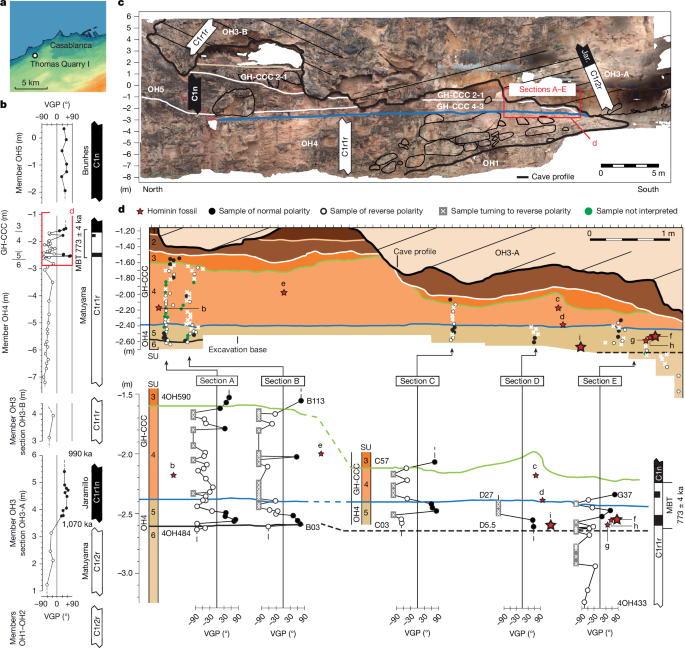
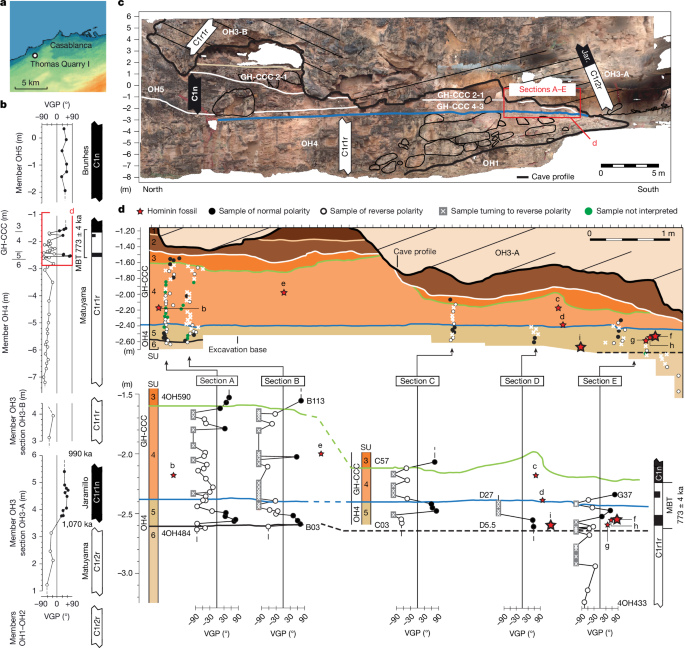
Article Image: Figure 1 (ThI-GH site)
Summary
Researchers report a suite of Middle Pleistocene hominin remains from Thomas Quarry I — Grotte à Hominidés (ThI-GH) near Casablanca, Morocco, securely placed in the stratigraphic interval spanning the Matuyama–Brunhes transition (nominally 773 ± 4 ka). The assemblage includes adult and juvenile mandibles, multiple teeth, vertebrae and a femoral fragment, all recovered in situ from SU4–SU5 deposits.
High-resolution magnetostratigraphy ties the deposits to the Matuyama–Brunhes polarity transition and associated MIS19 sea-level events; biochronology and combined dating (ESR/U-series on teeth, OSL with caveats) support an age close to the EP–MP boundary rather than much younger estimates. The fossils show a mosaic of features: many mandibular and dental characters are primitive or H. erectus-like, yet several dental and mandibular traits trend toward later Homo (including early H. sapiens and European Middle Pleistocene forms).
Morphometric and enamel–dentine junction analyses place the ThI-GH specimens near the base of the H. sapiens lineage and close to the African–Eurasian split, suggesting these Northwest African hominins represent an evolved H. erectus sensu lato population that is phylogenetically basal to later H. sapiens. The work emphasises the Maghreb as a key region for Middle Pleistocene hominin diversification and for understanding the origin of our species.
Key Points
- The ThI-GH cave (Casablanca) yielded multiple hominin specimens (mandibles, teeth, vertebrae, femur fragment) in secure stratigraphic context.
- Magnetostratigraphy captures the Matuyama–Brunhes transition (MBT), placing the hominins at about 773 ± 4 ka — a high-resolution tie to MIS19 transgressive/regressive events.
- Dating is concordant with faunal biochronology; ESR/U-series on teeth give minimum ages while some OSL ages are likely underestimated or inconsistent with sequence stratigraphy.
- Morphology is mosaic: overall mandibular and vertebral signals align with evolved H. erectus sensu lato, while dental EDJ and some mandibular traits show affinities with early H. sapiens and Middle Pleistocene European material.
- ThI-GH hominins appear phylogenetically basal to the H. sapiens lineage, near the African–Eurasian divergence — supporting an African rather than Eurasian origin for H. sapiens.
- The findings indicate regional differentiation between North Africa and contemporary European populations by the late Early Pleistocene.
- Evidence of carnivore activity at the site (tooth-marked femur, coprolites) affects taphonomic interpretation and suggests some remains were scavenged prior to final deposition.
Context and relevance
This study provides rare, securely dated Middle Pleistocene hominins from North Africa tied directly to a well-constrained geomagnetic reversal. The combination of detailed stratigraphy, multiple dating approaches and modern 3D morphometrics makes the Moroccan sample unusually informative for debates about the timing and geography of the split between the lineages that led to Neanderthals/Denisovans and that led to H. sapiens. It strengthens evidence that the Maghreb played a pivotal role in hominin diversification during the EP–MP transition and supports an African-rooted emergence of our species.
Why should I read this
Because this paper gives you a carefully dated snapshot — a rare Middle Pleistocene cast of characters from Morocco that sit right at the branching point leading to modern humans. If you want to know where we might reasonably place the ancestral stock of H. sapiens (and how North Africa fits into that story), this is the headline dataset: good dating, lots of fossils, and solid 3D analyses. Short version: it nudges the origin story back to Africa and makes the Maghreb a major player.
Author style
Punchy: the team combines rigorous stratigraphy, magnetostratigraphy and modern morphometrics to present a decisive, high-quality dataset. This is substantial — not a speculative claim based on a single bone — and readers interested in human origins should dig into the morphometric, dental EDJ and dating detail: the nuances matter for interpreting ancestral relationships and regional differentiation.
Source
Source: Early hominins from Morocco basal to the Homo sapiens lineage — Nature (full article)