
AMD threatens to go medieval on Nvidia with Epyc and Instinct: What we know so far
Summary
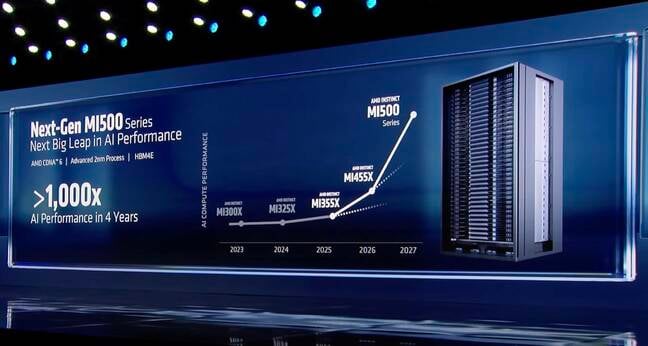
AMD used CES 2026 to tease two waves of datacentre silicon: the near-term MI400-series (MI455X, MI440X, MI430X) and a loftier MI500 family slated for 2027. CEO Lisa Su claimed the MI500-series will deliver a “1,000x” uplift over two-year-old MI300X nodes — a headline figure that depends on an unspecified rack configuration and isn’t an apples-to-apples comparison.
More concrete are the MI400 details and AMD’s Helios rack: Helios nodes will pack MI455X GPUs paired with new Venice Epyc CPUs, Pensando networking/DPU tech and an open interconnect called Ultra Accelerator Link (UALink). AMD positions these systems to challenge Nvidia’s rack-scale Rubin/Vera Rubin offerings on both AI inference/training and HPC workloads.
Key Points
- AMD boasts a potential 1,000x performance uplift by 2027 comparing MI500 rack systems vs an eight-GPU MI300X node — the basis of comparison is unspecified and likely optimistic.
- The MI400 family includes MI455X (AI-optimised), MI440X (eight-way enterprise box) and MI430X (mixed AI/HPC), with varying chiplet mixes and HBM4 memory.
- Helios rack uses MI455X GPUs with 12 3D-stacked dies, likely 12×36GB HBM4 stacks, 72 GPUs per rack and one Venice Epyc CPU per four GPUs.
- Helios claimed per-chip figures: ~40 petaFLOPS dense FP4 inference, ~20 petaFLOPS FP8 training, 432GB HBM4 (~19.6 TB/s) and ~3.6 TB/s chip-to-chip interconnect — rack totals estimate ~2.9 exaFLOPS FP4 and 1.4 exaFLOPS FP8.
- Venice Epyc appears to support up to 256 Zen 6 cores, roughly 128 PCIe 6.0 lanes and doubled memory bandwidth versus prior gen (speculated 16-channel DDR5-8800).
- Networking: Helios will use Pensando Volcano 800Gb NICs (up to 12 per blade), a Solina DPU to offload networking/storage/security, Broadcom Tomahawk 6 switch ASICs and UALink over Ethernet as an NVLink alternative.
- AMD claims hardware FP64 capability on MI430X (true HPC capability) rather than relying on emulation like Nvidia’s Rubin GPUs — a potential differentiator for scientific/HPC customers.
Content summary
At CES AMD set out a two-tier roadmap: MI400-series products and Helios racks arriving in 2H 2026, and an MI500 family using TSMC 2nm and CDNA 6 with HBM4e scheduled for 2027. The MI500 “1000x” claim is framed against an eight-GPU MI300X node and likely reflects a rack-vs-node comparison rather than a single-chip leap.
Helios is the centrepiece: a rack-scale design with 72 MI455X GPUs, high-bandwidth HBM4 memory, Venice Epyc CPUs for host duties and Pensando networking to form the scale-out fabric. AMD aims to match or exceed Nvidia’s Rubin rack numbers in dense FP4/FP8 inference and training, and to offer stronger native FP64/HPC performance in some MI400 SKUs.
Details remain incomplete — precise MI500 specs, true per-GPU throughput, software/stack performance and pricing are mostly unannounced. As usual, final system performance will depend heavily on interconnect, memory bandwidth, cluster networking and software distribution, not raw FLOPS alone.
Context and relevance
Why it matters: AMD’s push escalates the rack-scale GPU race. For cloud providers, hyperscalers, enterprises running on-prem models and HPC centres, AMD promising competitive racks and true FP64 hardware changes procurement dynamics and may pressure Nvidia on price, performance and openness (UALink vs NVLink).
This is timely for organisations planning 2026–2028 AI/HPC refreshes: Helios and Venice could be attractive alternatives to Nvidia Rubin racks if AMD’s claims hold up in real-world workloads and software support (frameworks, drivers, interconnect stacks) is solid.
Why should I read this?
Quick take: if you’re buying datacentre GPUs or planning an AI/HPC cluster, this is the gossip you want. AMD just showed racks that could actually sway budgets — and promised a jaw-dropping 1,000x headline figure that you should treat with healthy scepticism. Read on if you care about vendor competition, procurement choices or the next wave of rack-scale AI hardware.
Source
Source: https://go.theregister.com/feed/www.theregister.com/2026/01/07/mi500x_amd_ai/