
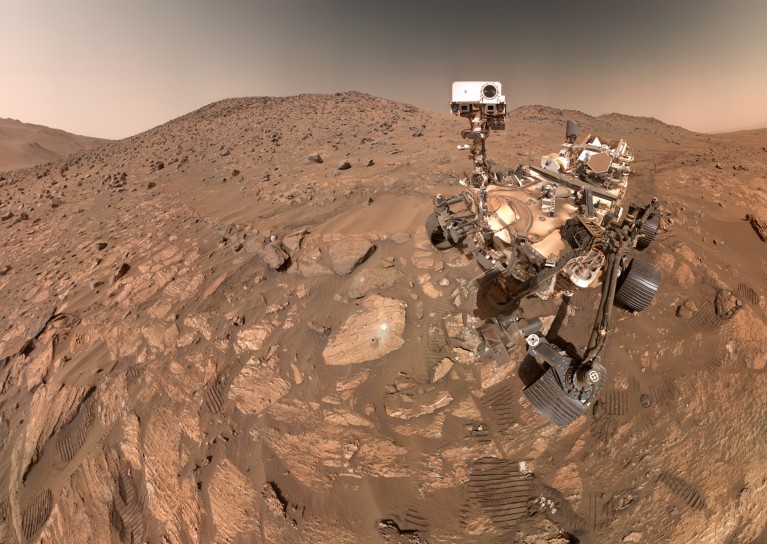
NASA won’t bring Mars samples back to Earth: this is the science that will be lost
Summary
Congress has passed a bipartisan spending bill that restores funding for most NASA science missions, but it contains no money for the Mars Sample Return (MSR) programme. MSR — the ambitious plan to return rock and dust collected by the Perseverance rover to Earth — now looks set to be cancelled. The project’s costs have ballooned (estimated at around US$11 billion), and NASA has previously acknowledged it lacked a concrete return plan. Scientists warn the cancellation would sacrifice unique scientific opportunities, including analyses that could clarify whether certain organic compounds in a Perseverance sample are biosignatures.
Author style
Punchy: This piece cuts straight to the heart of a major programme collapse and why it matters — especially to anyone invested in the hunt for life beyond Earth. Read the detail if you care about flagship science being derailed by cost and politics.
Key Points
- The bipartisan spending bill restores money for most NASA science missions but specifically omits funding for the Mars Sample Return programme.
- MSR’s estimated cost rose to roughly US$11 billion, comparable to the James Webb Space Telescope, prompting scrutiny and delays.
- Perseverance sample 25 (from the rock Cheyava Falls) contains two compounds linked on Earth to decaying matter and microbes, but their origin on Mars is ambiguous.
- Keeping the samples on Mars means scientists cannot perform the detailed lab analyses on Earth needed to discriminate biological from non-biological sources.
- The bill still needs Senate approval; cancellation is not yet legally final, but prospects for immediate revival are bleak without new funding or plans.
- Scientists and organisations express disappointment, noting the loss of a potentially definitive test for ancient Martian biosignatures.
Content summary
The Nature News article explains that, although a spending bill largely rescues NASA science from proposed cuts, it fails to allocate funds for the Mars Sample Return programme. MSR would have been the first mission to transport Martian material to Earth for advanced laboratory study. Cost overruns and an absence of a robust retrieval plan contributed to the programme’s removal from the bill. Researchers highlight a particularly compelling sample from Cheyava Falls that shows organic compounds of great interest; without Earth-based analyses, their origin — biological or abiotic — cannot be resolved.
The article quotes scientists expressing dismay but not surprise, given the programme’s funding and planning struggles. It notes that the bill still requires Senate approval and that other major projects, like the Habitable Worlds Observatory, survive the budget round. The piece frames MSR’s likely cancellation as a significant scientific loss while acknowledging the broader political and fiscal context that led to the decision.
Context and relevance
This story matters to researchers, funders and the public because MSR was designed to deliver samples that only Earth laboratories can analyse with the precision necessary to test for ancient life. The cancellation highlights tensions between ambitious flagship science, rising costs and political will. It also illustrates a broader trend: complex, expensive space missions are vulnerable to budgetary pressure even when they promise unique scientific returns. For planetary scientists, astrobiologists and policy watchers, the outcome affects research priorities, international collaboration prospects and how future sample-return ambitions might be structured or funded.
Why should I read this?
Short and blunt: if you care about whether we’ll ever know if Mars once hosted life, this is headline-level bad news. The article saves you time by showing what precisely gets lost if the samples never reach Earth — especially that tantalising Cheyava Falls rock that could, with the right lab work, answer one of humanity’s biggest questions. It’s a compact update on where politics, money and science collide.