
Rock art from at least 67,800 years ago in Sulawesi
Article metadata
Article Date: 21 January 2026
Article URL: https://www.nature.com/articles/s41586-025-09968-y
Article Title: Rock art from at least 67,800 years ago in Sulawesi
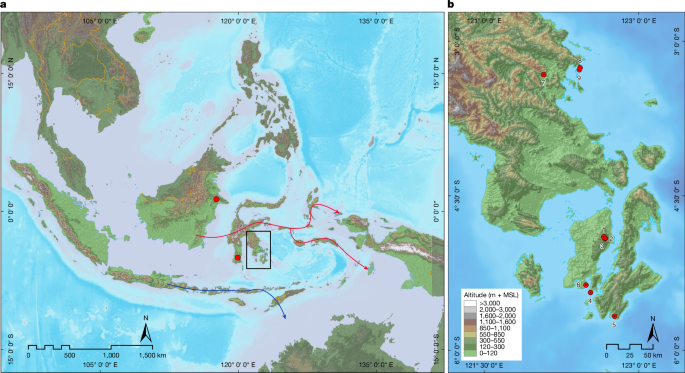
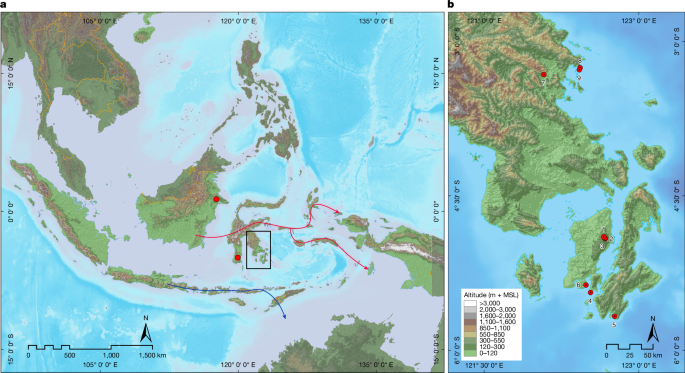
Article Image: Figure 1 (map)
Summary
Researchers report U-series dates from calcium-carbonate deposits over rock art in southeast Sulawesi (including Muna Island) that give minimum ages for hand stencils of at least 67.8 thousand years ago (LMET2; 71.6 ± 3.8 ka). This minimum age is older than previously published minimum ages for Indonesian parietal art and marginally older than the disputed Neanderthal-attributed hand stencil in Spain. The team documented 44 sites across Southeast Sulawesi, dated 11 motifs from eight sites using laser-ablation U–Th methods, and found a mix of Pleistocene and Holocene images. The findings support an early presence of Homo sapiens in Wallacea and bolster the idea that the first peopling of Sahul involved maritime journeys through northern Wallacea. The paper also reports younger motifs (including possible Austronesian-period images) and describes the laboratory LA-U-series imaging methods and sample integrity checks used to derive conservative minimum ages.
Key Points
- A hand stencil from Liang Metanduno (Muna Island) is constrained to a minimum age of 67.8 ka (71.6 ± 3.8 ka) by LA-U-series dating of calcite overgrowths.
- This Muna minimum-age exceeds previously published minimum ages from Maros-Pangkep by ~16.6 kyr and is ~1.1 kyr older than the Neanderthal-associated minimum from Spain.
- Multiple Southeast Sulawesi sites (44 recorded; 11 motifs dated) show hand stencils and figurative/geometric motifs with minimum ages spanning Late Pleistocene to Holocene.
- Some panels show multiple episodes of painting separated by tens of thousands of years (e.g. LMET1 with Pleistocene and later Pleistocene/Holocene layers), indicating long-lived parietal traditions.
- The dating method used was laser-ablation U–Th (LA-U-series) imaging of coralloid speleothems and calcite crusts directly over pigment layers, providing conservative minimum ages; the team checked for diagenesis, detrital contamination and open-system uranium loss.
- Although authors cannot definitively assign the oldest stencil to a human taxon, stylistic and technical features and regional chronology support attribution to Homo sapiens.
- The results strengthen the case that modern humans dispersed to Sahul via a northern Wallacean route (through Sulawesi), bringing a sophisticated painted-art tradition with them around the time of initial colonisation (~65 ka).
- Data and supplementary materials (including raw data) are publicly available on Zenodo.
Context and relevance
These dates add important archaeological evidence in a region that bridges Southeast Asia and Sahul. Sulawesi now appears to host widely distributed, very early parietal art, not just the Maros-Pangkep cluster. The new minimum-age constraint at Muna pushes back the earliest demonstrated age for parietal art attributable to our species and fills a key geographic gap along the proposed northern dispersal route into Sahul. That has knock-on implications for models of early maritime behaviour, planned sea crossings and the cultural capacities of early human populations moving into Island Southeast Asia and Australia.
Author style
Punchy: This is a big one for anyone interested in human origins and prehistoric art. The paper delivers clear, conservative minimum ages using robust LA-U-series imaging and shows that rock art production in Wallacea was deep-time and geographically widespread. If you want the short version: people with the ability and intent to create painted imagery were in Wallacea well before the conventional ~60 ka benchmark for Sahul settlement.
Why should I read this?
Short and blunt — it rewrites how early art and seafaring fit together in this region. If you care about the origins of symbolic behaviour, early maritime travel, or the routes modern humans used to reach Australia, this paper saves you wading through tonnes of specialist detail by giving solid, lab-backed minimum ages and clear implications for migration models. Also, the methods and the data releases mean you can follow up or reanalyse the numbers if you like poking at the technical stuff.
Caveats
U–Th ages on calcite overgrowths provide conservative minimum ages only; they cannot give exact painting ages. Assigning the oldest stencil to a particular hominin taxon is not possible from the art alone, although the authors argue for Homo sapiens on stylistic and chronological grounds. Some dating results have relatively large uncertainties, and detrital corrections and open-system behaviour remain methodological considerations (which the team address in detail).