
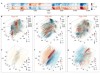
Alternative explanation for how celestial objects generate large-scale magnetic fields
Summary
Numerical simulations by Tripathi et al. demonstrate a new mechanism that can produce organised, large-scale magnetic fields in celestial objects such as stars and galaxies. The process relies on turbulence combined with shear-flow-induced jets, and crucially it avoids a physical effect that has hindered other dynamo models from reproducing the ordered fields we actually observe.
Key Points
- Simulations show shear-flow-induced jets in turbulent fluids can drive large-scale dynamos that create ordered magnetic fields.
- The mechanism sidesteps the problematic suppression (quenching) that limits other proposed dynamo processes.
- Works in numerical models applicable to astrophysical settings such as stellar interiors and galactic discs.
- Provides an alternative to classic mean-field (alpha-effect) dynamos and could reconcile models with observed macroscopic field structure.
- Findings stem from high-resolution computational modelling reported in Tripathi et al., Nature (2026).
Content summary
The research briefing summarises a study in which researchers used numerical simulations to explore how turbulence and shear flows interact to generate large-scale magnetic fields. Instead of relying on the traditional alpha-effect of mean-field dynamo theory, the team found that jets driven by shear flows produce organised magnetic structures through turbulent interactions. This route avoids a physical effect that tends to suppress the growth of ordered fields in other models, making the result notable for explaining observed ordered magnetism on astrophysical scales.
The paper links the new mechanism to common astrophysical conditions — rotating, shearing, turbulent plasmas — and argues the effect could operate in environments ranging from the Sun and other stars to entire galaxies. The authors back their claims with detailed simulation data and analysis showing sustained field growth and organisation under the proposed conditions.
Context and relevance
This is important because the origin of coherent, large-scale magnetic fields in astrophysical objects is a long-standing problem. Traditional dynamo theories can struggle with quenching and scaling to observed macroscopic fields; a mechanism that naturally avoids that suppression could reshape theoretical models and influence how we interpret observations of stellar and galactic magnetism. For researchers modelling magnetic behaviour or analysing observational magnetism data, the study signals a potentially significant shift in preferred dynamo processes.
Why should I read this?
Put simply: if you care about where cosmic magnetic fields come from, this is a neat shortcut through a messy problem. The paper gives a fresh, plausible route to build the big, tidy magnetic patterns we actually see — without the usual killing blow that wrecks other models. Quick read, big implications for anyone into astrophysical dynamos or magnetic observations.