
Bandwidth-tuned Mott transition and superconductivity in moiré WSe2
Article meta
Article Date: 28 January 2026
Article URL: https://www.nature.com/articles/s41586-025-10049-3
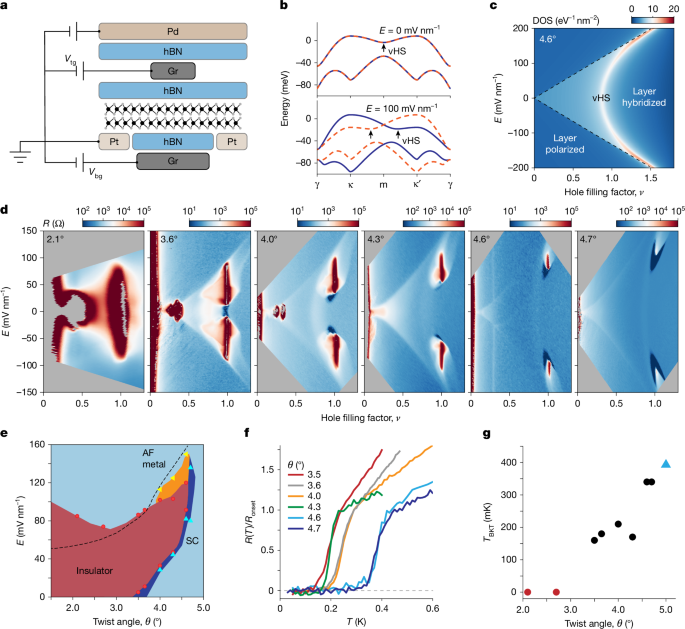
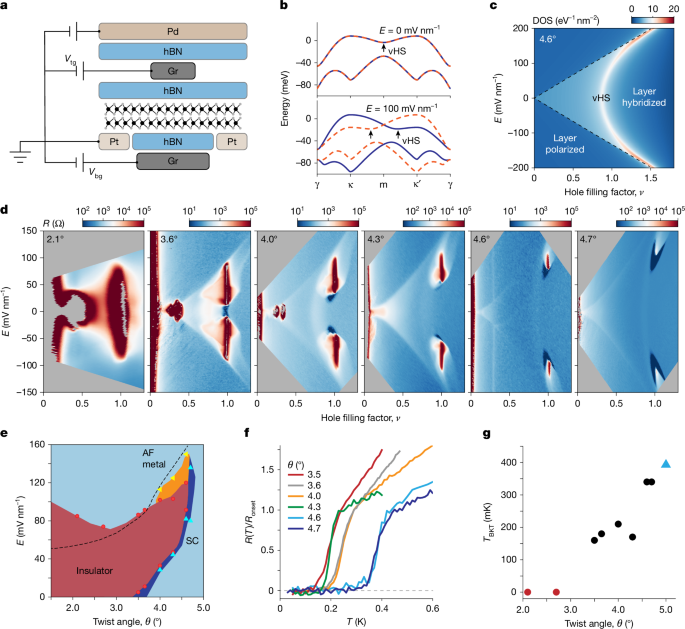
Article Image: Figure 1 (moiré band / device)
Summary
This work reports a detailed phase diagram of twisted bilayer WSe2 (tWSe2) near a twist angle of ≈4.6°, where the moiré bandwidth W and on-site interaction U are comparable. Using dual-gated devices, low-temperature transport and magneto-optical probes, the authors demonstrate a bandwidth-tuned Mott transition at moiré filling ν = 1 and observe superconducting domes on both electron- and hole-doped sides of the antiferromagnetic (AF) insulator. Key signatures include an AF insulating state at ν = 1, tightly bound Cooper pairs with coherence length ≈34 nm and highest Berezinskii–Kosterlitz–Thouless (BKT) Tc near 340–400 mK, abrupt Hall-density jumps signalling Fermi-surface reconstruction at optimal doping, and extended regimes of T-linear resistivity (strange-metal behaviour) adjacent to the superconducting domes. The vertical electric field and twist angle both tune the effective bandwidth and hence the correlation strength, enabling continuous evolution across the Mott transition within a single device. Band-structure calculations using a continuum model support the experimental interpretation and show the role of van Hove singularities and layer hybridisation in stabilising correlated states.
Key Points
- Tuning twist angle (θ) and vertical electric field (E) in tWSe2 adjusts U/W and drives a bandwidth-tuned Mott transition at ν = 1.
- An antiferromagnetic Mott insulator at ν = 1 is observed; AF order (T_N ≈ 3–8 K depending on conditions) weakens with E-field or slight doping.
- Superconducting domes appear on both electron- and hole-doped sides of the ν = 1 insulator; the strongest superconductivity sits adjacent to the insulator ‘melting’ point.
- Optimal Tc is of order a few hundred millikelvin (BKT Tc ≈ 340–400 mK); coherence length ≈34 nm indicates tightly bound Cooper pairs in the clean limit.
- Hall-density jumps at optimal doping show abrupt Fermi-surface reconstructions tied to the collapse of the Mott gap and/or van Hove singularities.
- Extended T-linear resistivity and non-quasiparticle transport (strange-metal behaviour) are found near the superconducting domes; electron–phonon scattering is unlikely to explain this range.
- The phase diagram resembles the cuprate phenomenology (AF insulator → doped AF metal → superconductor → strange metal → Fermi liquid) but on a triangular moiré lattice, offering new contrasts to square-lattice systems.
- Dual-gated device architecture plus magneto-optical magnetic circular dichroism (MCD) provide complementary evidence for AF order and its evolution through the Mott transition.
Why should I read this?
Because it’s one of those rare papers where you can actually tune the physics in real time. If you care about how Mott insulators turn into superconductors (and whether strong correlations — not phonons — do the heavy lifting), this gives a tidy, experimentally controllable platform. The team maps superconductivity, antiferromagnetism and strange-metal behaviour in a single device by changing twist and gate fields — neat, sharp and full of handles for follow-up experiments. Read it if you want a practical moiré playground for Hubbard-model physics.
Author style
Punchy: the experiment is a clean demonstration that bandwidth tuning in a tunable moiré platform reproduces many hallmarks of high-Tc phenomenology. If you work on correlated electrons or moiré materials, this paper is high-impact and worth digging into the figures and methods.
Content summary (concise)
The authors fabricate dual-gated tWSe2 devices with twist angles between ~2° and ~4.7°, focusing on ~4.6°. Transport maps at milliKelvin temperatures and MCD measurements identify an AF insulator at ν = 1 that can be suppressed by varying vertical electric field or twist angle. Around the insulator, superconducting domes form on both doping sides; the most robust superconductivity occurs adjacent to the melting of the AF insulator. Hall and quantum oscillation data reveal small Fermi surfaces in the doped AF metal and abrupt Hall-density jumps at optimal doping, signalling Fermi-surface reconstruction when the Mott gap collapses. Temperature-dependent resistivity shows broad T-linear regimes (strange-metal) and crossovers to Fermi-liquid T^2 behaviour at larger doping. Continuum-model band calculations explain the role of layer hybridisation and van Hove singularities in stabilising correlated states and how E-field shifts band features relative to the Fermi level.
Context and relevance
Why it matters: tWSe2 provides a highly tuneable, semiconductor-based simulator of the triangular-lattice Hubbard model in the moderate U/W regime — the same regime relevant for many unconventional superconductors. The observed proximity of superconductivity to a bandwidth-tuned Mott transition, plus strange-metal transport and Hall jumps, strengthens the case that strong electron correlations and emergent Fermi-surface reconstruction are central to unconventional pairing. Practically, moiré TMDs offer experimental control (twist, gates) unavailable in cuprates and thus open routes to test theoretical proposals about pairing symmetry, topology and quantum-critical transport.
Takeaway
This study places twisted WSe2 among the most promising, controllable platforms for exploring Mott physics, strange metals and unconventional superconductivity. It argues convincingly that correlation-driven mechanisms are at play and gives multiple experimental levers for future work (spectroscopy, phase-sensitive probes, disorder and strain studies).