
Prethermalization by random multipolar driving on a 78-qubit processor
Article Meta data
Article Date: 28 January 2026
Article URL: https://www.nature.com/articles/s41586-025-09977-x
Article Image: 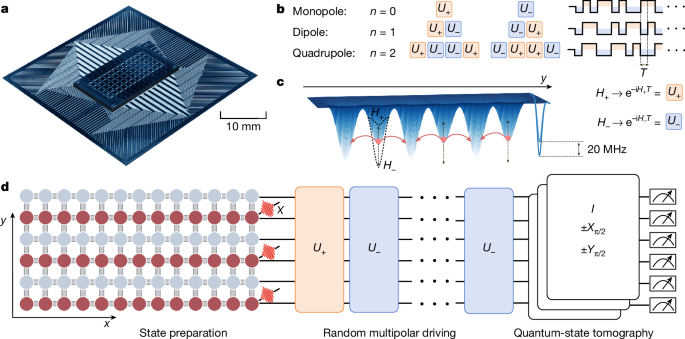
Summary
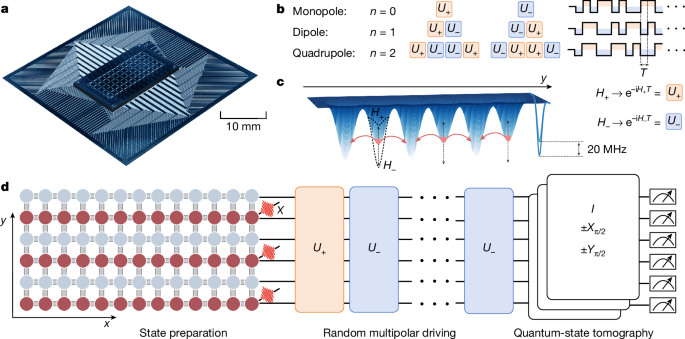
This paper reports large-scale experiments on a 78-qubit superconducting processor (Chuang-tzu 2.0) showing long-lived prethermal regimes under random multipolar driving (RMD). The team implements structured random sequences built from two elementary evolution operators and demonstrates that adding temporal multipolar structure (order n) strongly suppresses heating. They measure the decay of particle imbalance and track subsystem entanglement entropy using multiqubit tomography, observing a clear prethermal plateau and a tunable algebraic scaling of the prethermal lifetime with drive frequency. Advanced tensor-network methods (GMPS and PEPS) capture only early-time dynamics; the later evolution toward infinite-temperature, volume-law entanglement is shown to be classically hard to simulate.
Key Points
- Experiment performed on a 78-qubit, 6×13 superconducting processor with 137 couplers (Chuang-tzu 2.0).
- Random multipolar driving (RMD) protocol: temporal multipolar order n suppresses low-frequency components and slows heating.
- Observed long-lived prethermal plateaux in both subsystem entanglement entropy and particle imbalance; measured over >1,000 driving cycles thanks to long coherence (T1 ≈ 26.4 μs).
- Prethermal lifetimes scale algebraically with driving frequency: τ ≈ (1/T)^α, with α ≈ 2n + 1 predicted; experiments find values close to theory for n = 0, 1 and indicative results for n = 2.
- QST on subsystems (up to 4 sites) reveals a crossover from area-law to volume-law entanglement during heating; entanglement growth makes classical tensor-network simulation intractable at late times.
- Numerical methods (GMPS, PEPS) match early-time dynamics but deviate as entanglement grows, highlighting the quantum processor’s advantage for simulating full heating dynamics.
- Results demonstrate that structured temporal randomness can be engineered to control heating — opening routes to non-equilibrium phases beyond conventional Floquet engineering.
Content summary
The authors implement RMD sequences built from two Hamiltonians H_+ and H_- that differ by a staggered potential. By recursively anti-aligning multipoles they create n-RMD sequences; in the limit n→∞ this approaches Thue–Morse like drives. Starting from a density-wave initial state, the experiments track imbalance decay and reconstruct subsystem density matrices through quantum-state tomography to obtain entanglement entropy dynamics.
Key observations: (i) a distinct prethermal plateau appears in entanglement entropy and imbalance before eventual heating to an infinite-temperature state; (ii) increasing drive frequency prolongs the plateau dramatically; (iii) the prethermal lifetime follows a power-law in frequency with exponent that grows with multipolar order, consistent with theory (α = 2n + 1); (iv) spatially non-uniform entanglement is observed and a crossover from area-law to volume-law scaling is measured as the system heats.
Experimental control is notable: precise Z-pulse shaping, crosstalk calibration and timing alignment enable high-frequency drives (T ≈ 3–8 ns) across all qubits. The processor’s stability permits >1,000 cycles, allowing clear discrimination of scaling behaviours and long-lived prethermal plateaux in a 2D interacting system that is hard to simulate classically at later times.
Context and relevance
This work sits at the intersection of non-equilibrium many-body physics and quantum simulation. It extends Floquet prethermalisation concepts to structured random driving and demonstrates experimentally that temporal engineering of randomness (RMD) gives a universal knob to tune heating rates. The demonstration on a 78-qubit platform is important for two reasons: it validates recent theoretical predictions about RMD scaling in a large interacting system, and it establishes a practical method to keep driven quantum simulators in useful prethermal windows for much longer — relevant for anyone working on quantum simulation, dynamical phases, or quantum control.
Why should I read this?
Because it’s neat and useful. The team shows you can randomise the drive and still avoid frying your quantum simulator — by designing the randomness. If you care about keeping many-qubit devices coherent under time-dependent control (or just want a clever trick to slow heating), this paper saves you time: it packs experimental, theoretical and numerical evidence that multipolar temporal structure is a practical lever to control thermalisation.
Author style
Punchy: Big experiment, clear mechanism, direct measurements. If you want to understand or exploit controlled heating (or the lack of it) in many-body quantum simulators, read the full paper — the details matter for implementation.