
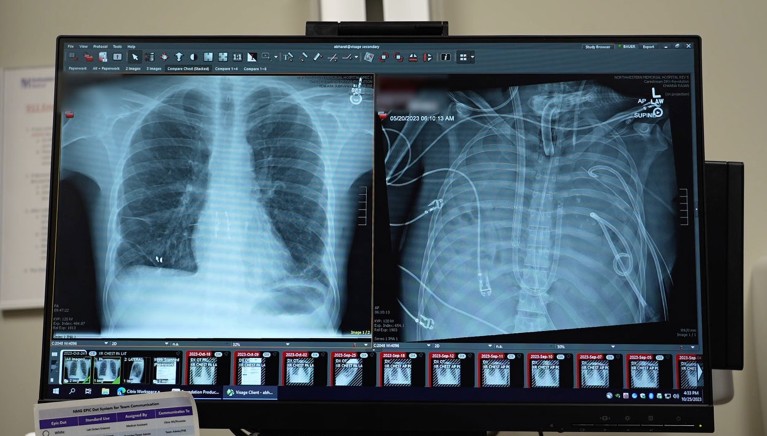
48 hours without lungs: artificial organ kept man alive until transplant
Summary
A 33-year-old man survived for 48 hours after surgeons removed his infected lungs and connected him to an external artificial-lung system developed by a team led by thoracic surgeon Ankit Bharat at Northwestern University. The device is notable because it maintains a balanced, continuous flow of blood through the heart while oxygenating blood — unlike previous extracorporeal devices that cannot preserve normal cardiac flow.
The patient had acute respiratory distress syndrome after influenza, then a drug-resistant Pseudomonas aeruginosa infection that caused septic shock and organ failure. After lung removal and support on the artificial-lung system, his blood pressure support was weaned, kidney function recovered and his heart function normalised within 48 hours. He then received a double lung transplant and, almost three years on, shows no signs of rejection or impaired lung function. The results were published in Med.
Key Points
- The artificial-lung system oxygenates blood while preserving continuous, balanced blood flow across the heart, lowering clot risk.
- The device acted as a bridge-to-transplant: surgeons removed infected lungs, stabilised the patient externally, then performed a double lung transplant 48 hours later.
- The patient recovered surprisingly quickly: off vasopressors, kidneys restored and normal heart function before transplant.
- This is a single but long-term positive case — the patient remains well nearly three years later.
- Authors suggest the system could help other critically ill patients waiting for transplants or recovering from severe lung infections.
Content summary
The man developed ARDS from influenza, was ventilated, then acquired a drug-resistant Pseudomonas infection that led to pus-filled lungs, septic shock and multi-organ failure. He arrested and was dying, so clinicians elected to remove the infected lungs. The novel external artificial-lung system kept him oxygenated and maintained cardiac blood flow, enabling rapid physiological recovery and a successful double lung transplant shortly afterwards.
Context and relevance
This case demonstrates a significant advance in extracorporeal organ support: unlike typical ECMO and related devices, this system is designed to maintain normalised haemodynamics as well as gas exchange. That could expand options for patients who are too sick to wait for transplants or who have lungs that must be removed because of infection. It also ties into broader trends in organ-replacement technology and intensive-care innovations developed or accelerated during recent pandemics and infectious-pressure periods.
However, it remains a single-case report; wider trials and replication are needed before the technique becomes standard care.
Why should I read this
Because it’s frankly astonishing — someone lived without lungs for 48 hours thanks to an external artificial organ that kept the heart working properly. If you follow critical care, transplant medicine or biomedical engineering, this is the kind of real-world breakthrough that could change how we bridge the sickest patients to transplant. Short, sharp and worth your two-minute skim.
Author style
Punchy: this isn’t a small tweak — it’s a bold clinical manoeuvre with a striking outcome. The article flags a potential game-changer for intensive care and transplant teams, so read the detail if you want to understand the device’s novelty and the caveats around a single-case result.
Source
Article date: 29 January 2026