
Atlas-guided discovery of transcription factors for T cell programming
Article Meta data
Article Date = 04 February 2026
Article URL = https://www.nature.com/articles/s41586-025-09989-7
Article Title = Atlas-guided discovery of transcription factors for T cell programming
Article Image = https://media.springernature.com/lw685/springer-static/image/art%3A10.1038%2Fs41586-025-09989-7/MediaObjects/41586_2025_9989_Fig1_HTML.png
Summary
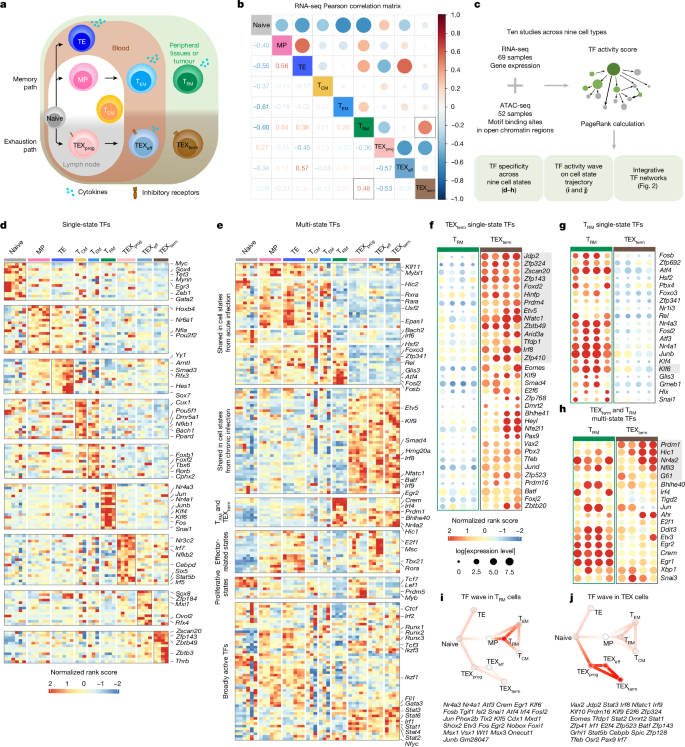
This study builds a multi-omics atlas of nine CD8+ T cell states and uses an integrative pipeline (Taiji) to infer transcription factor (TF) activity from matched RNA-seq and ATAC-seq data. By computing PageRank-based TF activity scores and mapping TF–TF networks, the authors distinguish single-state TFs (state-selective) from multi-state TFs and define coordinated ‘TF waves’. They validate predictions with in vivo Perturb-seq and targeted CRISPR perturbations in mouse infection and tumour models, and with KO experiments in human T cells. Key findings: several novel TEXterm-selective TFs (for example, ZSCAN20, JDP2, ZFP324) drive terminal exhaustion, KLF6 drives tissue-resident memory (T_RM) formation when overexpressed, and targeting exhaustion-specific TFs improves tumour control and synergises with anti-PD1 therapy. The proteasome pathway emerges as a functional hallmark of terminally exhausted T cells.
Key Points
- Taiji integrates ATAC-seq and RNA-seq across 121 samples to compute TF activity via a PageRank-like algorithm, giving a global regulatory influence metric rather than expression alone.
- The atlas identifies 136 single-state TFs and 173 multi-state TFs across nine CD8+ T cell states; 20 T_RM and 34 TEXterm single-state TFs were defined with statistical filtering.
- Novel TEXterm single-state TFs (ZSCAN20, JDP2, ZFP324, ZFP143, ZBTB49, ARID3A) were predicted and shown by Perturb-seq/CRISPR KO to reduce terminal exhaustion and boost effector-like programmes without impairing T_RM differentiation.
- KLF6 overexpression selectively expands T_RM cells in the gut without increasing terminal exhaustion, showing the atlas can suggest beneficial ‘TF recipes’ for cell engineering.
- Proteasome activity is elevated in TEXterm cells; sorting proteasome-high T cells yields worse tumour control, linking predicted pathways to function.
- Targeting TEXterm single-state TFs (Zscan20, Jdp2) improved tumour control in adoptive transfer models and synergised with anti-PD1 blockade; several TF activities are conserved in human tumour-infiltrating CD8+ T cells.
Content summary
The authors compiled paired ATAC- and RNA-seq from mice spanning acute and chronic LCMV infections and tumour models to build a regulatory atlas. Taiji constructs TF–regulatee networks weighted by motif, accessibility and expression, then ranks TFs by PageRank to reveal activity patterns. Statistical filtering classes TFs as single-state (state-selective) or multi-state. Network community and ‘TF wave’ analyses reveal coordinated programmes—T_RM-associated waves include AP-1 family members linked to TGFβ responses, while TEX waves include IRF8, JDP2 and NFATC1 tied to PD1/senescence pathways. In vivo Perturb-seq targeting 19 TFs confirmed many predictions: KO of several predicted TEXterm TFs reduced terminal exhaustion, increased effector-like subsets and improved viral control. Importantly, KO of TEXterm single-state TFs did not impede T_RM formation, whereas KO of some multi-state TFs (for example HIC1, PRDM1) impacted both states. KLF6 overexpression increased T_RM frequency dramatically without exacerbating exhaustion. Cross-species analysis with human single-cell multi-omics showed substantial conservation of TF activity; CRISPR KO in human T cells (ZSCAN20, JDP2) reduced exhaustion markers and improved cytokine responses. Combined TF KO and anti-PD1 therapy reduced tumour burden and improved survival in mouse models.
Context and relevance
Precise control of CD8+ T cell states is central to improving adoptive cell therapies (TILs and CAR-T) for solid tumours. This paper addresses a key bottleneck: transcriptional similarity between protective tissue-resident memory cells and dysfunctional terminally exhausted cells makes selective engineering hard. The atlas + Taiji pipeline lets researchers identify state-specific TFs to reprogram T cells away from exhaustion while preserving or enhancing tissue residency and effector function. The result is a practical route to produce T cells better suited for tumour therapy and to nominate targets (ZSCAN20, JDP2, KLF6) with translational potential. The finding that proteasome activity marks TEXterm cells links cellular metabolism/proteostasis to exhaustion and suggests new functional biomarkers.
Author style
Punchy: this is a method-forward, translational study — it not only maps TF activity across T cell states but actually tests and validates manipulable TF targets. If you care about next-generation cell therapies, the detail matters: the paper gives handleable TFs and a computational pipeline to find more.
Why should I read this?
Want smarter T cells for cancer therapy? Read this — the team made a genomic map that spots which TFs push T cells towards useless exhaustion versus useful tissue residency, then knocked some out and proved tumour control improves. It’s one of those papers that actually points to concrete engineering moves you can test in the lab or clinic.