

Spin-wave band-pass filters for 6G communication
Meta
Article Date: 04 February 2026
Article URL: https://www.nature.com/articles/s41586-025-10057-3
Article Image: Figure 1
Summary
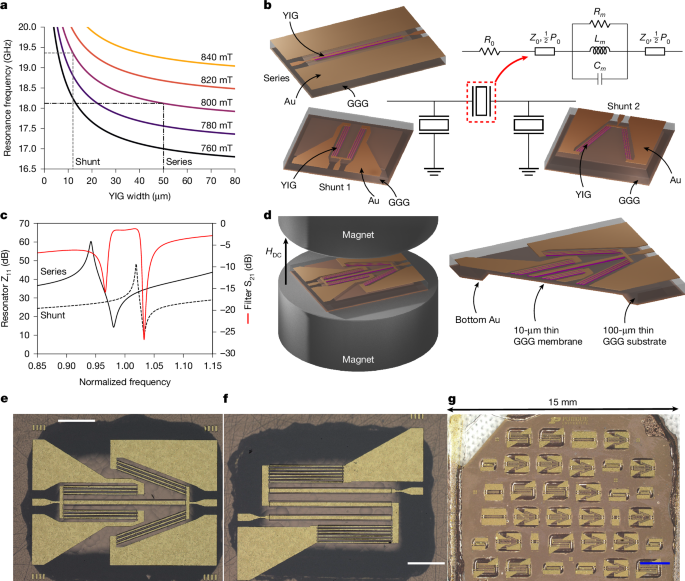
This paper demonstrates compact, lithographically defined spin-wave (SW) ladder band-pass filters built from yttrium iron garnet (YIG) films on gadolinium gallium garnet (GGG) for the FR3 / prospective 6G frequency range. By engineering strong geometry-dependent demagnetisation and wavevector contrasts between series and shunt resonators, the authors achieve large resonance separations while using a single uniform out-of-plane magnetic bias. The devices are fabricated on 15 × 15 mm chips using an ion-milling and deep GGG etch process that enables a close (<20 μm) ground plane beneath the YIG, boosting resonator coupling and performance. The team reports third- and fifth-order ladder filters with lithographically defined bandwidths up to 663 MHz, continuous centre-frequency tuning from 7.08 to 21.6 GHz, insertion loss in the 2.54–5.78 dB range, small footprints (~1.566 mm2), strong spur suppression below 18 GHz and high linearity. They also present a frequency-agile QAM radio demonstration (20 Mbps) showing robust demodulation and resilience to adjacent-channel interference.
Key Points
- Spin-wave ladder filters implemented on YIG-on-GGG chips achieve single-bias tuning across 7.08–21.6 GHz.
- Lithographic geometry contrast (wide series resonator vs narrow shunt fins) creates the required resonance separation without multiple external magnets.
- Demonstrated lithographic bandwidths up to 663 MHz with insertion loss 2.54–5.78 dB and compact footprints (~1.566 mm2 for a third-order filter).
- Fabrication uses deep Ar ion milling and anisotropic GGG etching to place a ground plane ~10 μm beneath YIG, improving keff2 (reported up to ~18% in related work) and yield across a 15 × 15 mm chip.
- Filters show high linearity (in-band third-order intercept point ≥ ~10 dBm) and suppressed spurious modes below ~18 GHz; some spurs appear above that range.
- Practical demo: a frequency-agile receiver using the SW filter preserves IQ demodulation and SNIR while hopping over an octave of frequency and attenuating near-band interference.
- Remaining challenges: compact tunable magnetic-bias packaging, optimisation of insertion-loss versus rejection trade-offs, and integration for wafer-scale production.
Author style
Punchy: this is a practical, materials-plus-microfabrication advance that directly tackles the size, band-count and tunability problems in 6G RF front ends. If you’re tracking hardware enablers for next-gen wireless, the devices and process details here are the kind of engineering step-change that matter — not just a lab curiosity but a path toward chip-scale tunable filters.
Why should I read this?
Short version — because it actually shows a believable way to replace stacks of fixed acoustic filters with one tiny, tuneable chip that covers many 6G bands. If you care about smaller, cheaper, reconfigurable RF front ends or frequency-agile radios that can hop and avoid interference, these spin-wave filters are worth a look. We’ve read the long paper so you don’t have to: the headlines are real performance gains (bandwidth, tuning range, low loss) and a fabrication route that looks scalable.
Context and relevance
This work addresses a key bottleneck for 5G/6G RF front ends: the explosion in the number of fixed filters required to cover many disjoint bands raises cost, size and power. Spin-wave resonators combine intrinsic tunability with intermediate wavelengths that enable device miniaturisation independent of operating frequency. By enabling single-bias, lithographically defined bandwidths and wafer-scale-capable micromachining, the paper aligns with industry trends toward reconfigurable RF hardware, and sits alongside advances in thin-film acoustic materials and micromagnetic packaging as realistic contenders for future mobile transceivers.