
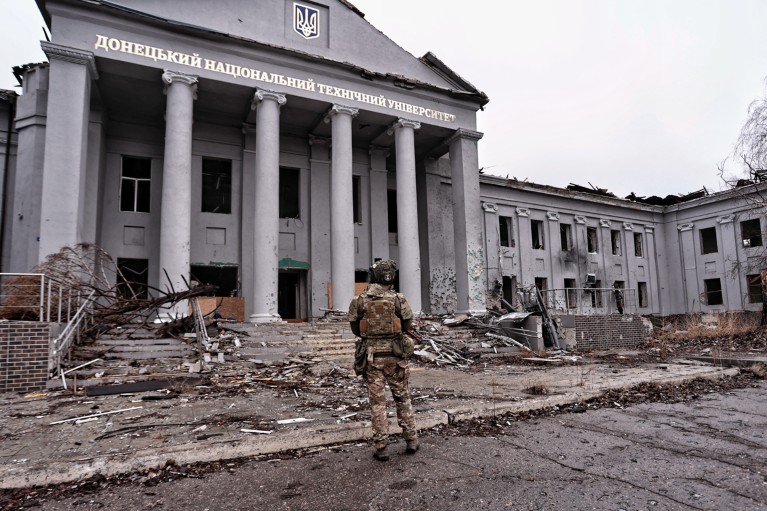
Universities in exile: displaced scholars count the costs of starting afresh
Article meta
Article Date: 06 February 2026
Author: Rachel Brazil
Source URL: https://www.nature.com/articles/d41586-025-04160-8
Image: Main image

Summary
This feature describes how universities and their staff have been forced into exile by war and political unrest — with case studies from Ukraine, Russia, Sudan and Myanmar. The piece follows displaced institutions such as Donetsk National Technology University and Donetsk National University, showing multiple relocations, major drops in student and staff numbers, loss or storage of laboratory equipment, and chronic funding and salary problems. It also covers initiatives run by displaced Russian educators (Smolny Beyond Borders) teaching online, and how Sudanese universities have set up satellite centres in Cairo and elsewhere to keep programmes running despite campus destruction.
The article highlights practical responses: pooling equipment across institutions, shifting to online delivery, creating mini teaching centres in safer cities or abroad, and targeted donor support that helped rebuild labs and campuses. It emphasises the human toll — families leaving with only essentials, difficulties at checkpoints, and the struggle to adapt curricula to new local industries. The piece closes by noting resilience and determination among displaced academics to sustain education and preserve community ties while hoping to return one day.
Key Points
- War and political unrest have forced universities to relocate repeatedly, shrinking student and staff numbers dramatically (examples: DonNTU and DonNU in Ukraine).
- Displaced institutions face practical barriers: lost or destroyed lab equipment, electricity cuts, inadequate teaching spaces and limited funding.
- Academic salaries have collapsed in real terms, creating financial strain for staff and students and increasing drop-outs.
- Universities adapt by moving teaching online, sharing equipment through pooled centres, opening satellite campuses, and recruiting local students and staff.
- Networks and initiatives (for example Smolny Beyond Borders) enable displaced faculty to continue teaching and offer accredited programmes to exiled students.
- Private institutions sometimes have more flexibility to set up abroad or in safer regions, but overall student numbers and planned expansions have fallen sharply.
- Despite severe disruption, displaced scholars prioritise maintaining community, continuing research and training, and preparing for eventual return.
Context and relevance
The article matters for policymakers, university leaders and funders: it shows how higher education systems fracture under conflict and what practical measures help sustain teaching and research. It connects to bigger trends — the rise of online and transnational education, the fragility of research infrastructure in conflict zones, and the need for international support mechanisms for displaced academics and students. For anyone involved in higher education planning or humanitarian response, the cases described offer lessons on crisis resilience, rapid relocation, and the long-term costs of uprooting institutions.
Why should I read this?
Because it’s a stark, human-focused read that explains what actually happens when universities get ripped out of their communities — and how people keep things going anyway. If you care about higher education, research continuity or humanitarian responses, this saves you time by pulling together real examples of adaptation, the gaps that remain, and where help actually makes a difference.
Author style
Punchy — the reporting mixes concrete examples, personal testimony and practical outcomes. The tone makes the costs of displacement feel immediate and the adaptive responses credible; if you want to understand both the pain and the pragmatic fixes, read the detail.