Agouti integrates environmental cues to regulate paternal behaviour
Summary
This Nature paper uses the African striped mouse (Rhabdomys pumilio) to map how natural variation in male caregiving maps onto brain activity and gene expression in the medial preoptic area (MPOA). The authors show that the Agouti gene (Agouti signalling protein, ASIP) is enriched in MPOA neurons of infanticidal males and negatively correlates with pup care. Single-nucleus RNA-seq, brain-wide cFos mapping and viral manipulations confirm that MPOA activity and Agouti expression gate paternal behaviour. Crucially, Agouti responds to long-term socio-environmental cues (housing density/territory) rather than acute hunger: single housing lowers MPOA Agouti and increases paternal care, while group housing raises Agouti and, in some males, infanticide. Viral overexpression of Agouti in the MPOA is sufficient to suppress care and drive infanticidal tendencies in previously ambivalent males.
Key Points
- Male striped mice naturally show wide variation from infanticide to robust alloparental care without prior mating or sensitisation.
- MPOA activity (cFos) distinguishes allopaternal from dysparental males and correlates with the amount of pup-directed contact.
- snRNA-seq of the MPOA revealed cell-type composition is conserved, but transcriptional states differ by phenotype; Agouti (ASIP) is the top gene enriched in infanticidal males.
- Agouti expression in the MPOA negatively correlates with caring behaviour; qPCR and RNAscope validated this relationship in independent samples.
- Overexpressing Agouti in MPOA neurons (AAV) reduces paternal behaviours and increases infanticide in ambivalent males, demonstrating sufficiency to suppress care.
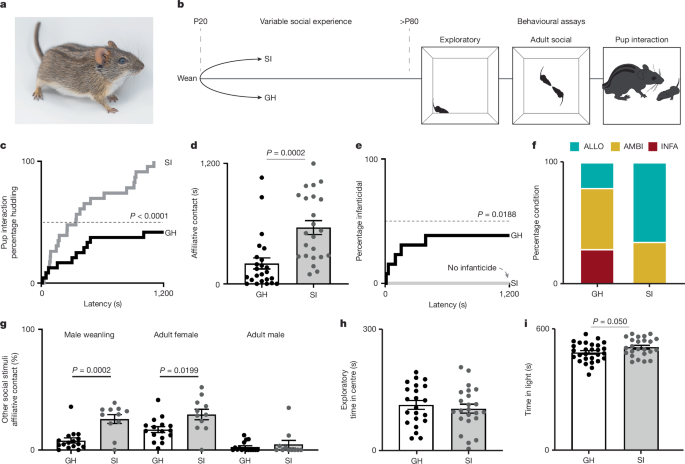
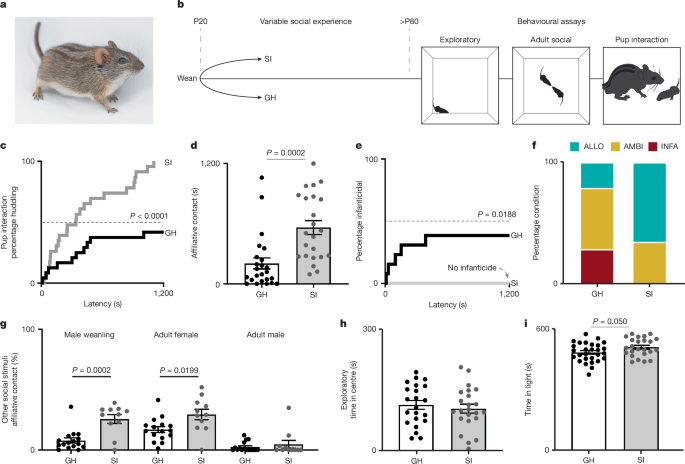
- Agouti levels are sensitive to longer-term socio-environmental cues (housing density, perceived territory) but not to short-term satiety; isolation reduces Agouti and increases paternal care.
- Findings implicate local ASIP–MC4R signalling in the MPOA as a mechanism that biases conserved parental circuits towards aggression or caregiving depending on ecological context.
Content summary
The researchers compared sexually naive single-housed (SI) and group-housed (GH) male striped mice in a standardised pup interaction test. SI males were far more likely to show alloparental care; GH males showed more ambivalence and some infanticide. Brain-wide cFos mapping after pup exposure highlighted the MPOA as a hub whose activity strength correlates with caring behaviour. Single-nucleus RNA sequencing of MPOA tissue from alloparental, ambivalent and infanticidal males (plus sires and dams) found conserved cell-type composition but distinct activity- and gene-expression states. Agouti emerged as the most differentially expressed gene enriched in infanticidal animals across multiple MPOA-specific clusters.
Functional tests established causality: AAV-mediated Agouti overexpression in MPOA neurons suppressed care and increased infanticide in ambivalent GH males, and reduced care in previously paternal individuals. Manipulations of feeding (short-term food restriction) showed hunger did not explain Agouti differences, whereas changing housing density (GH to SI) over days lowered MPOA Agouti and shifted behaviour towards caregiving. The authors therefore interpret Agouti as an integrator of socio-environmental information (population density/territory) that gates conserved parental circuits — likely via ASIP action on melanocortin receptors (notably MC4R) within MPOA neurons.
Context and relevance
This work shifts the focus from mechanisms that ‘activate’ parenting to mechanisms that gate or suppress caregiving within ancestral circuitry. The MPOA is a shared parental hub across mammals; here, naturally varying male behaviour is regulated by modulation of melanocortin signalling through Agouti, linking ecological context to decision-making about offspring investment. The finding is important for behavioural neuroscience because it identifies a molecular rheostat (ASIP–MC4R) within the MPOA that biases male responses to infants — a mechanism conserved enough to connect to known maternal circuits yet flexible to ecological pressures.
Why should I read this?
Quick and dirty: if you want to know how male mammals switch between being carers and killers — and how social context flips that switch — this paper nails a molecular player. It’s tidy, causal and uses a natural behavioural model so you don’t have to rely only on artificial lab tricks. Good read if you care about neural circuits, evolution of parenting, or how the brain integrates social ecology.
Author style
Punchy: The paper is high-impact and mechanistic — not just correlative. It combines behaviour, brain-wide activity mapping, single-nucleus transcriptomics and causal viral manipulation to show Agouti in the MPOA is a context-sensitive off‑switch for male caregiving. If you follow neuroendocrine control of social behaviour, this one’s worth your time.
Source
Article date: 18 February 2026
Source: https://www.nature.com/articles/s41586-026-10123-4