
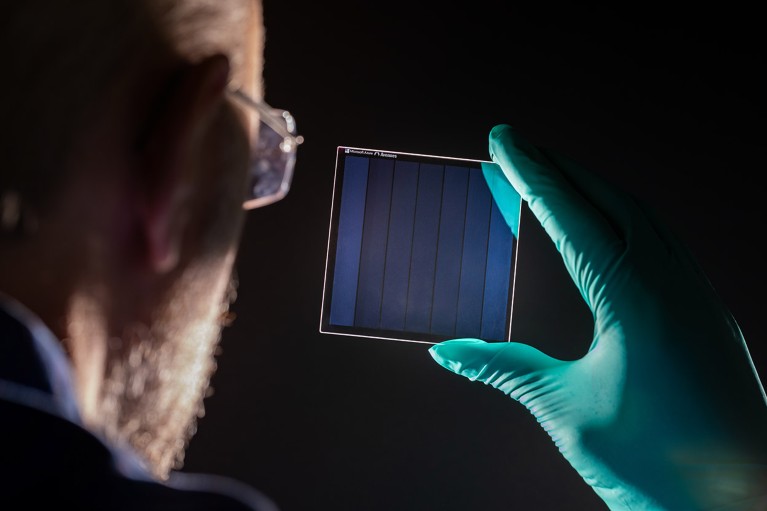
Microsoft team creates ‘revolutionary’ data storage system that lasts for millennia
Article Date: 18 February 2026
Article URL: https://www.nature.com/articles/d41586-026-00502-2
Summary
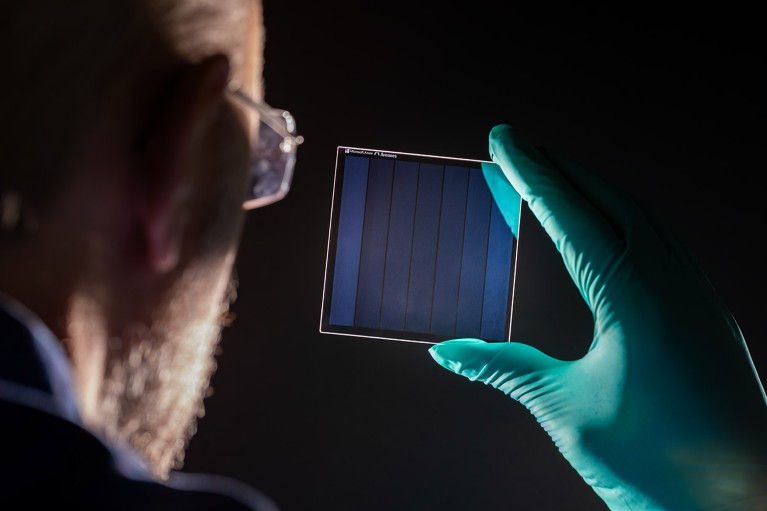
Microsoft Research has demonstrated a glass-based archival storage system that uses ultrafast (femtosecond) laser pulses to create nanoscale, plasma-induced deformations inside borosilicate glass. A 12 cm-wide, 2 mm-thick square can hold about 4.8 TB — roughly two million printed books — and the team estimates the data will remain readable for at least 10,000 years at 290 °C and far longer at room temperature. The method trades the speed of conventional drives for near-permanent, low-maintenance archival durability and relies on microscope-based readout of the written nanostructures.
Key Points
- Storage medium: borosilicate glass written by femtosecond laser bursts that create plasma-induced nano-explosions and local refractive changes.
- Capacity: 4.8 TB on a 12 cm × 12 cm × 2 mm glass plate — equivalent to about two million printed books.
- Durability: Data predicted to survive at least 10,000 years at 290 °C and potentially tens or hundreds of times longer at room temperature; written data are immutable and need no active maintenance.
- Read/write trade-offs: Writing and reading require specialist hardware (laser writing and microscope readout); not as quick as HDDs or SSDs but tailored for archival permanence.
- Practical progress: Microsoft moved from fused silica to cheaper borosilicate glass and optimised for faster, more reliable writing and decoding, bringing the technology closer to deployable archival use.
Context and Relevance
Conventional magnetic tapes and hard drives typically last around a decade, forcing frequent data migration and high maintenance costs for long-term archives. This glass approach tackles that pain point by offering a write-once, maintenance-free medium suitable for scientific archives, cultural heritage, legal records and other data that must be preserved for centuries. It builds on previous optoelectronics and materials advances and could reshape long-term backup strategies and data-centre design for archival storage.
Why should I read this?
Quick take — this is geeky but huge. If you care about keeping data safe for centuries without constant copying, this could change how archives are built. Microsoft has moved glass storage from lab trick to something you could actually use to back up the important stuff. If you’re responsible for backups, research data, legal archives or cultural heritage, it’s worth a skim — we’ve saved you the deep read.
Author style
Punchy: the paper shows a clear step from materials experiment to a practical archival system. Experts call it potentially revolutionary for long-term data storage — read the original paper if you need the technical details.