

A membrane-bound nuclease directly cleaves phage DNA during genome injection
Article Date: 25 February 2026
Article URL: https://www.nature.com/articles/s41586-026-10207-1
Article Image: Figure 1
Summary
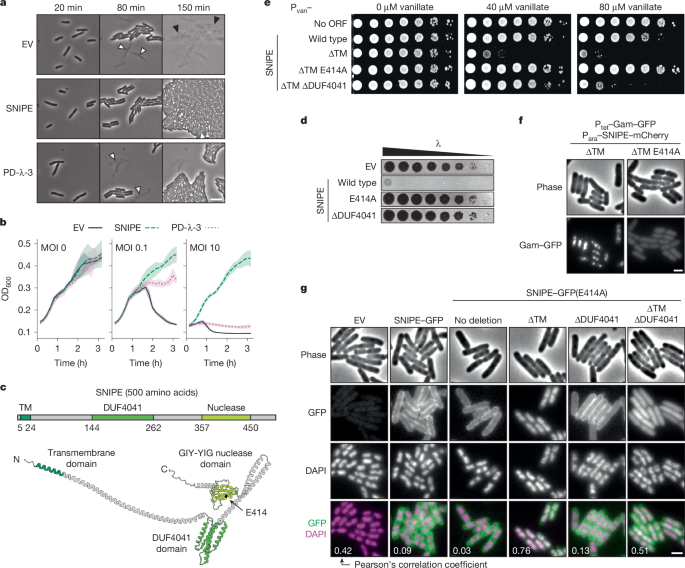
This study identifies and characterises SNIPE (surface-associated nuclease inhibiting phage entry), a previously unrecognised membrane-anchored bacterial defence protein that directly cleaves incoming phage DNA during genome injection. SNIPE is an inner-membrane protein with a GIY-YIG nuclease domain and a DUF4041 domain that promotes DNA binding. It associates with the mannose permease complex (ManYZ) and with phage tape measure proteins (TMPs), positioning its nuclease to cut phage genomes as they enter the cell, thereby preventing productive infection without killing the host.
Key Points
- SNIPE is an inner-membrane-anchored nuclease (GIY-YIG) that provides direct defence against several siphoviruses, including lambda.
- The DUF4041 domain promotes DNA binding; the transmembrane anchor sequesters nuclease activity to avoid autoimmunity.
- SNIPE cleaves phage DNA during genome injection — shown by fluorescence parS/ParB assays and 32P-labelled DNA fragmentation experiments.
- SNIPE interacts with the mannose permease ManYZ and the phage tape measure protein (TMP), localising it to injection sites; ManYZ-dependence explains susceptibility for many phages.
- SNIPE can act independently of ManYZ by weakly interacting with diverse TMPs; mutations in DUF4041 strengthen defence against particular phage clades.
- SNIPE homologues are widespread and modular: conserved nuclease domain, variable N-terminal regions (often membrane-targeting), and diversified DUF4041 to tune phage specificity.
- The mechanism differs from CRISPR or restriction systems by exploiting subcellular localisation (membrane-proximal cleavage) rather than sequence or modification recognition.
Content summary
The authors reconstituted and characterised the PD-λ-1 system (renamed SNIPE) in E. coli. Time-lapse microscopy and growth assays show SNIPE enables infected populations to survive without abortive infection. Structural prediction and topology tests indicate an N-terminal periplasmic region, a single transmembrane helix anchoring SNIPE in the inner membrane, a DUF4041 domain that binds DNA, and a C-terminal GIY-YIG nuclease essential for activity.
When infected with phage lambda engineered to report genome entry, SNIPE-expressing cells show a ~30-fold reduction in visible injected genomes; radiolabel assays show injected phage DNA is fragmented in SNIPE+ cells. Proximity labelling (TurboID) and crosslinking pinpoint associations between SNIPE, ManYZ and the phage TMP. Genetic screens and mutagenesis reveal SNIPE can be tuned (via DUF4041 mutations) to better target some phage TMPs, while SNIPE homologues across bacteria show conserved nuclease features but variable membrane-targeting and DUF domains to broaden or alter specificity.
Context and relevance
This work uncovers a fundamentally different ‘direct defence’ strategy: targeting the act of genome entry by localising a nuclease at the membrane where phage DNA first appears. It expands our understanding of bacterial innate immunity beyond sequence-specific systems (CRISPR, restriction) to spatially targeted mechanisms. The finding explains how bacteria can neutralise phages without committing suicide and suggests SNIPE-like systems shape phage–host coevolution, influence phage therapy outcomes, and might be repurposed or considered when engineering phage-resistant strains.
Author style
Punchy: This paper delivers a crisp, mechanistic advance — SNIPE is a membrane-parked assassin that nicks phage genomes as they try to enter. The experiments are thorough (microscopy, radiolabelling, proximity labelling, genetics) and the discovery is broadly relevant: SNIPE homologues are widespread and modular, so this isn’t a lab oddity but a general bacterial strategy. If you work on phage–host interactions, innate immunity or phage therapy, the molecular detail here is worth digging into.
Why should I read this?
Short answer: because it shows bacteria can stop phages right at the door. It’s a neat, unexpected defence trick — SNIPE sits on the membrane, waits for the phage to shove DNA in, and chops it up. If you’re into phage–host arms races, microbial immunity, or designing phage-resistant strains (or phages that evade defence), this saves you time — read the paper for the methods and the mutational maps that show how specificity is tuned.