

Coral microbiomes as reservoirs of unknown genomic and biosynthetic diversity
Article Date: 2026-02-25
Article URL: https://www.nature.com/articles/s41586-026-10159-6
Article Image: Figure 1
Summary
This paper reports a genome-resolved survey of coral- and sponge-associated microbiomes built from the Tara Pacific expedition plus public datasets. The authors reconstructed ~13,446 metagenome-assembled genomes (MAGs) representing 4,224 species — about 90% of which are genomically novel — and compiled them into the Reef Microbiomics Database (RMD). Coral microbiomes (especially fire corals) harbour unexpectedly rich biosynthetic potential: more biosynthetic gene cluster families (GCFs) per species than open ocean microbes, many novel GCFs, and several BGC-rich candidate species. The team validated and characterised novel RiPP biosynthetic enzymes from Acidobacteriota (including a GMC-family oxidase that installs thiazoles) and demonstrated biological activity (a ThaA-derived peptide inhibiting human neutrophil elastase, IC50 ≈ 2.6 µM). The work highlights both biotechnological opportunities and the risk of losing unique biosynthetic diversity as reefs decline.
Key Points
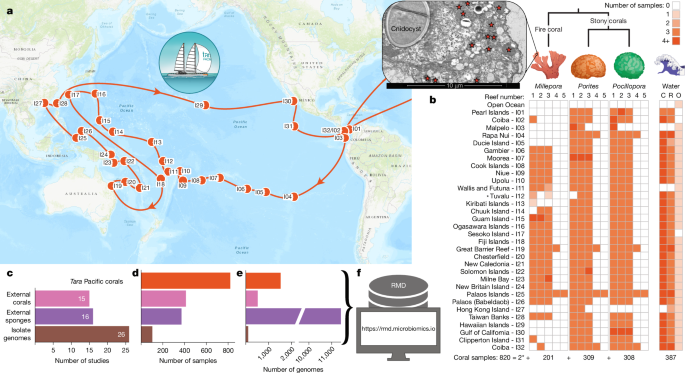
- The study reconstructed 13,446 MAGs (1,524 from Tara Pacific) and defined 4,224 species-level clusters; ≈90% of these species are new to GTDB.
- Coral and sponge microbiomes are highly host-specific: 95% of microbial species are unique to a particular coral host genus; corals and sponges share <1% of species.
- The Reef Microbiomics Database (RMD) contains 16.3 million non-redundant genes — reef-associated species encode substantially more genes per species and larger estimated genome sizes than open-ocean microbes.
- Reef microbes encode richer biosynthetic diversity than the open ocean: 6,612 GCFs (1.57 GCFs per species) vs 5,877 (0.71 per species) in the Ocean Microbiomics Database; 64% of reef GCFs are newly identified in this study.
- Fire corals (Millepora) are particularly BGC-rich (~4.0 GCF per species), marking reef-building corals as promising bioprospecting targets.
- Twenty candidate BGC-rich microbial species were identified (Acidobacteriota, Proteobacteria, Cyanobacteria, etc.); long-read validation increased the count of complete BGCs for top Acidobacteriota genomes.
- Functional characterisation uncovered novel RiPP enzymology: a GMC-family oxidoreductase (ThaO/TheO) installs thiazoles (without YcaO-type phosphorylation) and modified peptides show bioactivity (neutrophil elastase inhibition, IC50 ≈ 2.6 µM); TheO tolerates short/truncated cores and can modify fused cargo peptides.
Content summary
The Tara Pacific expedition sampled 820 reef-building coral metagenomes across 99 reefs and 32 islands; these were combined with 412 coral and 371 sponge public metagenomes. Using established assembly, binning and antiSMASH-based BGC prediction workflows, the authors produced the RMD and compared reef-associated genomic and biosynthetic diversity with open-ocean datasets.
Key findings include pervasive genomic novelty (≈90% novel species), strong host specificity of microbiomes, and higher gene content and biosynthetic richness in host-associated reef microbes. By clustering predicted BGCs into GCFs the team showed the reef microbiome contains many novel biosynthetic pathways (low overlap with MIBiG/BiG-FAM). After normalising for sampling effort, corals — especially fire corals — are shown to harbour many GCFs per species, including an elevated share of NRPS and T1PKS pathways.
Targeted follow-up combined long-read metagenomics, heterologous expression, HPLC–MS/MS, NMR and biochemical assays to validate and characterise RiPP clusters from Acidobacteriota. They discovered a new lanthipeptide-like cluster (aci) and a tha cluster where a GMC oxidase (ThaO) installs thiazoles alongside lanthionine macrocycles. A homologous soil-derived the cluster (TheO) operates without a lanthionine synthetase and accepts truncated or cargo-fused cores — demonstrating biocatalytic potential. One modified peptide inhibited human neutrophil elastase at low micromolar concentrations.
Context and relevance
This study reframes reef-building corals from being underexplored to being exceptionally promising sources of novel microbial genomes, biosynthetic enzymes and natural products. For natural-product discovery it points to non-destructive, genome-guided bioprospecting: metagenome-mining plus synthetic biology avoids overharvesting animals. For microbiome and coral biology it provides a genome-resolved resource (RMD: https://rmd.microbiomics.io) to study host–microbe interactions and potential microbial contributions to coral health and resilience.
There are practical implications for biotech (new BGCs and enzymes, e.g. thiazole-installing oxidases with relaxed substrate scope), drug discovery (novel RiPPs with protease inhibition), and conservation policy — because unique microbial and biosynthetic diversity is tied to host biodiversity that is under rapid decline. Note: the authors highlight that any downstream commercial use must comply with international law and sampling permits.
Author style
Punchy: This is a major, well-executed dataset with real payoff. The authors don’t just catalogue novelty — they follow through, validate enzymes and show a bioactive product. If you work in marine natural products, enzyme discovery or coral microbiome science this paper is a game-changer and worth digging into in full.
Why should I read this?
Short answer: because the paper finds a ton of brand-new genomes and biosynthetic pathways hiding in corals — and the team actually turned a few of those predictions into characterised enzymes and an active peptide. If you’re into new drug leads, biocatalysts, or caring about what we lose as reefs die, this saves you weeks of reading. Great mix of big-data sampling, solid bioinformatics and hands-on chemistry/biochemistry.