

Entanglement-assisted non-local optical interferometry in a quantum network
Article Meta
Article Date = 25 February 2026
Article URL = https://www.nature.com/articles/s41586-026-10171-w
Article Title = Entanglement-assisted non-local optical interferometry in a quantum network
Article Image = figure 1
Summary
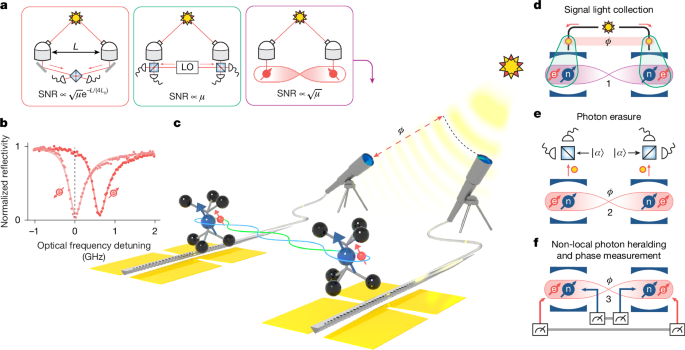
The authors demonstrate a proof-of-concept quantum-memory-assisted non-local optical interferometer using silicon–vacancy (SiV) centres in diamond as quantum-network nodes. By pre‑generating entanglement between remote nuclear spins and using electron spins for non‑destructive photon heralding plus local photon‑mode erasure, they store weak optical signal phase information in quantum memories and read out the differential phase non‑locally. The experiment combines a parallel entanglement generation scheme, photon erasure via interference with a local oscillator, and non‑local heralding to filter vacuum fluctuations and improve interferometric sensitivity in the weak‑signal regime. Key milestones include demonstration over a line‑of‑sight station separation (~6 m) and extension of the effective interferometer baseline (via fibre spools) to 1.55 km (3.1 km fibre inside the entanglement interferometer).
Key Points
- Entanglement-assisted non-local interferometry realised with SiV-based quantum nodes that provide long‑lived nuclear memories and fast electron communication qubits.
- Parallel entanglement generation (Mach–Zehnder configuration) yields ≈7.5× higher entangling efficiency than previous serial schemes; electron–electron entanglement rates reached 13 Hz at F ≥ 0.5 and 1.9 Hz at F ≈ 0.79.
- Photon mode erasure (interference with a local oscillator and photon‑number detection) preserves phase information while hiding which‑path data; combined with electron parity measurements this enables non‑destructive, non‑local photon heralding.
- Non‑local heralding filters vacuum noise and changes SNR scaling in the weak‑signal limit from ∝ μ_sig^2 to ∝ μ_sig (better scaling), improving nuclear parity visibility (example: average visibility rose from ~0.031 without heralding to ~0.090 with heralding across tested μ_sig values).
- Effective baseline extended to 1.55 km (3.1 km fibre inside the entanglement interferometer) with nucleus–nucleus Bell fidelity F = 0.63(3) and measured parity visibility ≈0.11(4), demonstrating scalability potential; remaining limitations arise from entanglement rate, mis‑heralding (~30% from imperfect Bell states) and photon loss.
Content Summary
The paper contrasts three approaches for phase sensing with weak thermal/optical signals: direct non‑local interference (optimal but suffers exponential fibre loss with distance), local LO‑based measurements (practical but vacuum noise dominates), and entanglement‑assisted non‑local sensing (the approach realised here). The experiment arms the interferometer by heralding nuclear Bell pairs between stations, collects weak signal light onto electron spins via spin–photon gates, erases photonic mode information by mixing with local coherent states and photon‑number detection, and performs parity measurements on electron spins to herald photon arrival without revealing the station. The differential phase is finally read out from the nuclear two‑qubit parity.
The authors implemented a parallel entanglement protocol in a phase‑stabilised Mach–Zehnder layout to increase entanglement rates and demonstrated both local temporal‑mode erasure/heralding and fully non‑local photon heralding using pre‑shared nuclear entanglement. They quantify improvements in nuclear parity visibility and the resulting Fisher‑information/SNR scaling, analyse sources of error (photon loss, detector dark counts, MW errors, mis‑heralding) and show how further hardware and protocol improvements (quantum repeaters, multiplexing, more qubits per node, phase gates, wavelength/strain tuning and packaging) could bring practical long‑baseline gains. The work closes with an outlook on applications such as quantum‑enhanced imaging, exoplanet detection and deep‑space optical communication.
Context and Relevance
This experiment is an important step towards using quantum networks to overcome the classical limitation of routing faint optical fields across long baselines. By encoding phase information into quantum memories and using entanglement to perform non‑local heralding, the team demonstrates a pathway to preserve interferometric sensitivity without suffering exponential fibre losses. That matters for long‑baseline optical interferometry — think higher resolution astronomy and improved weak‑signal imaging — and also for quantum‑assisted classical communications.
Technically, the paper sits at the intersection of quantum networking, cavity QED with colour centres, and quantum metrology. It converts several theoretical proposals into experimental techniques: parallel memory entanglement, photon‑mode erasure, non‑destructive heralding and nuclear parity readout. The main obstacles are still engineering‑level: raising entanglement rates (repeaters, multiplexing), reducing mis‑heralding (better Bell fidelity), and cutting transmission/loss and detector errors. If those are addressed, the approach could be transformational for weak‑signal imaging and long‑baseline interferometry.
Why should I read this?
Short version — cool trick: they used quantum memories and entanglement to let two distant receivers interfere weak optical signals as if the light had been combined centrally, but without hauling photons across exponential loss. If you follow quantum networks, telescope tech or weak‑signal imaging, this paper shows practical hardware steps that actually move the needle. It’s a proof‑of‑principle that points at real engineering upgrades needed to make quantum‑enhanced long‑baseline interferometry viable.