

Wide-swath altimetry maps bank shapes and storage changes in global rivers
Article Date: 04 March 2026
Article URL: https://www.nature.com/articles/s41586-026-10218-y
Article Image: Figure 1
Summary
The Surface Water and Ocean Topography (SWOT) satellite — using a Ka-band wide-swath interferometer — produced a near-global, first-year record (Oct 2023–Sep 2024) of river width and water-surface elevation (WSE). From ~1.65 million filtered observations the authors fitted hypsometric (width–elevation) relationships at 126,674 river reaches (covering ~73% of the widest rivers) and derived monthly river storage anomalies (RSA) and active corridor shapes.
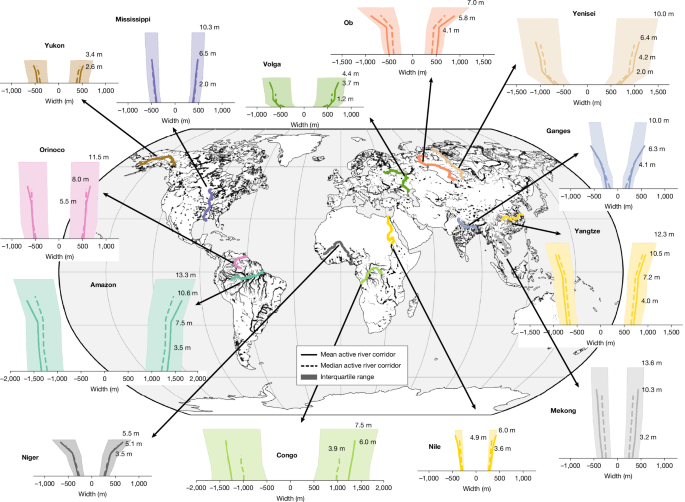
SWOT reveals a huge diversity of active channel shapes (concave to convex, steep to gentle) even for rivers with similar discharges, and maps hotspots and seasonality of storage variability. At basin scale the Amazon shows the largest annual storage range (ΔRSA ≈ 172.9 ± 16.4 km³). The near-global ΔRSA from observed reaches is 313.1 ± 129.5 km³ — substantially smaller than many previous model-based estimates. The record highlights limitations in current global models (poorly constrained run-off and flow-wave celerity) and SWOT observational caveats (one year only, reduced effective sampling after filtering, ice-affected regions, version C data issues).
Key Points
- SWOT simultaneous width and elevation measurements enable the first near-global mapping of active river corridor shapes and monthly storage anomalies (Oct 2023–Sep 2024).
- Hypsometric (width–WSE) fits were computed at 126,674 reaches; reach-averaged observations are ~10 km in length and the dataset covers ~73% of rivers wider than 30 m.
- Observed global annual river storage variability (ΔRSA) over SWOT-observed reaches ≈ 313.1 ± 129.5 km³ — lower than many prior model estimates.
- Amazon Basin produced the largest basin ΔRSA (≈ 172.9 ± 16.4 km³); the Nile showed an unexpectedly low ΔRSA (≈ 8.5 ± 1.6 km³) for 2023–24, likely influenced by drought and upstream retention.
- Key observational limits: only one science-year available, effective repeat ~28 days after filtering, Arctic/ice-season gaps, and early-version (C) product uncertainties; later reprocessing (version D) should improve results.
- Discrepancies with models point to systematic uncertainties in run-off inputs and assumed flow-wave celerities — parameters that strongly affect simulated storage.
- Data and code are openly available (Zenodo repositories and GitHub), supporting reproducibility and follow-up analyses.
Context and relevance
This work provides the first wide-swath altimetry-based observational constraint on river bank geometry and storage variability at near-global scale. Accurate river storage and geometry matter for water-resource planning, flood forecasting and understanding how climate extremes (droughts, floods) propagate through river networks. The SWOT observations give model builders empirical targets to reduce major uncertainties (run-off, celerity, channel form) and will help refine global hydrological and flood-risk assessments as more years of data accrue.
Author take
Punchy: this is a step change — for the first time we have near-global satellite observations that directly map how river widths respond to water levels and how much storage swings from month to month. The early SWOT record already exposes where models are likely getting river dynamics wrong. If you work on river modelling, water security or flood risk, this paper is highly relevant.
Why should I read this?
Short version: SWOT has given us the first proper satellite cheat-sheet on river shapes and how river storage actually moves around the planet. It’s messy (one year, early data), but the headline is clear — models are poorly constrained. Read this if you want to skip the technical slog and get what’s new straight away: empirical river geometry at scale, surprising storage numbers (lower than many models), and a roadmap for better modelling and monitoring.