

Capturing dynamic phage–pathogen coevolution by clinical surveillance
Article Date: 11 March 2026
Article URL: https://www.nature.com/articles/s41586-026-10136-z
Article Image: Figure 1
Summary
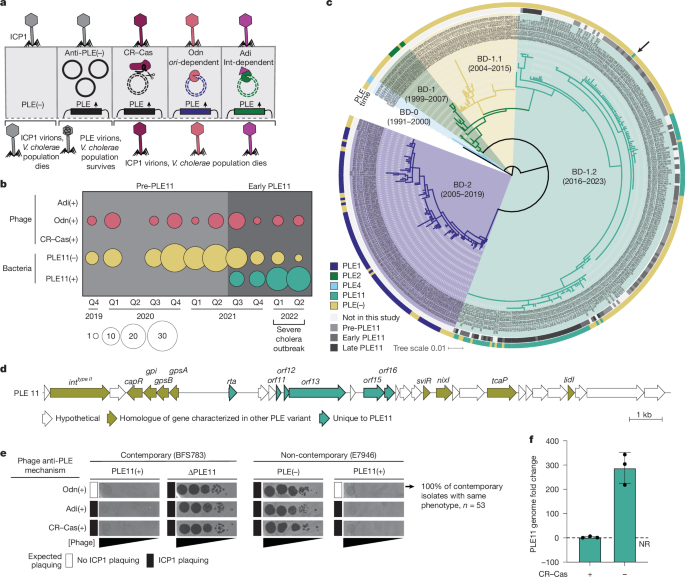
This Nature study reports high-resolution clinical surveillance in Bangladesh that captured real-time coevolution between Vibrio cholerae and its lytic phage ICP1 during a major 2022 cholera outbreak. Researchers detected the rapid spread of a new phage-satellite mobile genetic element, PLE11, which rose to dominate a BD-1.2 7PET lineage because it blocks ICP1 infection. PLE11 carries a small, novel protein, Rta, that disrupts phage tail assembly and prevents productive ICP1 propagation even when the PLE genome is being degraded by phage nucleases. Laboratory evolution showed ICP1 can escape Rta by substitutions in the phage tape measure protein (TMP); clinical surveillance later found naturally evolved ICP1 isolates carrying CRISPR–Cas anti-PLE systems plus specific TMP substitutions (notably L362P ± N355S) that restored infectivity. The work demonstrates a predictable coevolutionary sequence: bacteria pick up an effective anti-phage MGE, it sweeps through the population, and cocirculating phages adapt via combinations of nucleolytic countermeasures and structural protein changes. The study combines sequencing, genetics, electron microscopy and proteomics to reveal that PLEs build chimeric tails—incorporating satellite-encoded TMP and baseplate components—to evade tail-targeting defences and ensure satellite spread.
Key Points
- Clinical sampling (Dhaka and Mathbaria) during 2019–2023 captured the emergence and sweep of PLE11 in BD-1.2 V. cholerae coincident with a severe 2022 outbreak.
- PLE11 encodes Rta, an 80-amino-acid protein that blocks ICP1 tail assembly, producing tailless, non-infectious capsids.
- Rta protects V. cholerae even when ICP1 uses nucleolytic anti-PLE mechanisms (Odn, Adi or CRISPR–Cas) that degrade the PLE genome.
- Lab evolution selected ICP1 escape mutants with single amino-acid substitutions in the tape measure protein (TMP) that bypass Rta; surveillance later found analogous TMP substitutions in nature (L362P ± N355S).
- Natural ICP1 populations shifted from Odn(+) to CRISPR–Cas(+) phages with TMP substitutions, matching predictions from experimental evolution.
- PLEs assemble chimeric tails by incorporating satellite-encoded TMP, TAC and BhuB components; this both enables satellite transduction and helps evade tail-targeting defences.
- The work links phage predation and bacterial accessory genome changes to epidemiological dynamics, emphasising accessory genes (not just core SNPs) as drivers of strain success.
Author style
Punchy: This is crisp, mechanistic surveillance — they didn’t just sequence stuff, they caught evolution in action and showed exactly how a new anti-phage element drove strain success and how the phage fought back. If you care about pathogen evolution, phage–host arms races or why some cholera lineages surge, read the data.
Context and relevance
Why it matters: the Bay of Bengal remains a global source of pandemic cholera. This study shows that mobile elements that confer phage resistance can fuel rapid lineage replacement and shape outbreak severity. It also shows phage populations can rapidly respond through both nucleolytic systems (CRISPR–Cas/Adi) and structural protein changes, meaning phage–pathogen dynamics are predictable but fast. For epidemiologists and public-health genomics teams, the message is clear: monitor phages as well as bacterial genomes and track accessory elements (PLEs, TMP variants) to anticipate which bacterial genotypes may expand. The findings also inform phage therapy design by highlighting how quickly structural-target adaptations can arise.
Why should I read this
Short version — brilliant bit of evolutionary forensics. They caught a bacterial defence (PLE11) sweep during a major outbreak, worked out its unusual mechanism (Rta blocks phage tail assembly), predicted how the phage would adapt, and then saw those adaptations appear in patients. It’s a neat closed loop: surveillance → mechanism → prediction → validation. Fast, clean, useful.