

Intestinal interoceptive dysfunction drives age-associated cognitive decline
Article meta
Article Date = 11 March 2026
Article URL = https://www.nature.com/articles/s41586-026-10191-6
Article Image = Fig. 1
Summary
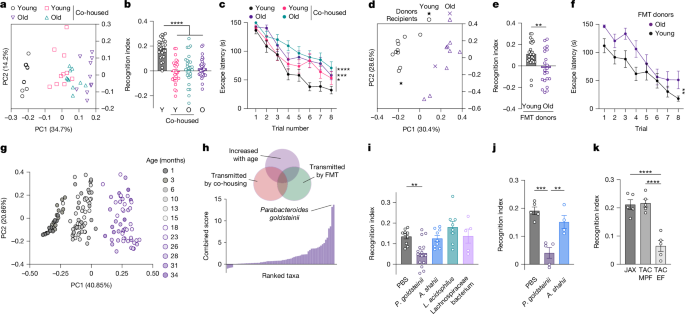
This Nature study maps a gut–brain pathway that links age-related changes in the intestinal microbiome to declining hippocampal memory. The authors used co-housing, faecal microbiota transfer and mono-colonisation in mice to show that an aged microbiome is sufficient to impair short-term and spatial memory in young animals. A standout bacterial candidate was Parabacteroides goldsteinii: its outgrowth with age (and transfer to young mice) correlated with memory loss.
Mechanistically, P. goldsteinii increases levels of medium-chain fatty acids (MCFAs) — notably 3-hydroxyoctanoic acid (3-HOA), decanoic and dodecanoic acids. These MCFAs activate GPR84 on peripheral myeloid cells, triggering local production of inflammatory cytokines (TNF and IL-1β). The inflammatory signalling impairs gut-innervating vagal sensory neurons (PHOX2B+ TRPV1+ CCKAR+ subset), reducing vagal/NTS activation and blunting hippocampal immediate-early gene responses to novelty, which in turn diminishes memory encoding.
Crucially, multiple peripheral interventions rescued memory in mice: broad-spectrum antibiotics or germ-free status, phage treatment that altered bacterial transcription and lowered MCFA levels, myeloid-cell depletion or GPR84 deficiency/inhibition, neutralising antibodies to TNF or IL-1β, vagal stimulants (low-dose capsaicin), and gut peptide agonists (CCK, GLP-1/liraglutide). These findings identify several non‑central, targetable steps to reverse interoceptive dysfunction and age-associated cognitive decline.
Key Points
- An aged gut microbiome is sufficient to transmit memory decline to young mice (co-housing or faecal transplant).
- Parabacteroides goldsteinii expands with age and impairs cognition when introduced into young or antibiotic-treated mice.
- P. goldsteinii releases small metabolites (MCFAs such as 3‑HOA) that reproduce memory deficits when given orally.
- MCFAs act via the MCFA receptor GPR84 on peripheral myeloid cells to induce TNF and IL‑1β production.
- Peripheral inflammation suppresses gut-to-brain sensory signalling: PHOX2B+ TRPV1+ vagal afferents show reduced activation, lowering NTS and hippocampal novelty responses.
- Interventions at the periphery restore memory: antibiotics, phage treatment, myeloid depletion, GPR84 inhibition (PBI‑4050), cytokine neutralisation, or vagal stimulation (capsaicin/CCK/GLP‑1).
- Vagal sensory activation can override inflammation-driven deficits, suggesting interoceptive stimulation as a therapeutic angle.
- Findings highlight a body‑to‑brain mechanism where peripheral immune–metabolic signals alter neuronal encoding without requiring overt brain inflammation.
Context and relevance
This paper connects three hot topics — ageing, the microbiome and neuroimmune signalling — and does so with extensive causal experiments. It shifts part of the focus from intrinsic brain ageing to loss of interoceptive input from the gut, showing that peripheral microbes and metabolites can actively drive cognitive decline via vagal pathways and myeloid-driven inflammation. That means there are multiple peripheral, drug‑gable entry points (phages, GPR84 antagonists, peptide agonists, cytokine blockade, vagal stimulants) that might be translated faster than treatments that must penetrate the brain.
For researchers working on cognitive ageing, neuroimmunology or gut–brain interfaces this is highly relevant: it provides mechanistic detail and reproducible manipulation points. Clinicians and translational teams should note the therapeutic implication — peripheral modulation of the gut–immune–vagal axis may protect or restore memory.
Why should I read this?
Because if you want a tidy experimental story that actually links a single bacterial signal to memory loss — and then shows multiple ways to fix it without touching the brain directly — this is it. It’s a neat, actionable roadmap from microbe to behaviour with real intervention ideas. Short version: gut changes -> small fats -> immune activation -> vagal silence -> memory drop. And the authors tested ways to turn it back on.
Author style
Punchy: a thorough, mechanistic tour de force that turns a vague gut–brain suspicion into a concrete, multi-step pathway with clear peripheral targets. If you’re in the ageing or microbiome space, this is worth reading in full — they didn’t just spot correlations, they demonstrated causality and reversibility with several therapeutics and genetic tools.