
Iran plots ‘infrastructure warfare’ against US tech giants
Summary
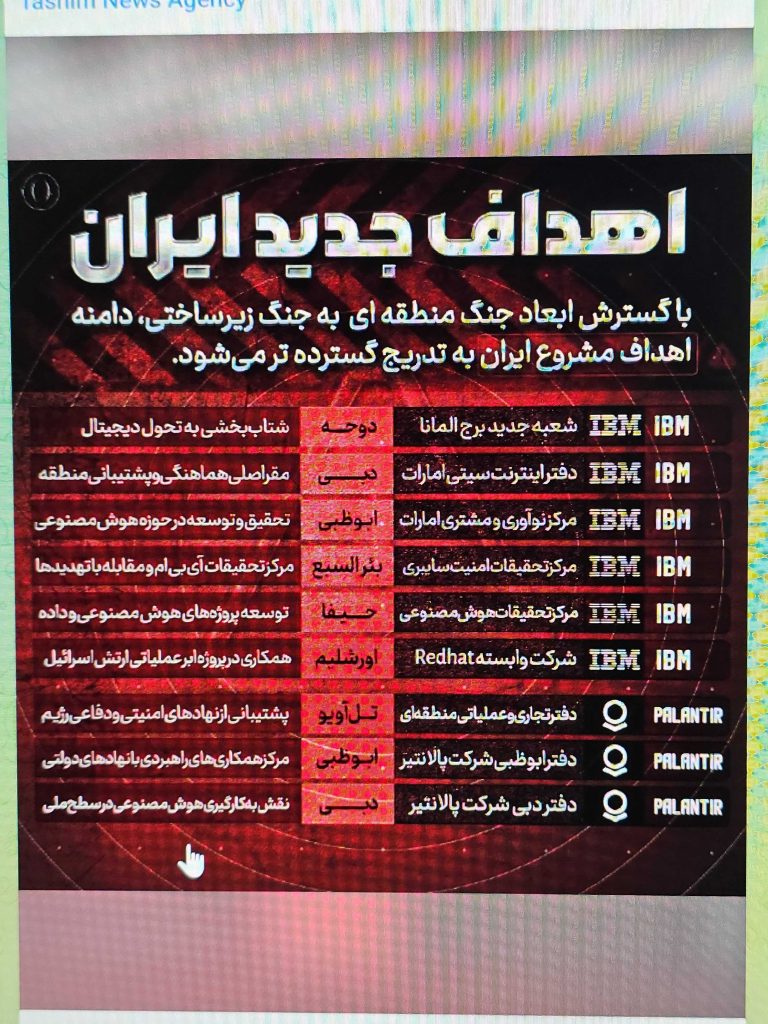
Iranian state-affiliated Tasnim news agency published a list naming nearly 30 facilities belonging to US tech firms as legitimate targets in a widening regional conflict. The list — reportedly based on IRGC intelligence — includes offices, datacentres and R&D centres for Amazon, Microsoft, IBM, Google, Nvidia, Oracle and Palantir across Bahrain, Israel, Qatar and the UAE.
This follows recent Iranian strikes on three AWS datacentres in the Middle East that disrupted multiple cloud services. Tasnim’s Telegram slides specify vendor, facility type, location and brief descriptions of activities at each site and warn civilians to keep away from banks in Israel. Iranian military sources vowed further “painful response” and framed attacks as retaliation for actions they attribute to US and allied forces.
Key Points
- Tasnim published a slide deck naming 29 locations tied to major US tech vendors as potential targets.
- Companies named include Amazon (AWS), Microsoft, IBM, Google, Nvidia, Oracle and Palantir.
- Facilities listed cover offices, datacentres and R&D centres in Bahrain, Israel, Qatar and the UAE.
- Iran has already struck three AWS datacentres in the region, which caused widespread cloud outages and failover advisories.
- The messaging frames these sites as part of the “enemy’s technology infrastructure” and signals an escalation toward targeting economic and technology assets.
- Tasnim also warned civilians to stay one kilometre from banks in Israel; Iranian military spokespeople warned of further responses.
- Regional cloud customers and providers have been urged to enact disaster recovery and failover plans.
Context and relevance
This is a significant development in how state-level conflicts intersect with commercial technology infrastructure. Targeting datacentres, regional offices and R&D hubs is a shift from purely military objectives to infrastructure warfare that directly affects global cloud availability, SaaS providers and regional customers.
Organisations that rely on single-region deployments or have critical services hosted in the Middle East should treat this as a practical risk: expect more disruption, elevated threat profiles for data centres and a renewed focus on multi-region redundancy, supply-chain resilience and physical security for cloud infrastructures.
Why should I read this?
Look — if you operate cloud services, manage critical apps, or simply rely on big-name providers for business continuity, this matters. Iran publicly naming specific offices and datacentres means outages could be political, physical or hybrid (kinetic plus cyber). Reading this gives you a quick reality check: review your DR plans, check failover zones and stop assuming regional stability. We’ve done the reading so you don’t have to dig through the slides yourself.
Author style
Punchy: This is more than rhetoric — it’s a shot across the bows of the global cloud industry. If you care about uptime, data sovereignty or geopolitical risk to your stack, drill into the detail and act now.