

Synthetic circuits for cell ratio control
Article Date: 18 March 2026
Article URL: https://www.nature.com/articles/s41586-026-10259-3
Article Image: Figure 1
Summary
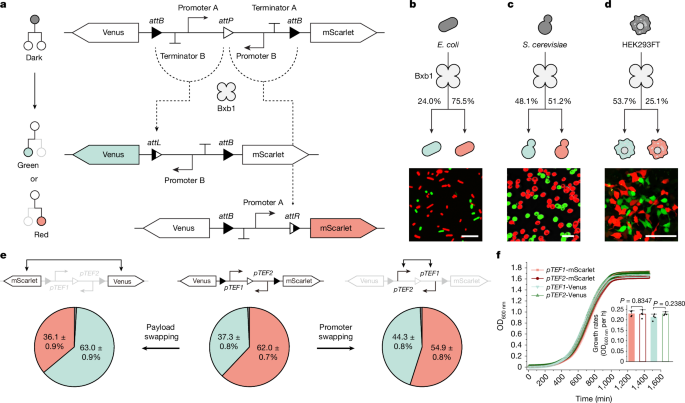
This paper presents a modular recombinase-based platform that programs a single founder cell to diversify into multiple, predefined cell types at precise ratios. The core device is a three-site branching cassette (attB–attP–attB) actuated by serine recombinases (principally Bxb1). By tuning elements between att sites—promoter identity, intervening DNA length, mutated att variants and degron tags—the authors control excision bias and therefore progeny fractions across bacteria, yeast and mammalian cells. A white-box ordinary-differential-equation model (R² ≈ 0.887) predicts outcomes and guides design.
The system supports parallel (orthogonal dinucleotide variants → 2^n combinatorial outcomes) and series (cascaded recombinases → hierarchical differentiation) topologies. Combining devices enables multiplicative and exponential computations that produce very rare subpopulations (demonstrated down to ~0.1%; projected to 10⁻⁶ with multiple orthogonal units). Practical demonstrations include a genetic colour palette (violacein vs β-carotene), tuned cellulase-secreting consortia, and programmed morphogenesis using surface-displayed adhesion pairs and synNotch signalling in CHO cells. Leakiness is mitigated with degradation tags (UbiY, DHFR) and circuit single-copy integration; many circuits remain stable over multi-day passaging.
Key Points
- Recombinase-based branching devices (attB–attP–attB) convert one founder into two distinct progeny states via irreversible excision; implemented in E. coli, S. cerevisiae and mammalian cells.
- Tuning promoters, intervening DNA length and engineered att variants allows quantitative control of binary progeny ratios from ~0.1% to 99.9%.
- A predictive mathematical model captures recombinase dynamics and steric effects, enabling accurate design (R² ≈ 0.887 between predicted and observed ratios).
- Parallel orthogonal devices multiply probabilities (2^n outcomes), allowing combinatorial generation of multiple cell types from a single genotype.
- Exponential architectures (repressor-based branching in parallel) produce extremely rare subpopulations reproducibly (demonstrated 8→1% → 1% → 0.1% with added layers).
- Series (cascaded) circuits permit sequential differentiation in response to distinct inputs, emulating hierarchical development and enabling multi-step programmes.
- Applications shown: programmable pigment mixtures, optimised cellulase consortia that match co-expression performance without growth penalty, and self-organising multicellular structures via synthetic adhesion and synNotch signalling.
- Leakage and stability addressed by protein destabilisation tags, single-copy genomic integration and orthogonal att/dinucleotide designs to prevent cross-talk.
Context and relevance
This work sits at the intersection of synthetic biology, developmental engineering and metabolic consortia design. It shifts the paradigm from manually mixing strains to in situ diversification: one engineered founder can autonomously produce a tailored consortium or patterned tissue-like assembly. That matters for scalable biomanufacturing (division of labour reduces stress), engineered living materials, and building organoids or spatially organised cell therapies where precise cell-type ratios and spatial arrangements are crucial.
Why should I read this
Short and blunt: if you care about building multicellular systems without the faff of juggling many strains, this paper hands you a practical toolkit and a model to predict what you’ll get. It shows how to make rare starter populations reliably, tune proportions, program sequences of differentiation, and even make cells self-assemble into patterns — all from a single founder. Saves you weeks of trial-and-error.
Author style
Punchy: the authors demonstrate a general, modular platform with clear design rules and cross-species portability. The combination of wet-lab validation, predictive modelling and real-world demos (pigments, enzymatic consortia, morphogenesis) makes this paper more than a methods note — it’s a blueprint for programmable multicellularity.