
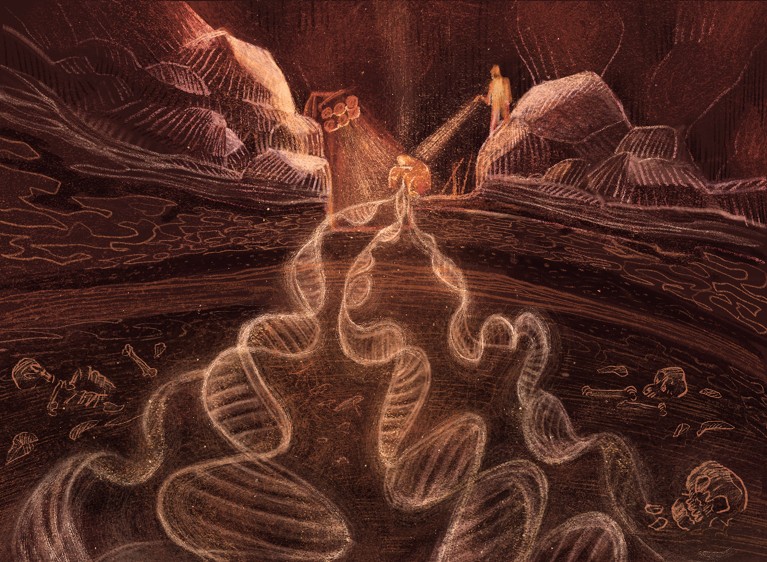
How DNA in dirt is shaking up the study of human origins
Article Date: 24 March 2026
Article URL: https://www.nature.com/articles/d41586-026-00879-0
Article Image: https://media.nature.com/w767/magazine-assets/d41586-026-00879-0/d41586-026-00879-0_52198480.jpg
Author: Dyani Lewis
Summary
Researchers are recovering ancient DNA from sediments (sedaDNA) — literally genetic traces preserved in soils and permafrost — and using it to fill gaps in the human fossil record. What began as an unconventional idea from Eske Willerslev has become a powerful tool: plant, animal and human DNA has been retrieved from layers of cave and permafrost sediment stretching back hundreds of thousands to millions of years. Sedimentary DNA is revealing who lived where and when (including Neanderthals, Denisovans and early modern humans), linking tool types to hominin groups, and even pushing back occupation dates at key sites. Advances in capture probes and computational methods now allow recovery of mitochondrial and, in some cases, nuclear DNA from dirt — though the signal is sparse and methodological caution remains essential.
Key Points
- Eske Willerslev pioneered recovery of ancient DNA from sediments; sedaDNA dates back hundreds of thousands to up to two million years in permafrost samples.
- Human DNA was first convincingly recovered from sediments in 2017, triggering widespread interest in using soil DNA to study human prehistory.
- Mitochondrial DNA (mtDNA) is easier to recover and useful for lineage detection; nuclear DNA is more informative but much harder to obtain from sediments.
- Capture probes targeted to human sequences greatly increase yield of informative nuclear sites compared with shotgun sequencing.
- SedaDNA has extended or confirmed occupations at sites such as Denisova Cave, Trou Al’Wesse, Baishiya Karst Cave and Galería de las Estatuas, sometimes revealing inhabitants where no bones exist.
- Analytical challenges include the rarity of human DNA in soil, contamination risks, sparse nuclear data and the need for specialised computational approaches.
- Researchers caution against overinterpretation; rigorous controls and cross-validation with archaeology and other biomolecular evidence remain vital.
Content summary
Willerslev’s insight — that DNA can persist in the environment even when bones are absent — led to the recovery of plant and animal DNA from ancient permafrost and cave sediments. Over the past decade this field has moved from palaeoecology into palaeoanthropology. Sedimentary DNA has detected traces of Neanderthals, Denisovans and early modern humans in layers lacking physical fossils, enabling researchers to extend occupation timelines and associate different stone-tool industries with particular hominin groups.
Methodologically, teams initially targeted mtDNA because of its abundance. Newer approaches employ capture probes that fish out human nuclear sequences scattered across the genome; these can provide richer population-history signals but yield sparse data and demand heavy computational lifting. A direct comparison has shown capture methods can outperform shotgun sequencing by a large margin for recovering informative human genomic positions. Case studies include confirming Denisovans at the Tibetan Baishiya cave and identifying Neanderthal population shifts in Spanish cave sediments.
Despite exciting results, scientists stress caution: human DNA is extremely scarce in many samples, background microbial and animal DNA dominate, and sediments have complex depositional histories. The field is advancing fast, but claims require careful validation with controls, stratigraphic context and, where possible, corroboration from fossils or proteins.
Context and relevance
This work changes the rules for where genetic data can come from: dirt can supplement or sometimes replace the need for rare fossils. For archaeologists and geneticists it opens a vast new archive — a “blue ocean” of environmental layers that archive whole ecosystems as well as hominin presence. That means new possibilities for mapping migrations, interactions (for example, between Neanderthals, Denisovans and modern humans), and for linking artefacts or cave art to the people who made them. At the same time, the technical limits and contamination risks mean sedaDNA is best treated as strong complementary evidence rather than definitive proof on its own. The technique is particularly relevant to anyone following human evolution, palaeoecology, and advances in ancient biomolecules and computational genomics.
Author style
Punchy: This is a big deal. Sedimentary DNA is rapidly becoming one of the most transformative tools in human palaeogenetics — it widens the field beyond fossils and gives us new ways to test who lived where and when. Read the full article if you care about the changing contours of human evolutionary research; the methodological detail matters for judging how far we can trust the new claims.
Why should I read this?
If you like dramatic storylines — lost chapters of human history turning up in the mud — this is your jam. The piece explains how scientists are squeezing meaningful human genetic signals from soil, why that’s rewriting timelines at famous sites, and what the big caveats are. Short version: it’s clever, it’s disruptive, and yes, you should know how far the evidence really goes (we skimmed the technical bits so you don’t have to).