
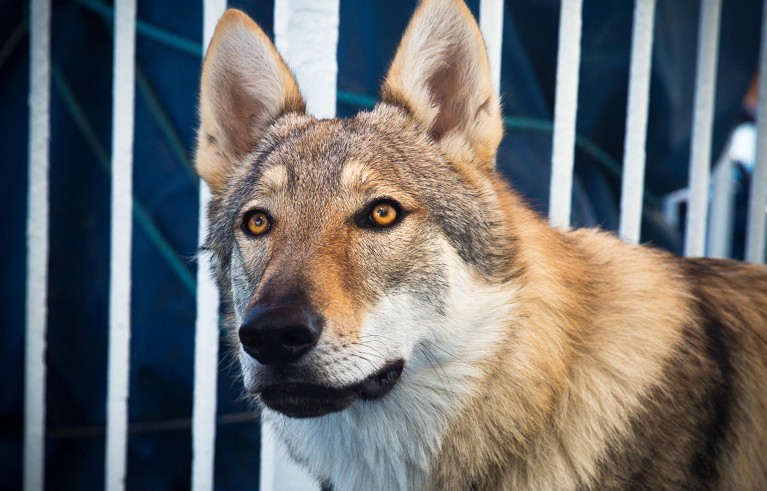
Who let the wolves in? Genetic record for domestic dogs pushed back by 5,000 years
Summary
Two new Nature papers report the oldest dog genomes yet recovered — from remains dated about 14,000–16,000 years ago in the UK, Switzerland and Turkey — extending the genetic record for dogs back by more than 5,000 years. The genomes point to an early domestic dog population that spanned western Eurasia and lived alongside diverse Ice Age hunter-gatherer groups. Although the studies don’t pin down a single origin, they narrow the search for when and how wolves became dogs and show that early humans moved and exchanged dogs across large distances.
Key Points
- Ancient genomes from Gough’s Cave (UK), Kesslerloch (Switzerland) and Pınarbaşı (Turkey) are 14,000–16,000 years old — the oldest dog DNA on record.
- The genomes are similar across sites, indicating a widespread early domestic dog population across western Eurasia during the Palaeolithic.
- Archaeological evidence shows dogs were treated much like humans (intentional burial, skull modification) and shared diets with their owners.
- Researchers used targeted ancient-DNA capture techniques to distinguish dog from wolf DNA among contaminated samples.
- The studies don’t settle the precise time/place of initial domestication but narrow possibilities and show dogs travelled with humans.
- Genetic signatures from this early population persist in modern dogs, tying present breeds to deep Ice Age roots.
Content summary
Teams led by researchers at Ludwig Maximilian University, the Natural History Museum (London) and the Francis Crick Institute screened numerous suspected canid remains and sequenced genomes from well-dated archaeological contexts. Key specimens include a 15,800-year-old puppy from Pınarbaşı (Turkey) and a 14,300-year-old individual from Gough’s Cave (England), plus a 14,200-year-old sample from Kesslerloch (Switzerland). Genomic analyses show these animals were clearly domestic dogs (Canis lupus familiaris) rather than wolves and that their genomes were remarkably similar across sites separated by thousands of kilometres.
The papers use improvements in ancient-DNA capture to extract canid genomes from heavily contaminated bones and provide isotopic and burial-context evidence that these animals lived closely with and were treated similarly to humans. While the findings push back the genetic record and sharpen the domestication debate, they stop short of identifying a single origin event — instead revealing a widespread, adaptable early dog population associated with ice-age hunter-gatherers.
Context and relevance
These results shift the timeline for dog domestication considerably and feed directly into debates about where and how domestication occurred. By demonstrating a broad, early domestic dog population across western Eurasia, the studies suggest domestication processes were underway well before the Holocene and that human mobility and cultural exchange played big roles in spreading dogs. The findings matter to archaeologists, evolutionary geneticists and anyone interested in human–animal co-evolution because they provide fresh genetic evidence to refine models of domestication and migration in the Palaeolithic.
Why should I read this?
Quick version: this paper smashes back the clock on dog DNA by thousands of years and proves early dogs were already roaming with people across Europe and western Asia. If you like history, genetics or just want the punchline without reading every technical detail — this gives you the new timeline and why it rewrites bits of the domestication story.
Author’s take
Punchy and worth your time: the work is a big step forward for the domestication debate. It doesn’t answer everything, but it changes the map and forces researchers to rethink when and how people and dogs first became partners.