
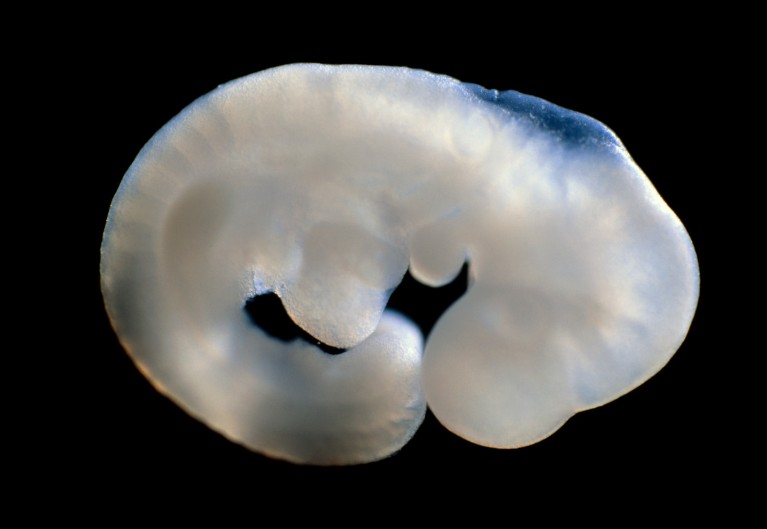
Female mice grow testes after this single DNA tweak
Summary
Researchers report that a single-letter change in a non-coding DNA region called Enh13 can cause genetically female (XX) mouse embryos to develop male reproductive organs, including testes. The effect requires modifications to both copies of Enh13; mice with only one altered copy remain phenotypically female. The work shows that Enh13 can act as both an enhancer and a silencer of the key sex-determining gene Sox9, and that small changes in non-coding DNA can flip the developmental outcome from ovary to testis. The study was published in Nature Communications (Abberbock et al., 2026).
Key Points
- A single-nucleotide change in the non-coding Enh13 region causes XX mice to develop male genitals and small testes when both copies are altered.
- Enh13 regulates Sox9 — a gene central to testis development — and appears to function as both an enhancer and a silencer depending on context.
- Previously, deleting Enh13 in XY mice was shown to produce female organs; this new work demonstrates the reverse effect in XX mice, revealing a two-way regulatory ‘tug of war’.
- The phenotype is dosage-dependent: heterozygous (one altered copy) XX mice remain female, indicating a threshold effect in regulatory control.
- Findings highlight the importance of non-coding DNA in sex determination and suggest that small variants in regions like Enh13 could explain some human disorders of sex development that currently lack a genetic diagnosis.
Author style
Punchy: this is a crisp, mechanistic advance. It nails down a concrete molecular switch in sex determination and points directly to where researchers — and clinicians — should look next in unexplained cases.
Why should I read this?
Quick and dirty: one tiny DNA tweak flips sex development in mice. If you care about how genes actually decide whether an embryo makes ovaries or testes, or why so many human cases of atypical sex development go unexplained, this is the paper to skim (or read properly if you like neat genetic sleuthing).
Context and relevance
This study adds to growing evidence that non-coding parts of the genome — long ignored in many diagnostic screens — can have outsized effects on development. Sox9 is a master regulator of testis formation; showing that Enh13 can both promote and repress Sox9 clarifies a fundamental switch in mammalian sex determination. For clinicians and geneticists, the work suggests that small variants in non-coding regulatory elements should be examined when protein-coding sequencing turns up nothing in disorders of sex development. The findings are in mice, so direct human translation requires caution, but the Enh13 region is known to be important in humans too, making it a strong candidate for further study and for improving molecular diagnosis rates.