
Electro-generated excitons for tunable lanthanide electroluminescence
Summary
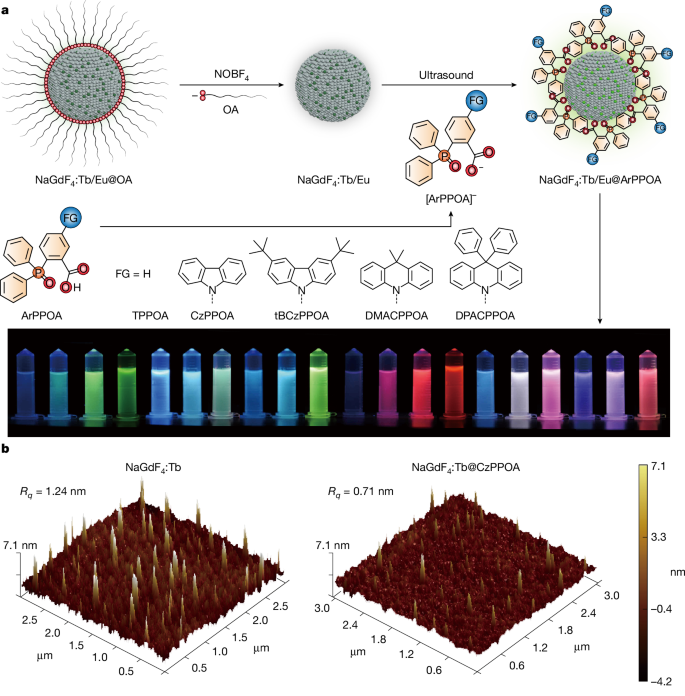
This Nature paper reports a ligand-engineered nanohybrid strategy that activates efficient electroluminescence (EL) from insulating lanthanide fluoride nanocrystals (NaGdF4:X) by decoupling charge transport from photon emission. The team functionalised 4 nm NaGdF4 nanocrystals with aryl phosphine-oxide ligands carrying electron-donating groups (for example CzPPOA). Those ligands act both as charge-transport media and exciton harvesters, enabling fast interfacial energy transfer into 4f states and electrically driven narrow-line lanthanide emission without dedicated carrier-injection layers.
Key outcomes include near-unity triplet-to-ion transfer efficiencies, film PLQYs up to ~25% (film) and ~44% (solution) for optimised hybrids, and LED devices showing state-of-the-art performance for insulating emitters: EQE up to 5.9%, current efficiency 9.99 cd A−1, power efficiency 7.66 lm W−1 and a turn-on voltage ≈4.1 V. Colour tuning from green to orange–red and into the near-infrared (1,064 nm with Nd3+) is achieved simply by altering dopant composition, all within a fixed device architecture. Limitations remain — brightness constrained by intrinsically long lanthanide radiative lifetimes and limited carrier mobility in the insulating core — but the ligand approach simplifies device design while delivering high spectral purity and robust EL.
Key Points
- Molecular ligands (ArPPOA family) both passivate nanocrystal surfaces and provide an electronic interface that harvests excitons and aids carrier transfer to 4f states.
- Ligand coordination accelerates intersystem crossing (ISC) to sub-nanosecond timescales and yields very high triplet-to-lanthanide energy-transfer efficiencies (≈95–97% for top performers).
- Optimised NaGd0.6F4:Tb0.4@CzPPOA films achieved film PLQY ≈25.6% and solution PLQY ≈44.3%.
- LED devices with ligand-functionalised nanohybrids delivered EQE up to 5.9%, current efficiency 9.99 cd A−1, power efficiency 7.66 lm W−1 and a turn-on voltage of ~4.1 V — the first efficient EL demonstration from insulating emitters.
- Exciton allocation studies (sliced TREES) show rapid host-to-ligand transfer and confinement of excitons on the nanohybrid, unlike ligand-free or oleate-capped nanocrystals.
- Colour tuning achieved by varying Tb3+/Eu3+/Nd3+ dopant ratios — continuous visible colour tuning and NIR emission (1,064 nm) without changing device structure.
- Devices show improved operational stability and longer EL lifetimes versus comparable perovskite and organic emitters under the same fabrication/testing conditions.
- Remaining challenges: limited brightness due to long f–f radiative lifetimes and insulating nanocrystal cores that restrict charge mobility; further work needed on ligand chemistry and transport engineering.
Content summary
The authors synthesised 4 nm NaGdF4 nanocrystals doped with Tb3+, Eu3+ or Nd3+ and performed a two-step ligand exchange to attach ArPPOA ligands (variants include CzPPOA, tBCzPPOA, DMACPPOA, DPACPPOA and TPPOA). Donor-substituted ligands lowered S1 and T1 energy levels and reduced singlet–triplet splitting, improving energy matching with lanthanide emitting levels and boosting sensitisation.
Spectroscopy (steady-state PL, transient absorption, femtosecond upconversion) shows coordination-induced ISC enhancement (conversion efficiency ≈98.6%), rapid triplet formation and efficient ligand-to-ion triplet energy transfer. The best ligand (CzPPOA) produced near-unity triplet transfer and the highest PLQY among variants. Cyclic voltammetry indicates the electrochemical behaviour of nanohybrids is dominated by the ligands; donor-functionalised ligands provide ambipolar characteristics, alleviating the insulating nature of the fluoride cores.
Devices were fabricated using an mCP host blended with the nanohybrid as the emissive layer in a four-layer architecture. EL spectra show pure narrow 4f peaks (Tb3+, Eu3+) with high colour purity. TREES slices confirmed exciton confinement on the ligand–nanocrystal hybrid during carrier recombination, explaining the efficient EL despite an insulating core. By adjusting doping ratios the team demonstrates continuous visible colour tuning and white/warm-white EL, and direct Nd3+ doping produced NIR emission at 1,064 nm. The work outlines both the practical performance and the physical mechanisms (exciton allocation, interfacial transfer dynamics) underpinning the results.
Context and relevance
High spectral precision, tunability and operational stability are increasingly demanded in next-generation displays, sensors, photonic quantum devices and neuromorphic photonics. Lanthanide 4f transitions provide ultranarrow lines and thermal/photochemical robustness, but their insulating hosts have prevented practical EL. This paper demonstrates a viable route to harness lanthanide emission in electrically driven devices via ligand engineering — a potentially transformative advance for high-colour-purity displays, integrated multiband light sources and niche sensing/quantum applications where narrow linewidths and stability matter.
For researchers, the study provides a clear ligand-design framework (energy-level matching, ISC control, ambipolar electroactivity) and experimental evidence (transient and TREES data) showing how to allocate excitons to lanthanide centres. For device engineers, it shows a pragmatic path to multicolour and NIR EL using a single, fixed architecture, reducing complexity compared with multi-layer, wavelength-specific emitters.
Why should I read this?
Short answer: because it’s clever and useful. If you care about brighter, sharper-colour LEDs or compact multiband light sources, these guys cracked a neat trick — use the right organic ligands to make insulating lanthanide nanocrystals behave like practical EL emitters. Saves you time if you’re scanning for new emitter strategies or thinking about next-gen displays and NIR sources.
Source
Source: https://www.nature.com/articles/s41586-025-09717-1
Article Date: 19 November 2025
Article Image: https://media.springernature.com/lw685/springer-static/image/art%3A10.1038%2Fs41586-025-09717-1/MediaObjects/41586_2025_9717_Fig1_HTML.png