
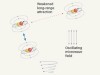
Thirty years of Bose–Einstein condensation
Article metadata
Article Date: 25 November 2025
Article URL: https://www.nature.com/articles/d41586-025-03592-6
Authors: Zoran Hadzibabic and Ulrich Schneider (Cavendish Laboratory, University of Cambridge)
Image: https://media.nature.com/lw100/magazine-assets/d41586-025-03592-6/d41586-025-03592-6_51741056.jpg
Summary
This News & Views piece marks the 30th anniversary of the first definitive experimental observations of Bose–Einstein condensates (BECs) in 1995, reported independently by Anderson et al. (Science) and Davis et al. (Physical Review Letters). The authors briefly recount how those landmark experiments fulfilled a decades-old prediction by Bose and Einstein and transformed atomic physics by creating a macroscopic quantum state in which many atoms share a single quantum wavefunction.
The article situates the 1995 discoveries within a longer history of low-temperature physics and highlights the rapid developments since: the rise of ultracold-atom experiments, explorations of superfluidity and vortices, studies of ultracold molecules, and applications in quantum simulation and precision measurement. It also provides key references tracing theoretical and experimental milestones that led to and followed the original observations.
Key Points
- 1995: Two independent experiments provided the first conclusive observation of Bose–Einstein condensation in dilute atomic gases (Anderson et al.; Davis et al.).
- A Bose–Einstein condensate is a many-body quantum state where atoms behave collectively as a single quantum object with shared coherence and macroscopic occupation of the ground state.
- The realisation of BECs realised long-standing predictions by Bose and Einstein and connected decades of low-temperature research, from superfluid helium to modern ultracold-atom platforms.
- BEC research spawned rapid progress in quantum simulation, studies of superfluidity and vortices, ultracold molecules, and precision measurements relevant to quantum technologies.
- The article summarises historical milestones and points readers to the original 1995 papers and key subsequent work for deeper reading.
Context and relevance
This short commentary places the 1995 experiments in a broader scientific timeline and emphasises their ongoing impact. For readers following quantum-technology trends, the BEC breakthrough is a foundational advance: it ushered in experimental platforms now used to explore quantum matter, develop neutral-atom quantum-computation architectures, and probe connections to cosmology and many-body physics. The piece is useful as a concise historical snapshot and a pointer to essential literature.
Why should I read this?
Because it’s a neat, readable reminder of where a lot of modern quantum science started. If you care about quantum tech, ultracold experiments, or simply enjoy seeing how decades of theory became real experiments, this saves you time by pulling the key moments together in one short read.
Author style
Punchy and authoritative—the authors are practising experimentalists who emphasise why the 1995 results mattered then and still matter now. If you work in quantum science, this is a tidy, high-value refresher that lights the path to the original papers.