
Ethylene modulates cell wall mechanics for root responses to compaction
Article Date: 26 November 2025
Article URL: https://www.nature.com/articles/s41586-025-09765-7
Article Image: Figure 1
Summary
This Nature paper shows how trapped ethylene in compacted soil triggers a transcriptional programme that changes cell-wall properties in rice roots to aid penetration. The volatile hormone ethylene accumulates when gas diffusion is restricted by compaction; this induces the auxin response factor OsARF1 in the root cortex. OsARF1 directly binds and represses primary-wall cellulose synthase (CESA) promoters (including OsCESA6), reducing cellulose biosynthesis in cortical cells. The result is thinner, softer cortical walls and radial expansion of cortex cells, which increases root diameter and helps roots push through dense soil. At the same time the epidermal layer becomes thicker and remains relatively stiff, providing perimeter support so the swollen root can penetrate without buckling.
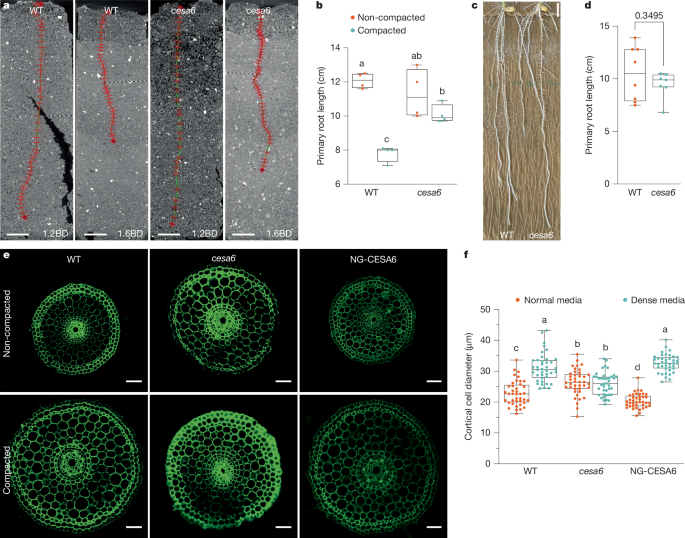
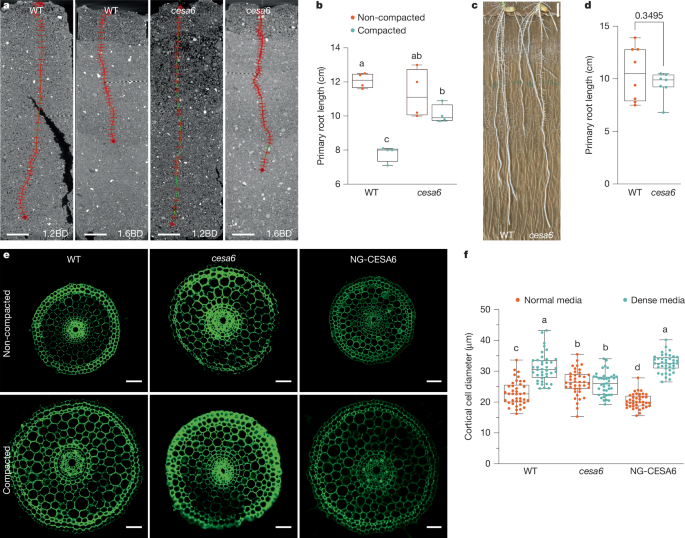
The authors combine pharmacology (low-dose indaziflam), CRISPR mutants (cesa6, arf1), overexpression lines, X-ray CT imaging, TEM and AFM stiffness measurements, yeast one-hybrid, EMSA and ChIP to link ethylene → OsARF1 → reduced CESA expression → altered wall thickness/stiffness → cortex radial expansion and improved penetration. Key evidence: low indaziflam or cesa6 mutants improve root penetration in dense media/soil; OsARF1 binds and represses several CESA promoters; arf1 mutants fail to swell their cortical cells in compacted conditions, while OE-ARF1 phenocopies cesa6; TEM/AFM show thinner, softer cortex and consistently thicker epidermis in compacted conditions. Genetic and chemical epistasis (arf1cesa6 double mutants; cellulose inhibitors) support the pathway. The authors place OsARF1 downstream of ethylene signalling (EIN2) and propose a thicker-epidermis / thinner-cortex mechanical model that improves root stability and penetration in compacted soils.
Key Points
- Soil compaction traps ethylene around roots; ethylene is the primary signal inducing OsARF1 in the cortex.
- OsARF1 directly binds promoters of several primary-wall CESA genes and functions as a transcriptional repressor.
- Reduced cellulose (pharmacologically or via cesa6 mutation) leads to thinner, softer cortical walls and radial cell expansion that aids penetration of compacted media and soil.
- OE-ARF1 causes constitutive cortical swelling; arf1 loss-of-function mutants fail to swell under compaction, showing OsARF1 is necessary and sufficient for the cortical response.
- TEM and AFM show a clear cortex-versus-epidermis mechanical difference: cortex thins and softens, epidermis thickens and stays relatively stiff under compaction.
- OsARF1 induction requires ethylene signalling via EIN2 (OsEIN2), linking compaction-induced ethylene accumulation to cellulose regulation.
- The proposed thicker-epidermis / thinner-cortex model increases root diameter while maintaining perimeter stiffness to reduce buckling and improve soil penetration.
- Findings suggest a route to breed or engineer crops with improved tolerance to compacted soils by targeting cell-wall and hormone-response pathways.
Why should I read this?
Quick and useful: if you care about how roots cope with compacted soils (farmers, breeders, plant biologists) this paper explains a neat, experimentally solid mechanism — ethylene causes cortical cell walls to become less cellulose-rich so the cortex balloons out while the outer skin stiffens. That combination helps roots push through dense soil. It’s practical intel if you’re thinking about crop traits, soil-management or fundamental root mechanics — saves you reading pages of methods because the main causal chain is clean and well supported.
Author style
Punchy — this is a high-impact, mechanistic study with direct implications. The work goes beyond correlation: it links a well-known environmental cue (compaction-driven ethylene) to a specific transcriptional regulator (OsARF1), to targeted repression of cellulose synthases and measurable mechanical changes in cell walls. For anyone working on root traits, soil resilience or cell-wall biology, the details are worth digging into because they suggest concrete molecular targets and a clear mechanical model that could be exploited in breeding or biotechnological approaches.