
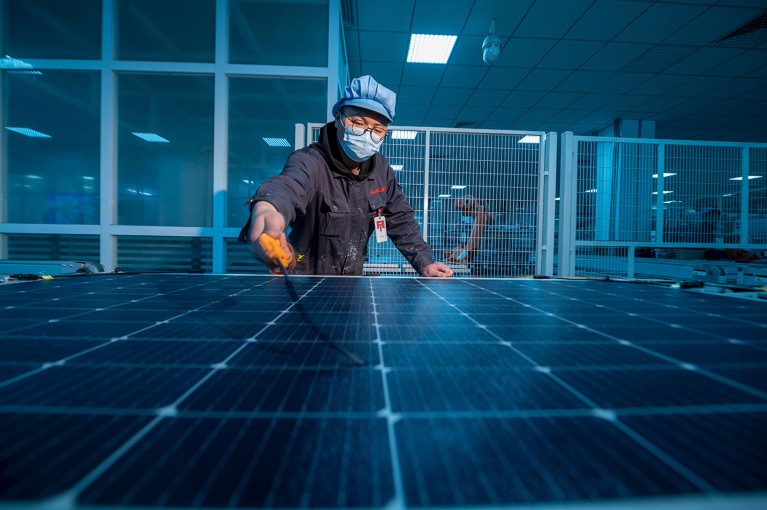
China accounts for more than half of leading output in the applied sciences
Article Date: 03 December 2025
Article URL: https://www.nature.com/articles/d41586-025-03715-z
Article Image:
Summary
The new Nature Index table for applied sciences shows a stark East–West divide: researchers based in China produced 56% of the applied-sciences output counted for the ranking in 2024 (Nature Index metric: Share = 22,261). The United States is a distant second with a 10% share (Share = 4,099). The top ten institutions in applied sciences are all in China. Other Asian economies — notably South Korea, Singapore and Malaysia — punch above their size in applied fields such as engineering, computer science and food science. The pattern reflects deliberate national strategies: many Asian governments prioritise near-term, industry-relevant research, while Western countries continue to emphasise fundamental science.
Key Points
- China accounts for 56% of Nature Index applied-sciences output in 2024 (Share = 22,261); the US accounts for 10% (Share = 4,099).
- The top ten research institutions in the applied-sciences ranking are all Chinese.
- Several Asian countries show a high proportion of their Nature Index output in applied sciences (Malaysia ~90%; China ~52%; South Korea ~53%; Singapore ~49%).
- Western countries have much smaller applied-sciences proportions (Germany 27%; UK 23%; France and US just under 18%).
- Experts attribute the split to differing national strategies: China and South Korea focus public funding on engineering and industry-relevant research, whereas the US favours fundamental research.
- China’s strategy has yielded industrial leadership in areas such as electric vehicles and a very large number of generative-AI patents (2014–2023 >38,000 filings by Chinese inventors).
- There is an ongoing debate: targeted applied funding can deliver fast industrial gains, while basic science provides a long-term reservoir for future innovation.
- The Nature Index applied-sciences table is based on articles in 25 journals and conferences that researchers named as venues for their most significant work, plus applied pieces in multidisciplinary journals.
Why should I read this?
Because if you care who’s actually producing industry-ready research — not just pure theory — this is the headline. China isn’t just racking up papers: it’s shaping tech and manufacturing priorities that will matter to companies, funders and policy-makers. We skimmed the numbers and the debate so you don’t have to — quick, sharp and useful.
Context and Relevance
Why this matters: the Nature Index applied-sciences ranking maps where research is deliberately aimed at near-term application and industrial advantage. That has implications for global competitiveness, supply chains, tech leadership (AI, EVs, manufacturing) and where companies should look for collaborators or talent. For research funders and universities, the findings are a wake-up call about the impact of strategic investment choices: prioritising applied work can deliver rapid industrial benefits, but neglecting basic science may limit longer-term breakthroughs. Policymakers in the West may see this as a prompt to rethink research portfolios if they want to sustain tech leadership.
Author style: Punchy — the piece is written to underline the strategic importance of the data for industry and policy.