
Sterile-neutrino search based on 259 days of KATRIN data
Summary
The KATRIN Collaboration analysed 259 days of tritium β-decay data (36 million electrons near the endpoint) from five measurement campaigns (KNM1–KNM5) to search for a light fourth (sterile) neutrino. No statistically significant sterile-neutrino signal was found. KATRIN sets new 95% confidence-level exclusion limits that rule out large parts of the parameter space favoured by the reactor antineutrino anomaly (RAA), the gallium anomaly (GA) and the Neutrino-4 claim, particularly at eV-scale masses. The experiment benefits from sub-eV neutrino-mass sensitivity, careful control of systematics, and complementary reach to short-baseline oscillation searches. Ongoing data-taking through 2025 and the planned TRISTAN upgrade will considerably extend sensitivity to both eV- and keV-scale sterile states.
Key Points
- KATRIN used 259 days of data (KNM1–KNM5), totalling ~36 million electrons in the analysis window, to search for a sterile neutrino in a 3+1 framework.
- No significant sterile-neutrino signal was observed; KATRIN produces a new 95% CL exclusion contour in the (Δm412, sin2(2θee)) plane.
- The KATRIN limits exclude much of the parameter space preferred by the reactor antineutrino anomaly and challenge the gallium-anomaly region (BEST/GALLEX/SAGE best-fit excluded at ~96.6% CL).
- The Neutrino-4 best-fit region (m4 ≈ 2.7 eV) is fully excluded by KATRIN at 99.99% CL.
- Analysis combined two independent fitting frameworks (KaFit and Netrium) with a robust blinding strategy and detailed systematic treatment; statistics dominate the uncertainty.
- KATRIN covers larger Δm412 values than many reactor experiments, so its constraints are complementary to reactor short-baseline searches (PROSPECT, STEREO, DANSS).
- Planned continued running through 2025 will raise statistics to >220 million electrons; the TRISTAN detector (post-2026) will enable differential, high-statistics searches up to keV-scale sterile neutrinos (possible dark-matter candidates).
- Data and inputs are openly available on Zenodo for independent checks and reanalysis.
Content summary
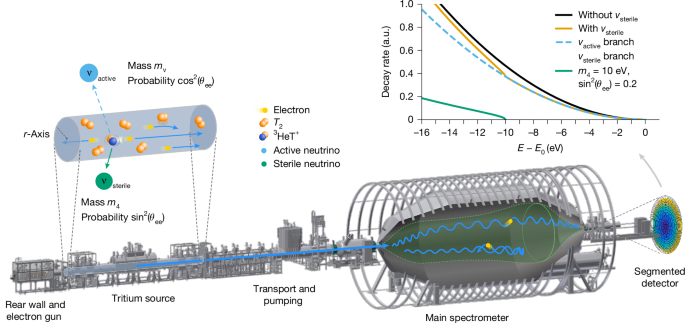
KATRIN measures the integral electron energy spectrum from molecular tritium β-decay near the 18.57 keV endpoint. A fourth neutrino mass eigenstate (m4) with non-zero mixing to the electron flavour creates a characteristic kink and global distortion in the spectrum. The collaboration performed a 50×50 logarithmic grid search in m4^2 (0.1–1,600 eV^2) and sin2(θee) (10^-3–0.5), minimising χ2 at each point while accounting for systematic uncertainties via pull terms.
The dataset comprises five campaigns with varying source conditions and background-reduction configurations (including a shifted analysing plane and ozone cleaning of the rear wall). The combined analysis used 1,609 merged data points and two independent model/fit pipelines (a numerical KaFit approach and a neural-network-accelerated Netrium) that cross-validated results. A rigorous blinding and unblinding procedure identified and corrected a data-combination issue in KNM4 before the final result.
The resulting 95% CL exclusion contour tightens limits across much of the eV-scale parameter space. KATRIN is particularly powerful at larger Δm412 values (several eV^2 and above), where reactor experiments have reduced sensitivity. Systematics (source density, energy-loss function, scan-time-dependent backgrounds, final-state distributions) were studied in detail and found to be subdominant to statistics for this dataset.
Context and relevance
This work addresses long-standing anomalies (RAA, GA, LSND/MiniBooNE tensions) that have motivated searches for light sterile neutrinos. KATRIN’s null result and strong exclusions substantially constrain many simple 3+1 sterile-neutrino interpretations of those anomalies, forcing the community to revisit flux predictions, systematic biases in reactor/gallium experiments, or consider more complex models beyond minimal 3+1 mixing.
For particle-physics and cosmology audiences, the result is important because it removes a sizeable chunk of the eV-scale parameter space that could have explained several experimental hints. For experimentalists, the paper demonstrates precision β-decay spectroscopy, advanced background control, and scalable analysis tools (including neural-network modelling) that will be vital for future, higher-statistics searches and for probing keV-scale sterile candidates.
Why should I read this?
Short version: if you care about whether those weird reactor and gallium hints point to a new neutrino, KATRIN just shut down a lot of the easy explanations. It’s a tidy, high-quality null result that forces theorists and experimentalists to either look at subtler systematics or more complicated models — and it tells you what regions are still open. Read it if you want the clearest, up-to-date limits from a top-end tritium β-decay experiment, and to see how the field will move forward with more data and the TRISTAN upgrade.
Source
Article date: 03 December 2025