
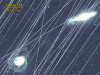
Even in space, telescopes can’t escape photobombers
Summary
Recent work highlights that the surge in satellite megaconstellations is not only spoiling ground-based astronomy with bright streaks, but simulations show space-based telescopes are increasingly affected too. Sunlight reflected from many low-Earth-orbit satellites can contaminate observations, risking lost data and reduced scientific return unless mitigations are put in place.
Key Points
- Satellite brightness and numbers have risen dramatically over the past five years, changing the night sky.
- Simulated observations (Borlaff et al.) indicate space-based telescopes will see increased contamination from reflected sunlight, not just ground telescopes.
- Contamination shows up as streaks and stray light that can mask faint astronomical targets or bias measurements.
- Without mitigation strategies (operational planning, design changes, satellite design/coordination), the problem will worsen as constellations grow.
- The issue intersects with policy, engineering and observational planning — solutions require collaboration across agencies, operators and the astronomy community.
Content summary
Meredith Rawls outlines how the rapid deployment of satellite constellations is altering the observational environment. Although most public attention has focussed on ground-based streaks, new simulations show space telescopes are vulnerable too: reflected sunlight from many passing satellites can pollute images and reduce effective observing time. The article references recent studies that quantify these effects and warns that, unless mitigations are adopted, the situation will degrade further as more satellites launch.
Context and relevance
This piece is important because it broadens the problem from ground-based nuisance to a widespread threat that also affects space observatories — facilities often costing billions and designed for faint, precise measurements. It ties into ongoing debates about responsible satellite deployment, sky stewardship, and the technical choices operators make (e.g. surface materials, orientation). For astronomers, satellite operators and policymakers, the findings underline the urgency of coordinated mitigation: scheduling, improved satellite design, and international guidelines.
Why should I read this?
Short version: if you care about clear skies or precious telescope time, this is a buzzkill — and a call to act. The article saves you digging through the technical papers by flagging that satellites don’t just streak ground images any more; they can mess up space telescopes too. Quick, relevant and a bit alarming — worth your two-minute skim.
Author style
Punchy. Rawls frames the problem plainly and links to the key study, amplifying why the details matter: this isn’t a niche nuisance but a growing threat to major astronomy investments. Read the full studies if your work or interests depend on clean sky access.