

‘Giant step forward’ for Huntington’s — the scientist behind the first gene therapy
Article meta
Article Date: 08 December 2025
Article URL: https://www.nature.com/articles/d41586-025-03842-7
Article Title: ‘Giant step forward’ for Huntington’s — the scientist behind the first gene therapy
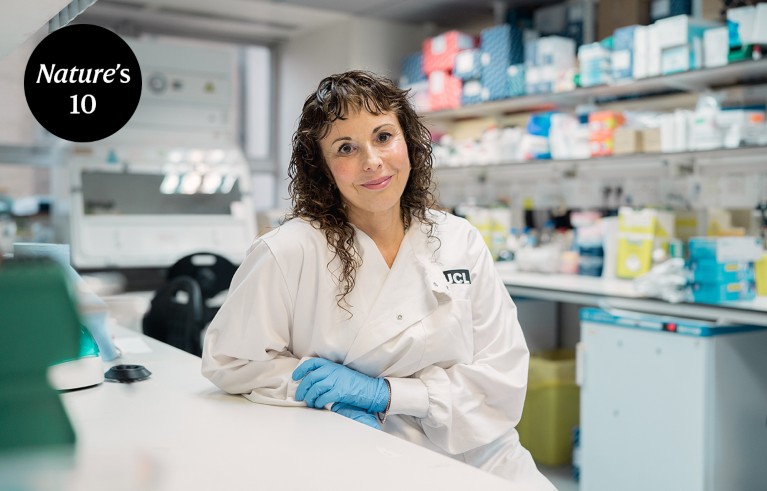
Article Image: portrait of Sarah Tabrizi
Summary
Sarah Tabrizi, a neurologist at University College London, played a central role in the trial that produced the first compelling clinical evidence that a gene-targeting therapy can slow Huntington’s disease. The treatment, AMT-130 from uniQure, delivers genetic material via a harmless viral vector to switch off production of the mutant huntingtin protein in affected brain regions.
The phase‑III dataset discussed was small — 12 people received the high dose — but results were notable: over three years the decline measured on a standard clinical scale was 0.38 points for treated participants versus 1.52 points for controls, indicating an approximately 75% slowing in rate of decline. Biomarker data from cerebrospinal fluid supported a reduction in markers linked to neuronal death. The therapy is invasive and requires brain surgery; safety and broader applicability remain under scrutiny.
Tabrizi, who served as the trial’s lead scientific adviser, is now engaged in evaluating multiple other huntingtin‑lowering approaches and continuing laboratory research into neurodegeneration mechanisms. The story also notes the field’s painful setbacks, such as the tominersen failure, underscoring how trials — successful or not — inform progress.
Key Points
- AMT-130 (uniQure) is a first‑in‑class gene therapy that uses a viral vector to reduce production of mutant huntingtin in the brain.
- High-dose recipients (n=12) showed a 0.38-point drop on a standard clinical rating scale over three years versus 1.52 points in controls — an estimated 75% slowing of decline.
- Cerebrospinal‑fluid biomarkers associated with neuronal death fell in treated participants, offering molecular validation of clinical effects.
- The treatment is invasive, requiring lengthy brain surgery; safety and longer‑term outcomes need continued monitoring and larger datasets.
- Sarah Tabrizi was lead scientific adviser on the trial and is now helping to evaluate several other huntingtin‑lowering therapies and driving related lab research.
- The field has faced major disappointments (for example, tominersen), showing that setbacks contribute to scientific learning and trial design improvements.
Context and relevance
This is a major milestone in neurodegeneration and gene‑therapy research: for a hereditary, relentlessly progressive disease like Huntington’s, evidence of a treatment that meaningfully slows decline is transformative. The result fits into broader trends in precision genetic interventions for brain disorders and validates huntingtin‑lowering as a therapeutic strategy.
For clinicians, researchers and patient communities, the finding shifts the clinical outlook — it opens a treatment window where meaningful disease modification appears achievable. For biotech and regulators, the result highlights both promise and the need for robust safety data and scalable delivery methods, given the invasiveness of current approaches.
Why should I read this?
Short version: this is proper big news. A gene therapy has for the first time shown convincing signs of slowing Huntington’s — not just in molecules but in how people actually fare. If you care about neurodegeneration, genetic medicines, or the future of disease‑modifying treatments, this saves you time — and gives you the headlines you need.
Author’s take
Punchy and clear: this isn’t just another incremental study — it’s a landmark that shifts the dial for Huntington’s research. Read the detail if you want to know the limits, the caveats and what comes next.