
Exposing a silent cancer
Article metadata
Article Date: 10 December 2025
Author: Rachel Nuwer
Source URL: https://www.nature.com/articles/d41586-025-03942-4
Image: Main image
Summary
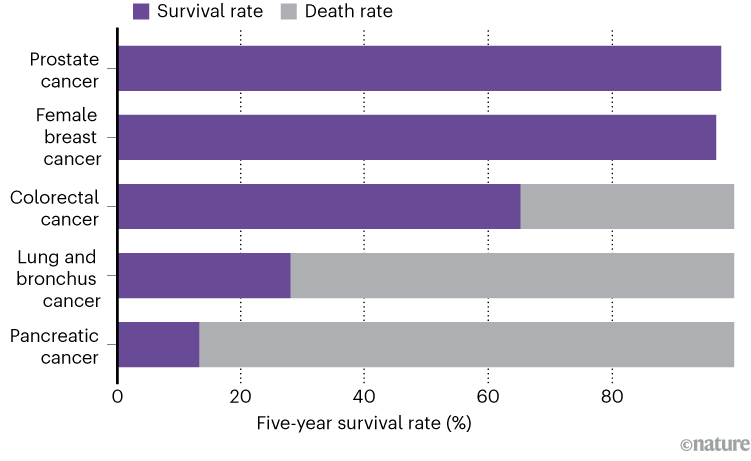
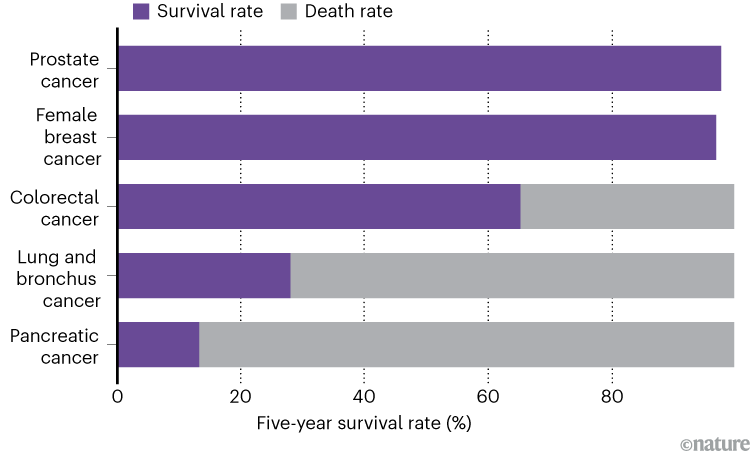
Pancreatic cancer remains one of the deadliest cancers despite accounting for only a small share of new diagnoses. Global cases rose from about 207,905 in 1990 to 508,533 in 2021. In the United States it represents roughly 3.3% of new cancer cases but causes 8.4% of cancer deaths, reflecting very poor survival. Funding for pancreatic-cancer research from the US National Cancer Institute increased by 38% between 2017 and 2023, but overall remains lower than for many other common cancers, which helps explain fewer clinical trials and slower therapeutic progress.
Alarmingly, incidence rates have climbed across age groups, with a notable rise among younger people — particularly US women aged 15–34, whose diagnosis rates increased about three times faster than those in young men between 2001 and 2018. Pancreatic tumours are often asymptomatic and detected only after they have metastasised, contributing to the disease’s high mortality.
Key Points
- Global pancreatic cancer cases increased substantially between 1990 and 2021 (from ~207,905 to ~508,533).
- In the US, pancreatic cancer is a small fraction of new cases (3.3%) but causes a disproportionate share of deaths (8.4%).
- NCI funding for pancreatic-cancer research rose 38% from 2017 to 2023, but overall investment still lags behind other cancers.
- Incidence is rising across ages; the fastest increases are in younger people, especially US women aged 15–34.
- Pancreatic tumours are frequently asymptomatic and diagnosed late, which underpins poor survival and highlights the need for earlier detection and more clinical trials.
Content summary
The article outlines the scale of the pancreatic-cancer problem: relatively few cases but very high fatality, and a steep rise in global incidence over recent decades. It examines funding trends, noting a welcome increase from the US National Cancer Institute yet persistent underinvestment relative to other cancers. The piece highlights an unsettling epidemiological trend — growing incidence among younger people and a sharper rise in young women — and stresses that stealthy, asymptomatic tumours lead to late-stage diagnoses for many patients.
The article is part of a Nature Outlook supplement on pancreatic cancer that includes related pieces on early detection, models, vaccines and other research directions, produced with support from external funders while retaining editorial independence.
Context and relevance
This article is important for researchers, clinicians, funders and policy makers because it pulls together data showing rising incidence and persistent gaps in research investment. The trends it describes tie directly to urgent needs: better early-detection tools, more clinical trials, targeted funding and investigation into why younger people — particularly women — are seeing faster rises in diagnoses. It connects to wider developments in oncology (screening, biomarkers, translational models) and public-health planning.
Author style
Punchy: the piece cuts to the chase — rising case numbers, poor survival, funding that is improving but still behind, and an alarming trend in younger women. Read it if you want a succinct briefing backed by clear data.
Why should I read this?
Short version: pancreatic cancer is creeping up the charts, killing a disproportionate number of people, and showing a troubling rise in younger women. Funding is moving in the right direction but still lags, so this article saves you time by summarising the key facts and why further research and early-detection work are urgent.