
Observation of deuteron and antideuteron formation from resonance-decay nucleons
Summary
The ALICE Collaboration used pion–deuteron (π–d) femtoscopy in high-multiplicity proton–proton collisions at √s = 13 TeV to probe how light (anti)nuclei form. By analysing π±–d correlation functions they find model-independent evidence that most (anti)deuterons are not emitted directly, but form by nucleon fusion following the strong decay of short‑lived resonances — primarily Δ(1232) states. From the observed residual Δ signal in π–d correlations, ALICE measures that 60.6 ± 4.1% of deuterons come from Δ decays; extrapolating to all strong resonances gives 88.9 ± 6.3% formed via resonance-assisted binding. The result resolves a longstanding question about whether loosely bound nuclei seen at colliders are primordial or produced by late-stage coalescence after resonance decays, and indicates high survival probability for these nuclei due to low spectral temperatures of the resonances (≈20 MeV).
Key Points
- ALICE measured π+–d and π−–d correlation functions in high-multiplicity pp collisions at √s = 13 TeV using excellent PID and tracking.
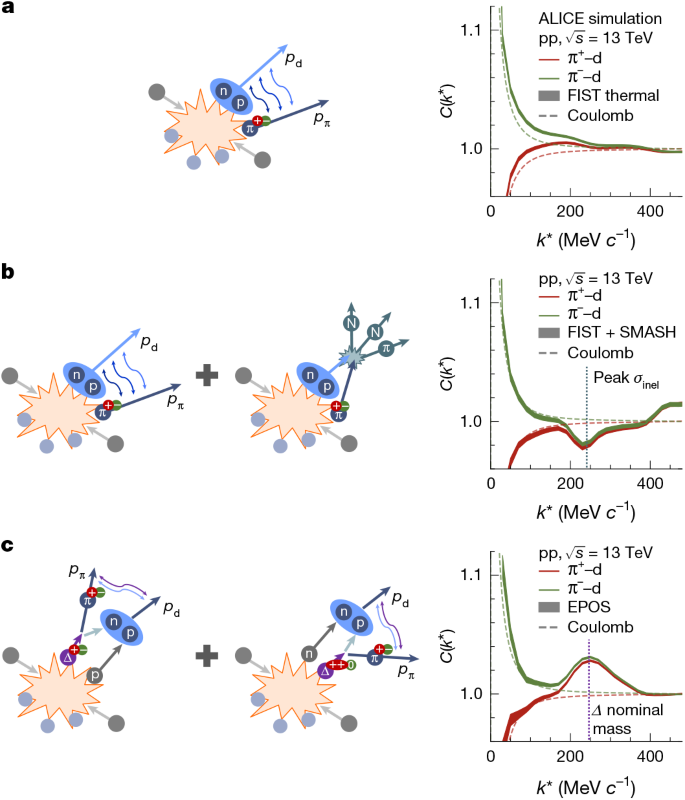
- Femtoscopy reveals a clear residual peak consistent with Δ(1232) resonance decays, shifted by rescattering effects.
- 60.6 ± 4.1% of measured deuterons are attributed to Δ decays within acceptance; acceptance and model extrapolations give 88.9 ± 6.3% from all strong resonances.
- Simulations (EPOS 3 + coalescence afterburner, ThermalFIST ± SMASH) reproduce the distinct shapes expected for thermally produced deuterons, rescattering effects, and resonance-assisted formation.
- The measured Δ spectral temperature is low (~20 MeV), explaining why loosely bound deuterons can survive despite higher kinetic energies during hadronisation (~100 MeV).
- Alternative sources such as dibaryon decays are strongly disfavoured by the data and fits to the π–d correlations.
Content summary
Light nuclei and antinuclei production in hadronic collisions is a long-standing puzzle because their binding energies are tiny compared with typical hadron kinetic energies. Two broad pictures exist: direct statistical hadronisation and secondary coalescence/coalescence aided by third bodies (mesons) or resonance decays. ALICE applied pion–deuteron femtoscopy — measuring relative momentum distributions in the pair rest frame — to discriminate these scenarios. Distinct correlation shapes are expected for: purely thermal emission, thermal plus rescattering/destruction, and formation via nucleons coming from resonance decays.
The measured π±–d correlation functions show a feature consistent with Δ resonance decays. ALICE models the genuine correlation with Coulomb + (negligible) strong final‑state interactions plus a data-driven Δ spectral shape taken from π±–p femtoscopy. Fits reproduce the data well and yield an effective fraction of deuterons linked to Δ decays. Correcting for pion acceptance and extrapolating using canonical statistical model expectations for all resonances, ALICE concludes nearly nine out of ten (anti)deuterons originate from resonance-decay nucleons that subsequently bind.
Extensive systematic studies, alternative model predictions and Monte Carlo cross-checks (EPOS, PYTHIA, ThermalFIST, SMASH, coalescence afterburners) support the interpretation and demonstrate the result is robust and largely model-independent.
Context and relevance
This finding resolves a key question in heavy‑ion and hadron collision physics about whether light (anti)nuclei are emitted as intact objects at hadronisation or assembled later. It impacts:
- Microscopic modelling of nucleus formation in accelerator experiments — favouring secondary binding after resonance decays (coalescence-like processes) as the dominant mechanism in pp at the LHC.
- Astrophysical predictions for cosmic-ray and antinuclei fluxes used in searches for exotic sources (for example, dark matter). Accurate microphysics of antinuclei production and survival is essential for interpreting indirect dark-matter signals.
- Transport and event-generator development: the result provides a concrete experimental constraint (resonance-driven formation and low spectral temperatures) that models must reproduce.
Why should I read this?
Because it actually pins down how tiny, fragile nuclei get made in the chaos of particle collisions — and that matters if you care about interpreting cosmic antinuclei, improving event generators, or just want the answer to a long-running puzzle in nuclear physics. Quick take: most deuterons at the LHC form after resonance decays, not as primary hadrons. That’s a tidy result that saves you time — and gives model builders a clear target.