
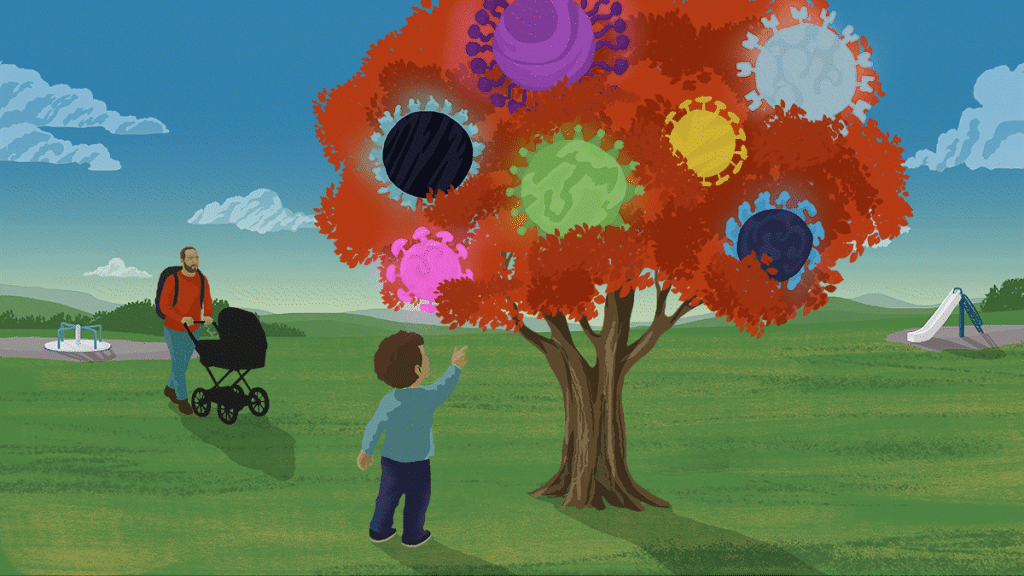
Immunological sin: how a person’s earliest flu infections dictate life-long immunity
Article metadata
Article Date: 17 December 2025
Article URL: https://www.nature.com/articles/d41586-025-03606-3
Article Title: Immunological sin: how a person’s earliest flu infections dictate life-long immunity
Article Image: 
Summary
This Nature Spotlight piece reviews research into “original antigenic sin” (OAS) — the tendency of the immune system to preferentially recall antibodies and immune memory shaped by a person’s earliest influenza exposures. Longitudinal cohorts such as DIVINCI, and studies from multiple labs, show that childhood imprinting strongly biases antibody and B-/T-cell responses for life. That bias can be protective (immune imprinting against related group 1 or group 2 viruses) but can also limit responses to newly evolved viral features or updated vaccines. Experimental work in animals demonstrates that memory B cells dominate responses to very similar re-exposures, while more divergent antigens recruit naive B cells. Real-world examples (H5/H7 correlations, H3N2 and H1N1 seasons) indicate imprinting can both reduce risk and create vulnerability in particular birth cohorts. The article closes by noting that understanding imprinting is central to better vaccine design and deployment decisions, and that continued funding and long-term studies are crucial.
Key Points
- Original antigenic sin (OAS) means earliest childhood influenza exposures ‘imprint’ long-lasting immune memory.
- Birth year is a useful proxy for initial flu subtype exposure; imprinting often maps to protection within haemagglutinin groups (group 1 vs group 2).
- Evidence from DIVINCI and related cohorts ties antibody and cellular memory signatures to early-life infections and later protection or susceptibility.
- Studies (including 2016 population analyses and recent 2024–25 serology work) show people imprinted with group 1 viruses tend to have stronger responses to group 1 avian influenzas such as H5N1.
- Animal experiments show memory B cells dominate responses to very similar repeats, but more divergent antigens allow greater naive B-cell recruitment.
- Imprinting can be beneficial if antibodies target conserved, neutralising sites; it can be detrimental if memory focuses on mutable, non-protective epitopes.
- Historical seasons (notably H3N2 and H1N1 shifts) suggest some cohorts became more susceptible or had reduced vaccine effectiveness because of imprinting.
- Longitudinal studies and improved vaccinology are needed to exploit, steer or overcome imprinting when designing vaccines and prioritising groups in outbreaks.
Context and relevance
Understanding OAS matters for vaccine policy, pandemic preparedness and predicting which age groups will be protected or vulnerable during new influenza emergences. The findings link immunology, epidemiology and vaccine strategy: they inform decisions such as whom to prioritise for novel vaccines (for example, children vs older adults in an H5N1 scenario) and where universal‑vaccine efforts must overcome entrenched memory biases. Ongoing cohort studies (DIVINCI and others) and experimental work are central to translating imprinting knowledge into better public-health practice.
Why should I read this?
Because your immune system basically keeps a childhood scrapbook — and that scrapbook can help or hinder you when new flu strains show up. This article cuts through the technical detail and explains why who you were first exposed to as a toddler still shapes vaccine responses, pandemic risk and who public-health authorities should protect first. Handy if you follow vaccines, public health policy, or just want to understand why flu shots sometimes feel hit-or-miss.
Author style
Punchy: the piece brings together cohort data, lab studies and real-world season outcomes to show imprinting is not just an oddity but a major factor for flu immunity and vaccine strategy. If you work in vaccinology or public health, the details here are directly relevant — the article points to specific cohort and experimental evidence you’ll want to read in full.