
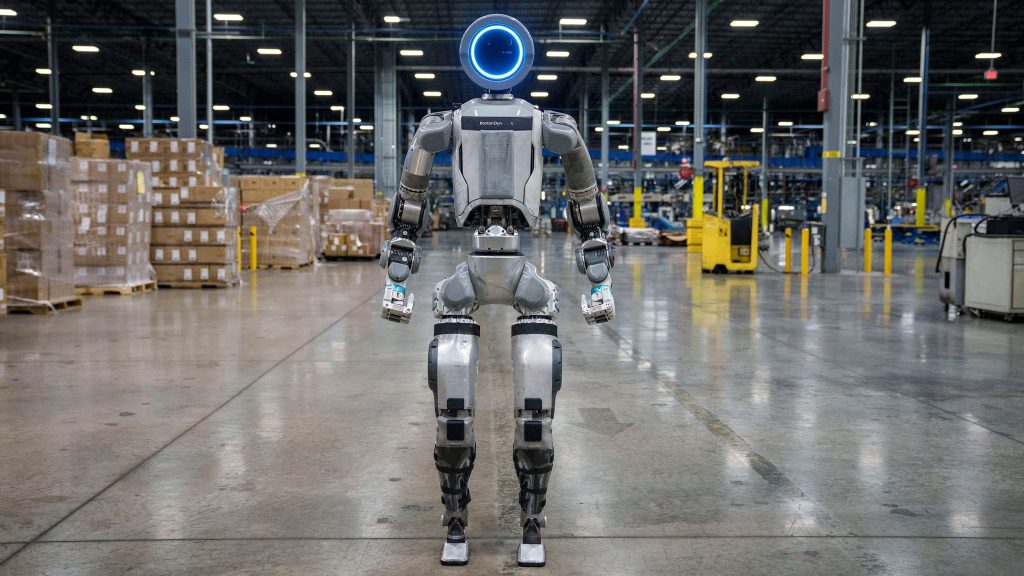
Google Gemini Is Taking Control of Humanoid Robots on Auto Factory Floors
Summary
Google DeepMind and Boston Dynamics have announced a partnership to integrate the Gemini robotics model into Boston Dynamics machines, including the humanoid Atlas and the quadruped Spot. The companies will test Gemini-powered Atlas robots at Hyundai auto factories, aiming to give robots better contextual awareness, object recognition and manual manipulation abilities so they can perform a wider range of manufacturing tasks. The collaboration ties advances in multimodal AI with physical robotics and includes plans to use factory data to refine Gemini’s physical reasoning. Boston Dynamics and DeepMind stress built-in safety controls and additional AI reasoning to prevent dangerous behaviour, but questions remain about dexterity limits and broader risks.
Key Points
- Google DeepMind will deploy its Gemini robotics model on Boston Dynamics robots such as Atlas and Spot.
- Initial tests are planned at Hyundai auto factories, aiming to automate manual tasks that require object handling and contextual awareness.
- Gemini’s multimodal design (vision, language, reasoning) is intended to help robots understand and act in unfamiliar physical environments.
- Factory-collected data will be used to improve Gemini’s real-world physical intelligence in a feedback loop.
- Boston Dynamics emphasises safety: existing hardware safeguards plus Gemini’s reasoning to pre‑empt risky behaviour.
- The move signals growing convergence between large AI models and robotics, accelerating competition in humanoid development worldwide.
Context and Relevance
This announcement sits at the intersection of two big trends: the push to give AI systems better physical intelligence, and the industrial drive to automate manual tasks. Deploying Gemini on Atlas in real factory settings is an early, concrete step towards general‑purpose robots that can adapt to varied tasks rather than being confined to single, repeatable motions. That matters to manufacturers, robotics firms and policymakers because it affects productivity, workforce planning and safety regulation. It also shows how major AI labs are shifting from virtual-only models to systems that must handle real-world messiness — a major technical and ethical pivot.
Why should I read this?
Short version: if you care about whether robots are actually getting useful — rather than just flashy — this is the update to skim. It tells you who’s teaming up, where they’re testing, and why those factory floors might be the place we finally see humanoids do honest work. If you want the gist fast: Google + Boston Dynamics + Hyundai = robots that might soon stop being just demonstrations and start doing proper jobs.
Author style
Punchy: this isn’t a small tweak — it’s a potential turning point. If you follow AI or industrial automation, read the detail: the technical progress, the safety framing, and the deployment plans all matter for strategy and regulation. If you don’t, at least note the likely acceleration in factory automation and the implications for jobs, supply chains and safety standards.
Source
Source: https://www.wired.com/story/google-boston-dynamics-gemini-powered-robot-atlas/