
Distinct neuronal populations in the human brain combine content and context
Article meta
Article Date: 07 January 2026
Article URL: https://www.nature.com/articles/s41586-025-09910-2
Representative image: Figure 1
Summary
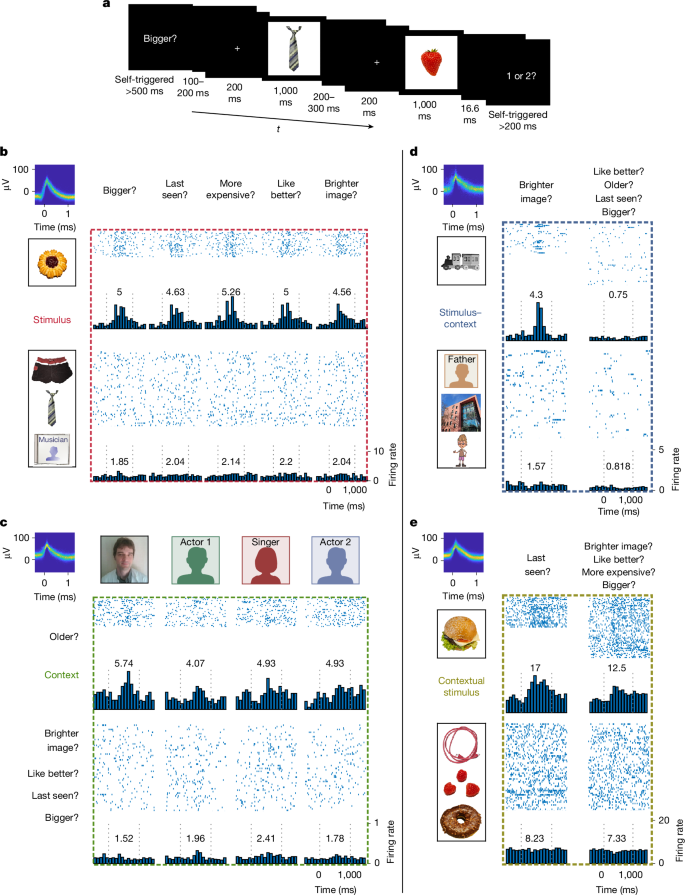
This study records 3,109 single neurons from medial temporal lobe (MTL) regions (amygdala, parahippocampal cortex, entorhinal cortex and hippocampus) in 16 neurosurgical patients performing a context-dependent picture-comparison task. Each trial began with a question (the task context) such as “Bigger?” followed by two pictures; participants had to choose which picture best fit the question. The authors used ANOVAs, decoding (linear SVM) and cross-correlation analyses to probe how single neurons represent “what” (content) and “which context” (the question) and how these representations interact.
Key results: the majority of neurons encode either stimulus identity (content) or task context, largely in an orthogonal manner; only a small fraction encode specific stimulus–context conjunctions. Context representations generalise across pictures and persist through picture presentations until decision time. Critically, after experimental pairing, entorhinal stimulus neurons predicted hippocampal context-neuron firing with a short (~40 ms) lag, suggesting experience-dependent sequential activation consistent with synaptic modification and pattern-completion mechanisms. Pre-activation of context neurons by questions boosted their later reactivation during pictures and strengthened stimulus–context interactions.
Key Points
- Distinct MTL populations predominantly code content (stimulus) or context (task question); conjunctive stimulus–context neurons are rare.
- Context decoding is robust, generalises across pictures and serial positions, and persists until the decision is made.
- Entorhinal stimulus-neuron firing predicted hippocampal context-neuron firing after ~40 ms, emerging during and after the experiment — consistent with experience-driven synaptic changes (STDP-like).
- Pre-activation of context neurons by the question predicts their subsequent reactivation during picture viewing and enhances stimulus-driven reinstatement of context.
- Findings support a model where orthogonal content and context representations are combined via co-activation, reinstatement and synaptic changes to enable item-in-context memory and context-dependent decisions.
Why should I read this
Want to know how the brain keeps the “what” and the “when/why” apart — and then joins them up when it matters? This paper drills into single-neuron activity in humans and shows that separate neuron sets hold content and task context, but can be stitched together quickly by experience. It’s a neat peek under the hood of memory formation and retrieval — short, dense and worth skimming if you care about memory, decision-making or neural coding.
Author style
Punchy: this is a crisp, experimentally rigorous demonstration that content and context are largely encoded by different single neurons in the human MTL, and that their interaction can be induced and read out at millisecond timescales. If you work on memory mechanisms, hippocampal indexing, pattern completion or neurally informed models of decision-making, the details here will repay careful reading.
Context and relevance
Why it matters: the study clarifies how generalisation (context-invariant concept neurons) and context-sensitive retrieval coexist in the human MTL. It links single-neuron coding to behavioural performance and to a plausible plasticity mechanism for binding items to contexts. The results bridge debates about pattern separation versus generalisation in human hippocampal function, and they provide mechanistic constraints for models of episodic retrieval, memory-guided decision-making and artificial systems that aim to mimic human memory indexing and pattern completion.
Broader takeaways: distinct but interacting representations allow flexible retrieval — enabling both broad generalisation across contexts and selective recall of context-relevant memories. The entorhinal→hippocampal sequential interactions reported here suggest an experience-dependent pathway for storing and reinstating item-in-context associations.