
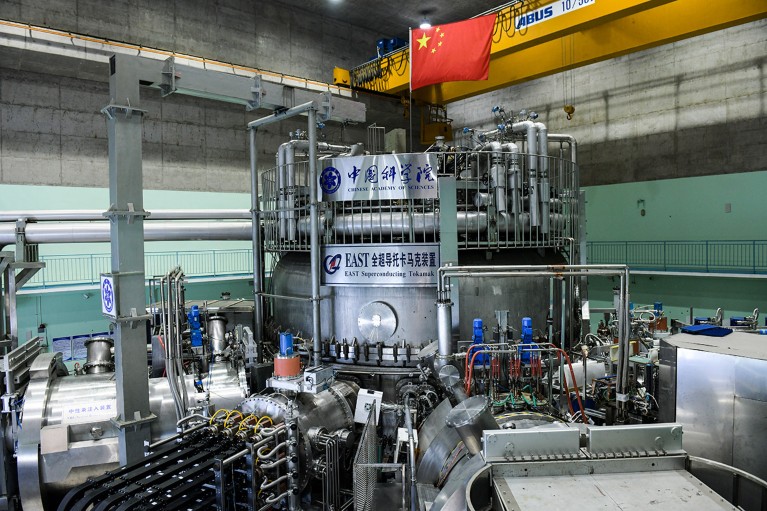
Chinese nuclear fusion reactor pushes plasma past crucial limit: what happens next
Article Date: 09 January 2026
Article URL: https://www.nature.com/articles/d41586-026-00063-4
Article Image: https://media.nature.com/lw767/magazine-assets/d41586-026-00063-4/d41586-026-00063-4_51917120.jpg
Summary
Researchers working on China’s Experimental Advanced Superconducting Tokamak (EAST) report surpassing the long-standing Greenwald density limit in a tokamak, reaching plasma densities about 30%–65% higher than EAST’s usual operating range. The result, published 1 January 2026 in Science Advances, used a combination of high-power microwave heating and large neutral-gas injection to reduce wall-sputtered impurities and raise core density while keeping the plasma stable. The work builds on a theoretical proposal that a stable, mutually reinforcing plasma–wall state can allow operation beyond the traditional limit.
Key Points
- EAST exceeded the Greenwald density limit by roughly 30%–65%, according to the published experiments.
- High-power microwave heating of the initial fuel reduced sputtering from the tokamak wall, lowering metal impurities in the plasma.
- Large injections of neutral gas supplied more fuel for higher densities and cooled edge regions, further cutting impurity production.
- Fewer impurities mean reduced radiative losses, helping the plasma remain stable even at higher densities.
- The experiment follows a 2022 theoretical proposal that plasma and wall conditions can be tuned into a stable, mutually supportive state to exceed the Greenwald limit.
- Experts warn the result must be replicated on other devices and scaled to larger, reactor-class machines before it can change fusion-design strategies.
Content summary
The EAST team combined efficient microwave heating (to preheat fuel and protect walls) with heavy neutral-gas puffing to reach and sustain unusually high plasma densities. This approach reduced the number of metal atoms liberated from the tokamak’s inner wall — a common source of radiation and instability — allowing the core plasma to remain hot and confined despite the higher particle count.
The experiment operationalises a hypothesis by Escande and colleagues that a stable plasma–wall equilibrium can push past the empirical Greenwald limit. While the results are promising, they are preliminary: the experiments were performed on EAST and must be tested on other tokamaks and examined for compatibility with longer pulses, higher temperatures and reactor-scale engineering constraints.
Context and relevance
Surpassing the Greenwald limit is potentially important because plasma density is a key factor in achieving fusion power gain: more particles at the right temperature generally increase reaction rates. If the physical and operational tricks used on EAST translate to other machines, it could relax a major constraint on tokamak performance and open new operational windows for existing and future devices.
However, there are caveats. Techniques that work on one machine do not always scale to larger devices such as ITER. Neutral-gas puffing and particular heating schemes can affect confinement and steady-state operation differently in reactor-scale systems. The immediate next steps are independent reproduction, detailed stability studies, and assessment of engineering impacts on materials and reactor components.
Author style
Punchy. This is a short, sharp dispatch: a longstanding empirical ceiling appears negotiable. If confirmed across devices, the result could reshape part of the tokamak playbook — but don’t expect overnight commercial fusion. Read the detail if you want the practical implications and technical caveats.
Why should I read this?
This is proper fusion news — not hype. The team has nudged open an old door that researchers thought was shut. If you follow energy research, fusion development or advanced plasma physics, this saves you the time of parsing the paper yourself: the experiment shows a plausible path to higher-density operation, outlines the tricks used, and highlights the realistic limits and next tests. In short: it’s a neat technical advance with big potential, but still plenty of homework to do.