
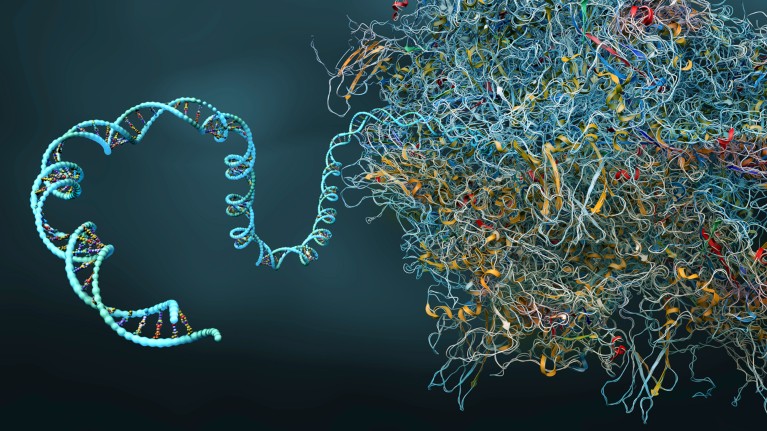
A ‘time capsule for cells’ stores the secret experiences of their past
Article Meta
Article Date: 15 January 2026
Author: Ewen Callaway
Source: https://www.nature.com/articles/d41586-026-00116-8
Summary
Researchers have engineered cellular “time capsules” called TimeVaults by repurposing mysterious barrel-shaped organelles known as vaults. The modified vault proteins selectively capture messenger RNA (mRNA) molecules produced over a defined window, storing them inside the vaults for at least a week without apparent harm to the cell. The approach offers a way to record transcriptional activity continuously, rather than needing to predefine which events to monitor, and could reveal how past molecular events influence future cell behaviour.
Key Points
- TimeVaults are engineered from natural vault organelles to capture and store mRNA produced within a specific time window.
- The capture is triggered by producing a modified vault protein (the ‘record’ button), controlled experimentally by adding and withdrawing a drug.
- TimeVaults stored a fraction of all mRNA made in a human cell line over 24 hours and retained it for at least a week.
- Cells carrying TimeVaults showed no obvious adverse effects or changes in vault structure after loading.
- Early applications include studying cancer persister cells and stem-cell biology; the method could extend continuous transcription recording across many biological contexts.
Context and relevance
Existing cell-recording tools (many CRISPR-based) force researchers to choose what to track in advance. TimeVaults offer a less biased approach by physically sequestering mRNA produced during a chosen interval, enabling retrospective readout by sequencing. That makes them timely for fields where transient events matter: understanding drug resistance in cancer, mapping cell-fate decisions in development and stem-cell research, and generally probing how short-lived molecular signals have long-term consequences. This fits into a broader trend in single-cell and transcriptomic technologies focused on capturing temporal dynamics rather than single snapshots.
Why should I read this?
Because it’s clever and actually useful — the team turned one of biology’s oddities (vaults) into a practical recorder. If you care about how cells remember past events, drug resistance or tracking fleeting gene activity, this saves you the hassle of following dozens of technical papers: TimeVaults let you capture the past and read it back later. Quick, elegant and potentially a game-changer for temporal cell biology.