
Core–envelope miscibility in sub-Neptunes and super-Earths
Article Date: 21 January 2026
Article URL: https://www.nature.com/articles/s41586-025-09970-4
Article Image: 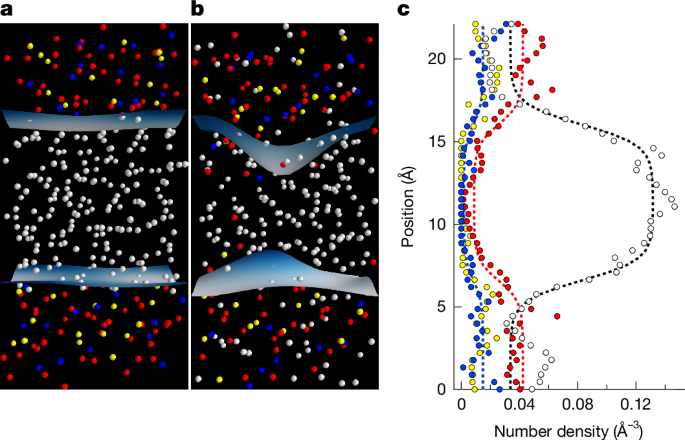
Summary
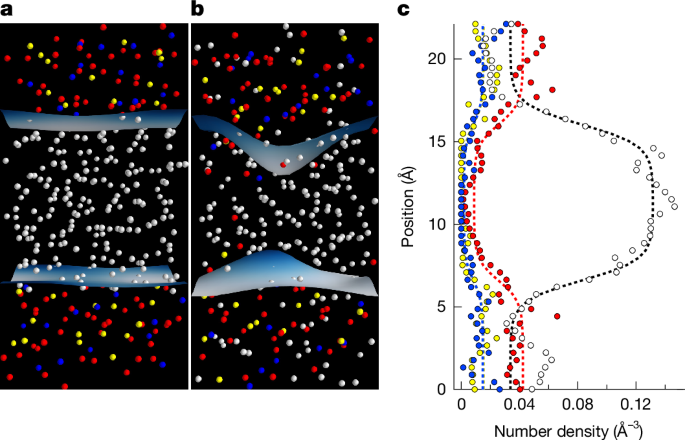
The authors use first-principles molecular dynamics (density functional theory driven) to show that at plausible core–envelope pressures and temperatures for sub-Neptunes and super-Earths, silicate (modelled as MgSiO3) and hydrogen become completely miscible. Chemical reactions between H2 and silicate produce species such as silane (SiH4), SiO and H2O; these products alter both interior composition and atmospheric chemistry. The study maps a phase diagram showing a critical temperature that decreases with pressure (roughly 3,500 K at 2 GPa down to ~2,600 K at 10 GPa), and demonstrates that many sub-Neptune core–envelope boundary conditions lie above that critical curve, implying core–envelope mixing is likely during formation and evolution. This miscibility affects hydrogen partitioning, retention during boil-off, thermal evolution, possible silicate rain-out on cooling, and observables (notably water and silicon-bearing species detectable with JWST).
Key Points
- First-principles simulations find complete miscibility of silicate (MgSiO3) and hydrogen over a wide range of P–T conditions relevant to sub-Neptune core–envelope boundaries.
- Reactive chemistry (redox exchange) converts H2 + SiO2 into species including SiO, silane (SiH4) and H2O — altering both interior and atmospheric compositions.
- The critical temperature for miscibility falls with pressure (Tc ≈ 3,500 K at 2 GPa to ≈ 2,600 K at 10 GPa), so many evolving sub-Neptunes spend time in the miscible regime.
- Large amounts of hydrogen can be dissolved into the core, which changes expectations for envelope loss (boil-off/photoevaporation) and the formation of super-Earths from sub-Neptunes.
- Products of core–envelope chemistry (H2O, SiO, silanes) may be observable with JWST and could explain water enrichment and other atmospheric signatures without invoking icy accretion.
Why should I read this?
Short and blunt: this paper flips a common assumption. Instead of a passive rocky core sitting under a hydrogen blanket, the core and envelope can chemically mix and trade hydrogen. That changes how much atmosphere a planet keeps, what its interior looks like, and what telescopes might detect. If you follow exoplanet atmospheres, formation or JWST results, this one saves you time by flagging a major process most models have been ignoring.
Context and relevance
This result matters because it links microphysics at extreme conditions to macroscopic exoplanet observables and population trends (for example, the radius valley separating super-Earths and sub-Neptunes). Many formation and evolution models assume limited solubility or ideal mixing; the simulations here show non-ideal, reactive behaviour that permits extensive hydrogen uptake by molten silicates and generates oxygen- and silicon-bearing volatiles. That has three immediate impacts: (1) models of atmospheric mass loss must account for hydrogen sequestered in the core, (2) planetary thermal and compositional evolution (including possible silicate condensation or rain-out) will be altered by changing partitioning on cooling, and (3) interpretation of JWST spectra (water enrichment or presence of SiO/silanes) should consider endogenous production via core–envelope reactions rather than solely external ice accretion. Overall, this work suggests a necessary re-evaluation of structure and atmosphere models for the common sub-Neptune/super-Earth population.