
Probing quantum mechanics with nanoparticle matter-wave interferometry
Article Date: 21 January 2026
Article URL: https://www.nature.com/articles/s41586-025-09917-9
Article Image: Figure 1
Summary
This Nature paper reports matter-wave interference of metal nanoparticles (sodium clusters) containing thousands of atoms. Using a Talbot–Lau near-field interferometer with three deep-UV standing-wave gratings, the authors delocalise the centre-of-mass of clusters of order 5,000–10,000 atoms over distances far greater than the particle diameter. They measure clear interference fringes, compare the results to detailed quantum and classical models, and use Bayesian analysis to quantify the experiment’s macroscopicity, finding mu ≈ 15.5 — about an order of magnitude beyond prior records.
Author style: Punchy — the paper is presented as a decisive step: it pushes quantum superposition to much larger masses and uses that leverage to test theories that would collapse macroscopic states.
Key Points
- The team demonstrates near-field matter-wave interference of sodium clusters (~170 kDa, ~8 nm diameter) with measurable fringe visibilities up to V≈0.10 and higher for heavier bins.
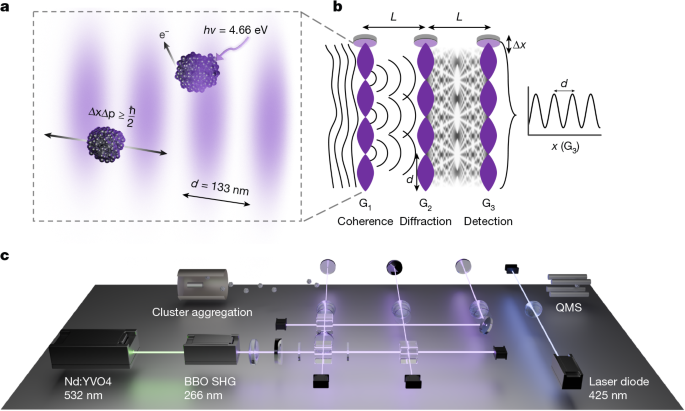
- They use a three-grating Talbot–Lau interferometer formed by 266 nm standing UV waves, combining absorptive (ionising) and phase interactions to prepare and read out coherence.
- Experimental data match the full quantum model and deviate from the classical prediction in the mass range below ≈200 kDa, demonstrating wave-like propagation rather than classical shadowing.
- Bayesian hypothesis testing against minimally invasive macrorealist modifications yields a macroscopicity μ≈15.5, surpassing previous macroscopic superposition tests by an order of magnitude.
- The setup is versatile — it can handle various metals and dielectrics and points toward future experiments on MDa-scale particles and even complex biomolecules if velocities can be reduced.
Content summary
The experiment (MUSCLE) uses a cryogenic cluster source to produce sodium clusters travelling at ~160 m s−1 with de Broglie wavelengths of order 10–20 fm. Three UV standing light gratings spaced by ~0.983 m create a Talbot–Lau interferometer: G1 generates transverse coherence, G2 imprints a phase pattern via the optical dipole force, and G3 samples the interference pattern while neutral clusters are subsequently photo-ionised and mass-filtered.
Fringe visibility is extracted by scanning G3 and fitting sinusoidal patterns. By varying G2 laser power and comparing the observed contrast to both quantum and classical models (Wigner–Weyl phase-space treatment), the authors show that the quantum model explains the data without recourse to classical moiré-shadow effects. For heavier clusters the quantum and classical predictions converge, but the authors identify a window where the quantum signature is unambiguous and outline paths (slower particles, vertical geometry) to extend the discriminating mass range to the MDa regime.
Context and relevance
Why this matters: the work extends experimental tests of quantum superposition into a new regime of combined mass and spatial delocalisation. That makes it particularly sensitive to proposed modifications of the Schrödinger equation that would localise massive objects (collapse or gravity-induced models). The result: no evidence for a breakdown of standard quantum mechanics at these scales, and a substantial tightening of constraints on macrorealist modifications via the macroscopicity metric.
Broader implications: the platform opens the door to interferometry with metal nanoparticles and, prospectively, large biomolecules or small viruses. Applied uses include precise measurements of electric or magnetic susceptibilities while particles propagate as delocalised waves — a complementary technique for cluster and nanoparticle characterisation.
Why should I read this?
Short answer: because it shows quantum weirdness getting seriously heavy. If you care about whether quantum mechanics needs tinkering to account for the classical world, this experiment punches above its weight — testing collapse ideas with nanoparticles that inch toward biomolecular/viral masses. Also, the methods are neat: UV ionising gratings, cryogenic cluster beams and a rigorous quantum-vs-classical model comparison. You’ve saved time — read this if you want a clean, modern test of macroscopic quantum superpositions and the experimental roadmaps to push them further.